
Executive Summary
Since its founding, Ricoh Co., Ltd. has supported the transformation of its customers’ work. The company has applied that same commitment internally through what it calls ‘Process DX,’ a digital-driven approach to business improvement and process reform built on practical, hands-on expertise. With the goal of resolving front line challenges by strengthening how teams use digital technology, the company adopted WalkMe to visualize, optimize, and continuously improve processes using data. They are steadily expanding the systems supported by their digital adoption strategy, and the results are already taking shape.
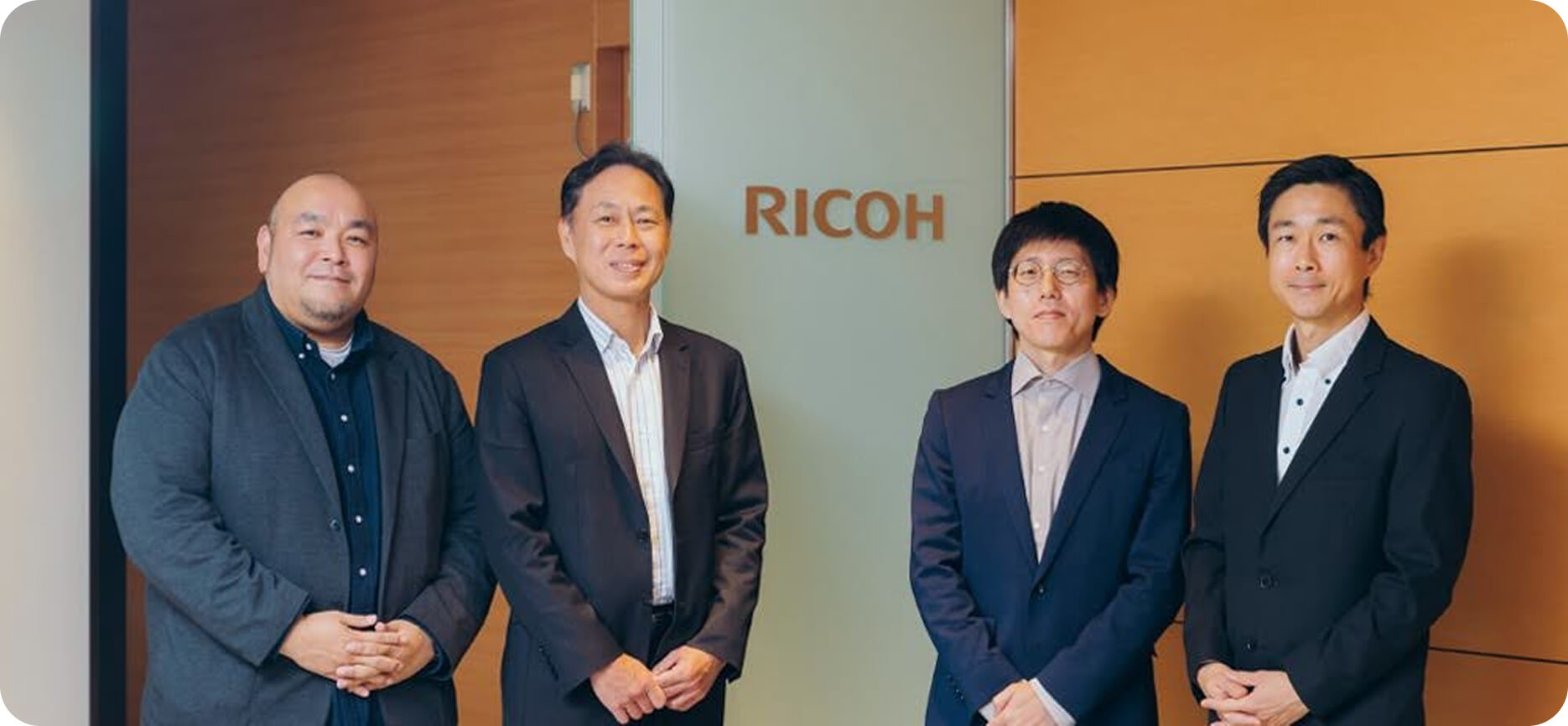
Mr. Haruhisa Shioya, Manager, Process DX Development Department, Workflow Transformation Center, Digital Transformation Division, Ricoh Company, Ltd. (Left), Mr. Takashi Asaka, General Manager, Digital Transformation Division, and Manager, Workflow Transformation Center, Ricoh Company, Ltd. (Center-Left), Mr. Hirokazu Iida, DevOps Section, Process DX Development Department, Workflow Transformation Center, Digital Transformation Division, Ricoh Company, Ltd. (Center-Right), Mr. Yuji Arai, Deputy Manager, Process DX Development Department, Workflow Transformation Center, Digital Transformation Division, and Manager, DevOps Section, Ricoh Company, Ltd. (Right) *As of April 1, 2026, the content of this article is based on information gathered during an interview in early March 2026. This case study reflects RICOH's WalkMe implementation in Japan.
Transforming IT from subtracting value to actively adding it
Since advocating the concept of office automation (OA) in 1977, Ricoh has supported its customers’ work, focusing primarily on office printing solutions such as copiers and multifunction printers. The company’s mission is to continuously drive transformation by staying close to work, supporting the expression of unique human creativity, and building a sustainable future society. This sentiment is embodied in the new corporate philosophy and vision established in 2023: “Fulfillment through Work.”
This is also why the company is undergoing process transformation not with the aim of improving operational efficiency or introducing IT itself, but as part of a cultural reform to change the way people work. “There is no point in implementing digital technology in processes that are not necessary in the first place. Instead of starting with digitalization, we should first decide what we want to do, and then ask what the process should be like based on that. That’s why we call our efforts toward process transformation ‘Process DX,’ not DX,” says Mr. Asaka, who leads Process DX as General Manager of the DX Division.
A key characteristic of the company’s Process DX is that it is driven by employees on the front lines “It is those employees that are facing challenges, able to understand the situation, and have ideas for improvement. To enable the front lines to be able to identify problems themselves, devise solutions, and take on the responsibility of implementation, the Center of Excellence (CoE) within the DX Division provides ongoing support in terms of governance and talent development,” notes Mr. Asaka.
An IT system only becomes valuable when it’s built and made usable by the field. Therefore, the goal of the DX Division is not merely to ensure the stable operation of the system, but to continuously strengthen its utilization, leading to further improvements in operational efficiency and reductions in IT costs. Traditionally, IT organizations have been evaluated on a ‘subtractive’ basis, where adhering to QCD (Quality, Cost, Delivery) is the norm and points are deducted when issues arise. Ricoh’s aim is to shift that model by building IT teams that create value through ‘addition’ by connecting their efforts directly to the needs and satisfaction of front line teams.
Promoting autonomous Process DX to resolve challenges on the front line
To effectively advance a front line-driven Process DX model, visualizing and optimizing operations is essential. With that foundation in place, teams can apply digital technology to their processes and use real data to drive continuous improvement. By implementing their digital adoption program, Ricoh was able to bring this data-driven approach to life across the organization. The team started by clearly defining what they wanted to solve, then deployed guidance to address it, measured results, and refine as needed, letting data drive each subsequent improvement. Having already made meaningful progress across multiple systems, with strong recognition from users, Ricoh saw a clear opportunity to scale those results across the organization.
Digital adoption at Ricoh is a collaborative effort, spanning operational departments such as accounting and human resources, maintenance and operations, IT infrastructure teams, and the Center of Excellence (CoE), which leads the broader promotion of digital transformation across the organization. As they moved toward a broader rollout, the team identified several areas where a stronger foundation would be needed to ensure long-term success.
“Content development procedures and rules were not defined, and it was inconsistent across systems, and no knowledge had been accumulated, making it difficult to hand over responsibilities when roles changed hands,” says Mr. Arai. To address this, the CoE took the lead in establishing a solid foundation, focusing on standardizing development documentation and clarifying requirements for content development.
Furthermore, to accommodate a growing user base, they prepared a trial environment so departments considering digital adoption could easily test it. Combined with the CoE’s side-by-side support, this ensured a smooth and sustainable rollout. Through this work, the CoE’s role evolved to champion a front line-driven approach to Process DX across three dimensions: environment, motivation, and skill.
How their CoE brings Ricoh's digital adoption strategy to life
After focusing on laying the foundation for deployment in 2025, the company has been gradually expanding the systems that WalkMe supports, completing implementation in nine systems by January 2026. The number of employees across Ricoh Group who are supported by their digital adoption program has already reached approximately 35,000. As SaaS systems become increasingly central to core systems, WalkMe is expected to play a key role in Ricoh’s Process DX strategy, adapting to existing business processes without requiring modifications to the package itself.
The company is driving meaningful adoption across departments through five core pillars:
1. Creating a “ready-to-use” environment
To prevent departments from needing to start from scratch, the CoE provides standardized implementation models, including setup processes and guidelines. Infrastructure operations, including browser extension distribution and identity provider (IdP) integration, have been standardized so that systems are ready to use from the moment they go live.
2. Creating a learning environment
To ensure front line work does not stall due teams’ lack of WalkMe technical knowledge, the CoE consistently provides learning content, training sessions, and developer certifications. Lessons from real projects and insights gained through Q&A sessions are captured and incorporated, building a continuously growing internal knowledge base.
3. Creating a collaborative environment
In departments introducing a system for the first time, it can be difficult to visualize how it will be used, so the CoE provides support during the initial stages. The CoE works side-by-side with front line teams to support development from the start. When a department faces resource constraints, the CoE steps in to handle development directly, ensuring momentum is maintained.
4. Creating an environment where users can easily ask questions
Alongside publishing technical information, guidelines, and FAQs on the internal portal, they have established a permanent technical consultation desk. This creates an environment where users can consult easily whenever they encounter difficulties, lowering the barrier to implementation.
5. Creating a safe operating environment
To ensure employees on the front line can develop and publish content with confidence, the CoE established a clear governance model using WalkMe’s role-based permissions. This structure gives builders the freedom to work in dedicated environments while maintaining quality controls that protect the live experience.
Mr. Iida, a CoE member, states, “When the foundation is solid, the front line can focus completely on developing dynamic content. As the number of builders grows, the front line teams become capable of driving continuous improvements autonomously.” In fact, the CoE has defined an operational process focused on monitoring KPIs. Mr. Arai explains, “With WalkMe, we can visualize exactly which features have been used, so measuring effectiveness is straightforward. Our Process DX runs on data-driven improvement cycles, and WalkMe is no exception — we see it as the foundation for advancing improvement together with the front line, grounded in data.”
While full deployment across all core systems is ongoing, early results are already compelling. In some cases, operation time has been cut by more than half, with further cost reductions expected as adoption scales.
“Implementing WalkMe at the point of system launch not only improves usability for front line teams, but also reduces reliance on outsourced documentation and decreases support inquiry volumes — delivering meaningful reductions in both external and internal support costs, and advancing two strategic goals simultaneously,” says Mr. Asaka.
Ensuring systems are ready to use from day one
As Mr. Asaka emphasizes, “Providing ‘systems that are usable right from the start’ is the absolute ideal.” Rather than improving usability after a system has been introduced, the company plans to integrate their digital adoption strategy from the launch stage of new systems moving forward. They also intend to extend their digital adoption strategy to systems already in use, scaling the resulting benefits across the organization. To support this, Mr. Arai shares his enthusiasm: “We want to further elevate our skills to push these boundaries.”
As a digital services company, utilizing AI is equally central to Ricoh’s vision, helping to further enhance their IT infrastructure and free up employees to focus on higher-value work. “When SaaS systems have a wealth of features, it can be difficult to find the functions you need. WalkMe’s AI features not only provide automatic guidance based on what you want to do, but also automatically input a certain amount of general information, so we expect it to be particularly helpful for first-time users,” notes Mr. Iida.
Furthermore, Mr. Shioya states, “Regarding the utilization of AI, there seem to be three major directions: areas that can be safely left entirely to AI, human-in-the-loop interventions where AI assists humans, and application within data analysis fields. We believe that future Process DX will need to be designed around how each of these plays a role.”
For Ricoh, Process DX is not a project with a finish line. It is a continuously evolving model, driven from their front line employees. Digital adoption plays a central role in that journey, helping the team turn their vision of fulfillment through work into something measurable, repeatable, and real.