GOVERNANCE
Struggling with inadequate recovery strategies during cyber attacks?
Lack of incident response planning leaves you vulnerable. Discover how a robust cyber resilience strategy can transform your preparedness and response.
When cyber resilience strategies falter, everyone suffers
When your cyber resilience strategy breaks down, you’re left vulnerable to cyber attacks with no clear path to recovery. You face a lack of incident response planning, inadequate recovery strategies, and poor organizational coordination, all of which amplify the chaos and risk during a cyber event.

Inefficient recovery processes
Recovery plans are slow and cumbersome, often requiring manual intervention. This inefficiency leaves critical systems offline longer, exacerbating the impact of cyber incidents.

Frustrated crisis response teams
Team members are confused and overwhelmed due to unclear protocols. The lack of a clear cyber resilience strategy leads to frustration and decreased morale.

Escalating compliance risks
With insufficient threat intelligence and coordination, your organization risks failing audits and facing regulatory penalties. This can result in significant financial and reputational damage.
What a cyber resilience strategy looks like when it actually works
Picture your team effectively anticipating and neutralizing cyber threats with ease. Recovery plans unfold seamlessly, and your organization adapts to new threats without missing a beat. Confidence soars as critical functions recover swiftly, and your business remains poised against the evolving cyber landscape.
- Incident response time slashed by 50%
- Critical functions recover in half the time
- Threat intelligence accessed in under 5 minutes
- Coordination delays reduced to near zero
SEE
See where cyber resilience strategy workflows break down
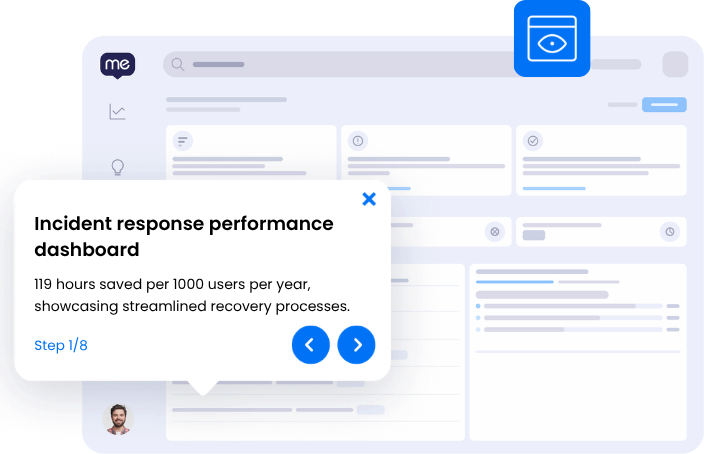
WalkMe captures screen-level context to reveal exactly where employees get stuck in the cyber resilience strategy workflow — no surveys, no backend APIs, just real-time visibility. Identify specific failure points like incident response planning, coordinating recovery strategies, and accessing threat intelligence.
119
hours saved per 1000 users per year
3x
more process gaps identified with workflow analytics
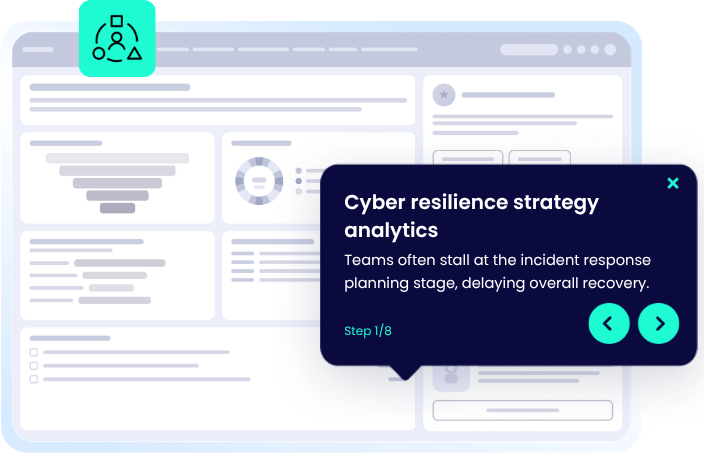

ACT
Navigate cyber resilience strategies — step by step
Empower your team with in-app, contextual guidance through the action bar, ensuring complex recovery plans are executed flawlessly. Eliminate the frustration of forgotten steps and enhance incident response without leaving the current workflow.
119
hours saved per 1000 users per year
75%
reduction in email security training time
MOVE
Keep your cyber resilience strategy moving across every application
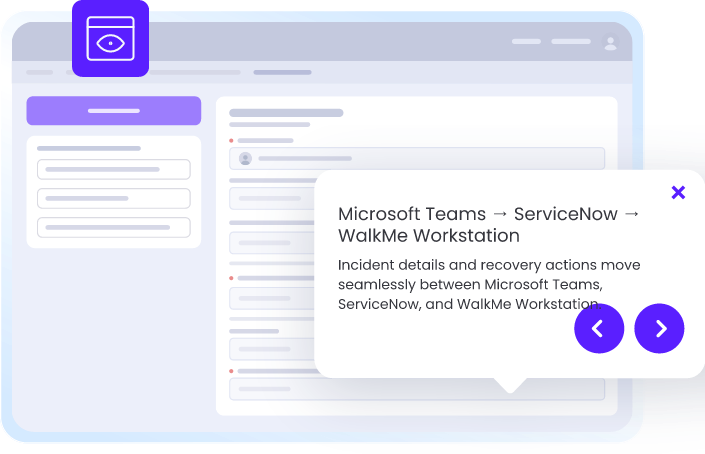
WalkMe’s cross-application orchestration seamlessly bridges the gaps between crucial tools like Microsoft Teams, ServiceNow, and WalkMe Workstation. It keeps your cyber resilience strategy on track by ensuring that context and data flow effortlessly from one application to the next, preventing any loss of critical information during transitions.
119
hours saved per 1000 users per year
30%
reduction in spam-related support tickets
Manage cyber resilience strategy across your applications
WalkMe deploys a single, consistent guidance layer across every application your team uses for cyber resilience.
-
Cyber Resilience Strategy in WalkMe Workstation
WalkMe Workstation centralizes and simplifies access to all necessary cyber resilience tools and resources in one platform.
-
Cyber Resilience Strategy in Okta
WalkMe guides users through Okta's authentication processes, ensuring secure access during high-stress cyber events.
-
Cyber Resilience Strategy in Google Drive
WalkMe aids in the organization and retrieval of cyber resilience documents stored in Google Drive, speeding up incident response.
-
Cyber Resilience Strategy in Dropbox
WalkMe streamlines access to incident response and recovery documents within Dropbox, enhancing team readiness.
-
Cyber Resilience Strategy in Box
WalkMe ensures secure and quick retrieval of recovery plans and critical data stored in Box during a cyber incident.
-
Cyber Resilience Strategy in SharePoint
WalkMe provides seamless access to recovery documents and threat intelligence resources stored in SharePoint.
-
Cyber Resilience Strategy in Slack
WalkMe centralizes threat intelligence updates and facilitates instant team coordination via Slack channels.
-
Cyber Resilience Strategy in ServiceNow
WalkMe guides crisis response teams through ServiceNow workflows, ensuring efficient incident logging and recovery plan execution.
-
Cyber Resilience Strategy in Outlook
With WalkMe, users receive step-by-step guidance to initiate threat alerts and manage incident communications directly from Outlook.
-
Cyber Resilience Strategy in Microsoft Teams
WalkMe's action bar automates critical communication protocols, ensuring rapid incident response coordination within Microsoft Teams.
Cyber resilience strategy capabilities
Frequently asked questions about cyber resilience strategy
Quantify your cyber resilience gains
Discover the time saved and risks reduced with a robust strategy.

SECURE YOUR FUTURE
Boost your cyber resilience today
Boost your cyber resilience today