
Systemic change meaning: How systems change fixes root causes

Systemic change is a shift that targets a problem’s root causes, not its symptoms, by reshaping structures, mindsets, and policies. Adopting systemic change, also called systems change, enables leaders to assess the organization’s dynamics and craft and implement effective change management solutions.
Systemic change is imperative as many organizational issues are deeply embedded in existing systems, structures, and foundational beliefs.
This process demands a deep overhaul of the organization’s core aspects, including culture, procedures, policies, and leadership vision.
Nonetheless, systemic change often seems daunting because of its complexity. Additionally, the lure of immediate results and financial objectives can pull focus away from systemic change, tempting organizations to postpone these essential shifts for later.
What is systems change?
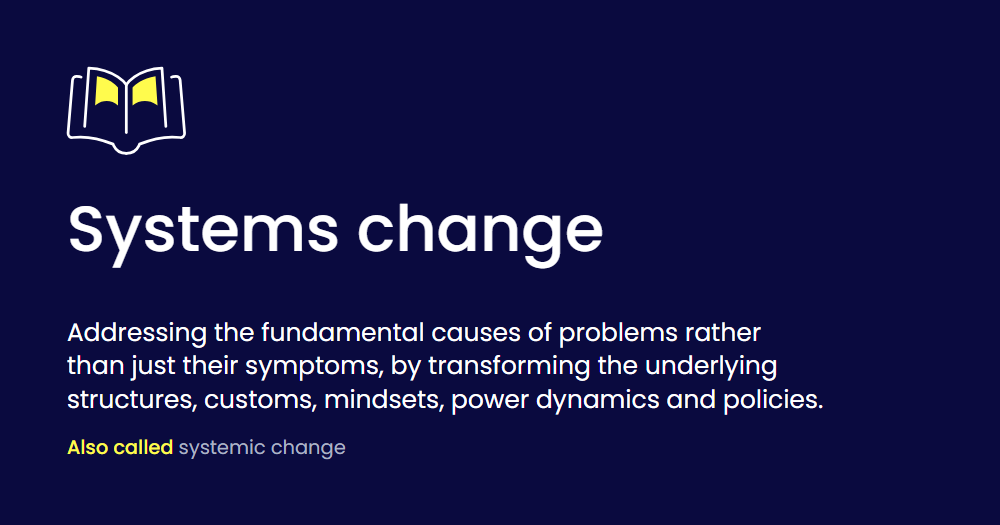
Systems change, or systemic change, involves addressing the fundamental causes of problems rather than just their symptoms. This transforms the underlying structures, customs, mindsets, power dynamics, and policies.
It emphasizes building an organization’s collective strength through cooperation among diverse individuals and organizations united by common objectives. This approach aims for enduring solutions to social issues locally, nationally, and globally.
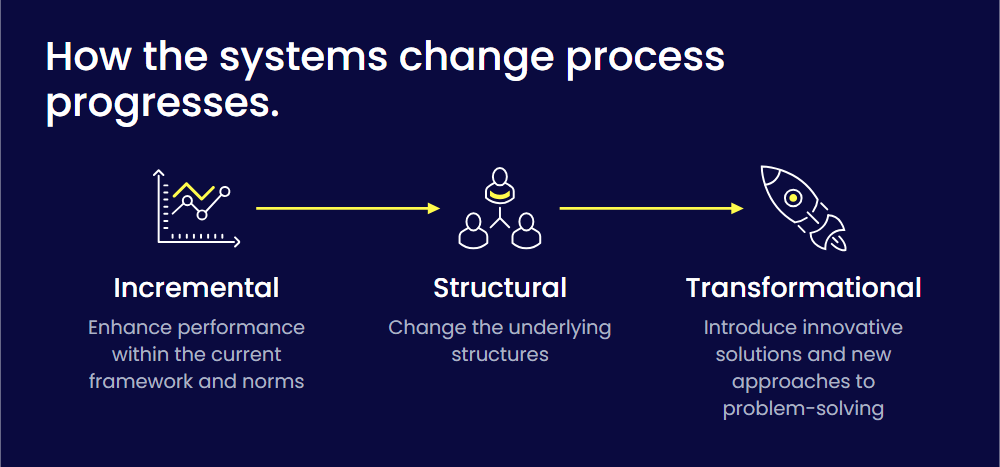
The systems change process can begin with incremental changes that enhance performance within the current framework and norms. It then progresses to structural changes, leading ultimately to profound, transformational changes that introduce innovative solutions and new approaches to problem-solving.
What is the purpose of systems change?
Companies can embrace systems change to alter the status quo through collective action by individuals, organizations, and policymakers involved in an issue, ensuring that old patterns are not reverted.
Moreover, systems change magnifies the impact beyond what individual efforts can achieve. This is because it can facilitate broad, significant transformations that can revolutionize an entire organization. It fosters more resilient communities and better prepares them for future adversities.
Additionally, systems change speeds up innovation, paving the way for new technologies, business models, and social frameworks that stimulate economic development.
What are the components of systems change?
Exploring the components of systems change offers businesses a comprehensive understanding of the essential elements required to enact meaningful transformations within their operational frameworks, fostering adaptability and innovation for long-term success.
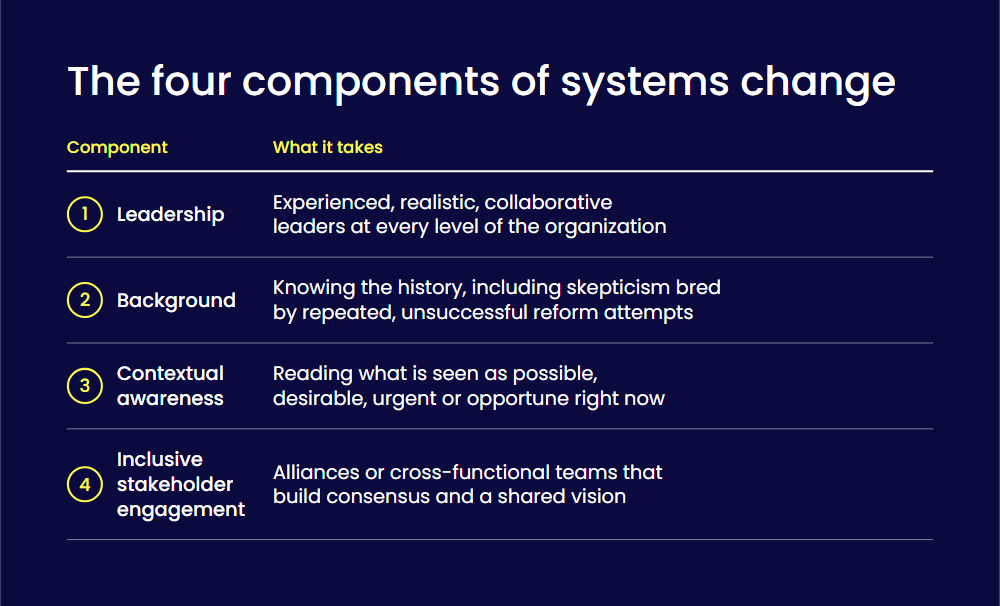
Meaningful and sustainable change within systems hinges on several key elements:
Leadership
Effective change leadership plays a pivotal role in rallying and influencing individuals. For systems change to be effective, it requires leaders who are experienced, realistic, and adept at collaboration, capable of inspiring progress and embodying the vision.
Leadership should permeate all levels of an organization, since no single leader possesses all the knowledge and skills needed for comprehensive systems change. Leaders must balance practical operational abilities with visionary insight, converting ambitious goals into tangible outcomes. The focus should be on nurturing leaders committed to driving positive transformation through individual and collective effort.
Background
Understanding the history behind change is crucial for cultural and systemic shifts. Assuming employees will readily embrace change overlooks the skepticism bred by repeated, unsuccessful reform attempts. Recognizing this historical context within an organization is vital; it informs how you engage employees who may adopt a ‘wait and see’ stance toward new initiatives.
Contextual awareness
Understanding and being on top of the world around you is essential. The global landscape influences perceptions of current events and affects receptiveness to change. Understanding what is seen as possible, desirable, urgent, or opportune reflects the importance of context. It shapes the strategies for identifying and leveraging moments ripe for systems change.
Inclusive stakeholder engagement
Stakeholder alliances or a cross-functional team will simplify consensus-building and vision development, which is critical for melding diverse perspectives into unified coalitions. Such partnerships are instrumental in marshaling collective action, energy, and intent.
Stakeholder forums play a crucial role in crafting compelling responses to the challenges of systems change, allowing ideas to be refined through broad participation. This inclusivity ensures that solutions address the concerns of many rather than a select few.
These are formed by identifying relevant parties and determining what attracts and retains their engagement. While these alliances are vital in launching new change initiatives, it’s essential to recognize that impactful change doesn’t have to be monumental from the outset. Even small-scale projects can significantly challenge and alter entrenched norms and practices.
How to implement systems change
Systems change is fundamentally about uniting all stakeholders to drive a societal-level business transformation. It involves empowering visionaries, persuading those invested in the status quo to shift, and enhancing cooperation among frontline workers for greater efficacy and efficiency. This collaborative effort aims to address complex challenges through collective action.
However, implementing systems change is complex. Organizations often face confusion about the need for change, staff resistance, and leadership challenges in aligning team efforts.
Addressing these issues requires strategic approaches and best practices to ensure successful systems change:
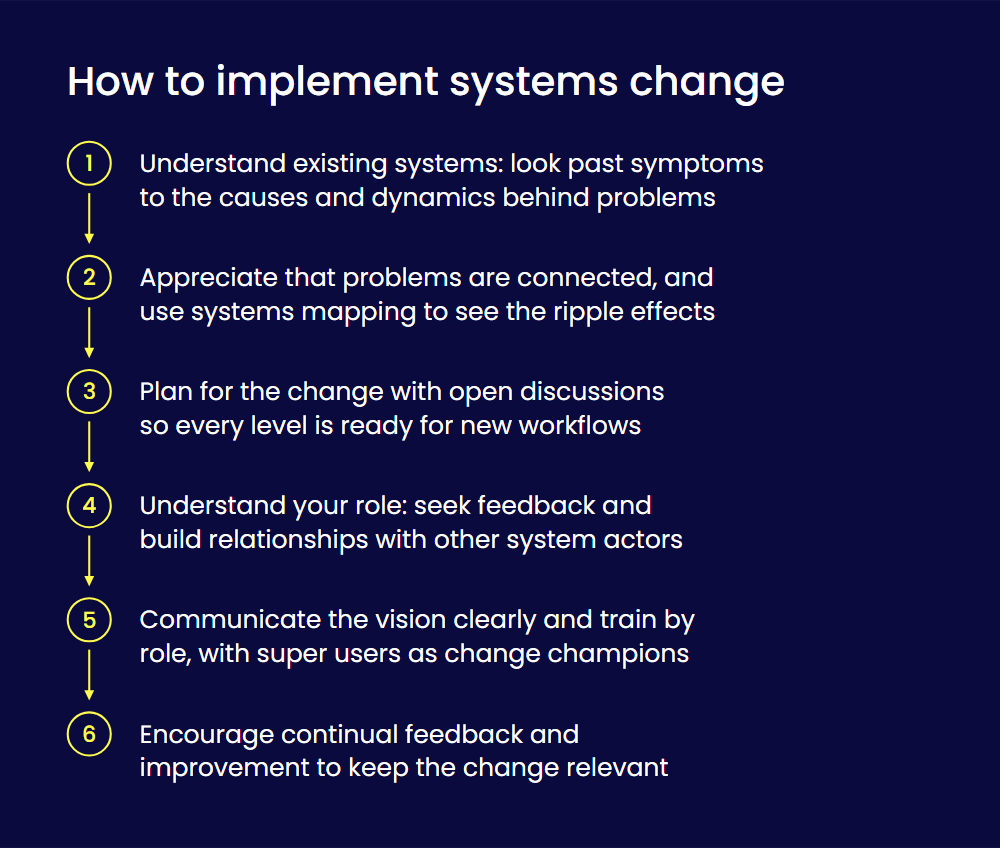
Understanding existing systems
Deeply understanding existing systems is central to systems change. This means moving beyond surface-level symptoms to understand the underlying causes and dynamics that perpetuate problems. It involves a comprehensive analysis of stakeholders, their interrelations, and the external factors influencing the system.
This foundational step ensures that change efforts are targeted and practical and avoids unintended consequences that could exacerbate existing issues or create new ones. Understanding the system’s architecture (its incentives, power structures, and prevailing narratives) is crucial for crafting interventions that can genuinely shift the status quo.
Appreciate that problems are connected
A systemic view is instrumental in recognizing the interconnectedness of challenges and the ripple effects that changes in one part of a system can have on others. This perspective requires a thoughtful consideration of trade-offs, the potential for unintended consequences, and the complex web of cause-and-effect relationships that define systems.
A change management agent can anticipate and mitigate negative impacts by adopting a systemic view, ensuring that solutions contribute to holistic and sustainable improvements. Systems mapping is a powerful tool in this context, offering a visual and analytical way to understand and navigate the complexities of systems change.
Plan for the systems change
Preparation is vital to successfully implementing systems change. This preparation involves open discussions about anticipated changes, ensuring that all organizational levels are informed and equipped to adapt to new workflows.
The human aspect of change is particularly significant; engaging with and understanding the concerns and aspirations of those affected is vital to fostering an inclusive, supportive environment. This stage also involves strategic planning to address power dynamics, biases, and resource allocation to ensure equitable change.
Understand your role in the change
Systems change is a collective endeavor that requires each participant to understand and embrace their unique role within the broader ecosystem.
This understanding is not just about acknowledging one’s responsibilities; it also means proactively seeking feedback, building meaningful relationships with other system actors, and finding one’s niche where strategic contributions can be made. Reflecting on our roles allows for a more nuanced engagement with the system, enabling targeted and impactful actions.
Ensure it includes clear communication and training
Effective communication and comprehensive employee training are indispensable components of systems change. Articulating the vision, rationale, and expected outcomes of the change process helps to align and motivate all stakeholders.
Training programs tailored to specific roles and departments ensure everyone has the knowledge and skills to navigate the new system. Identifying and empowering ‘super users’ or change agents within the organization can facilitate a smoother transition, acting as champions for change and supporting their colleagues through challenges.
Encourage continual feedback and improvement
Feedback mechanisms are critical throughout the systems change process. They provide valuable insights into the change’s effectiveness, areas for improvement, and overall impact on the organization and its stakeholders.
This employee feedback loop, coupled with a commitment to continuous training and adaptation, helps sustain momentum and ensures the systems change process remains relevant and responsive to emerging challenges and opportunities.
Practical examples of systems change
Mastering the implementation of systemic change within your organization also requires a deep understanding of the role companies, in particular, can play in driving transformation within complex systems.
Here is an illustrative example to guide you toward successful execution:
Petey Greene Program
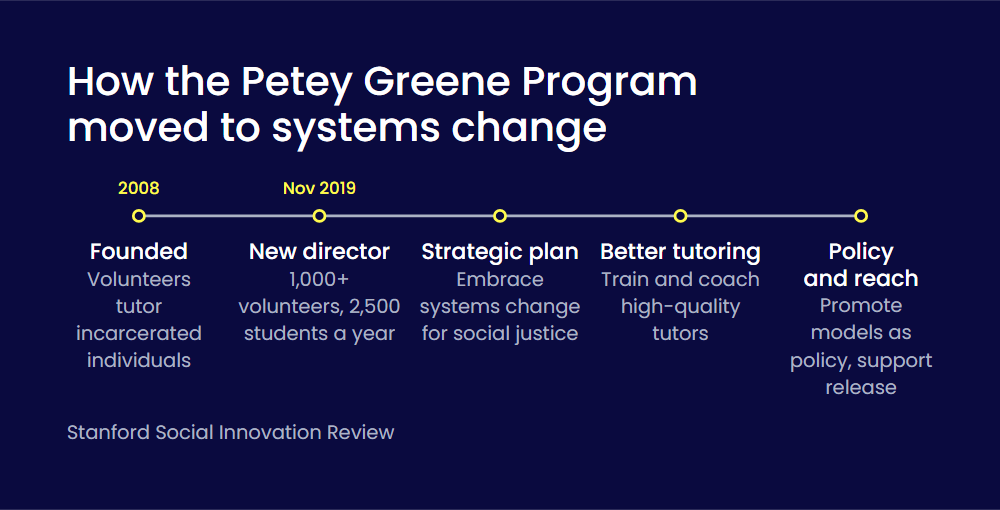
Founded in 2008 at Princeton University, the Petey Greene Program was created to recruit college students and community volunteers to tutor incarcerated individuals.
From its inception, the program made a significant impact at the individual level, addressing the educational needs of many incarcerated individuals who lacked a high school diploma, a symptom of the US’s school-to-prison pipeline.
These individuals could achieve academic success through personalized support, which fostered their self-confidence, especially seeing volunteers consistently return to support them.
For the volunteers, this interaction with incarcerated students prompted a deep reflection on the injustices of the criminal legal system, its ties to educational inequality, and their positions within these structures. The program created mutual benefit, shifting perceptions of self and others and challenging notions of oppression and dominance.
By the time Alison Badgett became its second executive director in November 2019, the Petey Greene Program had expanded significantly, recruiting more than 1,000 volunteers annually from 30 universities to tutor 2,500 incarcerated students each year across 50 jails and prisons in seven Eastern states and the District of Columbia.
But while the program encouraged its volunteers to become advocates, the organization maintained a neutral stance on policy issues. This position risked portraying it as complicit in perpetuating an unjust system by addressing its symptoms rather than its root causes. Still, some staff and many board members feared that pursuing systems change could detract from programming by diffusing the program’s focus.
Badgett aimed to guide the organization through a strategic planning process that embraced systems change from a social justice perspective. She believed that, if properly implemented, a systems change model would not scatter the program’s efforts but rather sharpen its focus, enhancing and expanding its educational services, underpinned by heightened public awareness and policy engagement.
The critical role of access to quality education in supporting decarceration was evident, necessitating a shift from merely coordinating volunteer efforts to actively training and coaching high-quality tutors.
This shift required staff to develop new skills and reallocate resources to create positions dedicated to operations, curriculum development, training, evaluation, and communications.
The systems change model advocated piloting innovative educational models and promoting them as policy. It demanded more from correctional facilities, including consistent access to academic resources and funding to sustain and enhance programming quality.
Furthermore, the program was responsible for participants’ educational outcomes beyond incarceration, continued support post-release, and exploring preventative measures against imprisonment, such as intensive educational interventions as alternatives to sentencing for youth.
This comprehensive approach marked a significant evolution in the Petey Greene Program’s strategy, aiming to address both the immediate educational needs of incarcerated individuals and the systemic issues contributing to mass incarceration.
The pros and cons of systems change
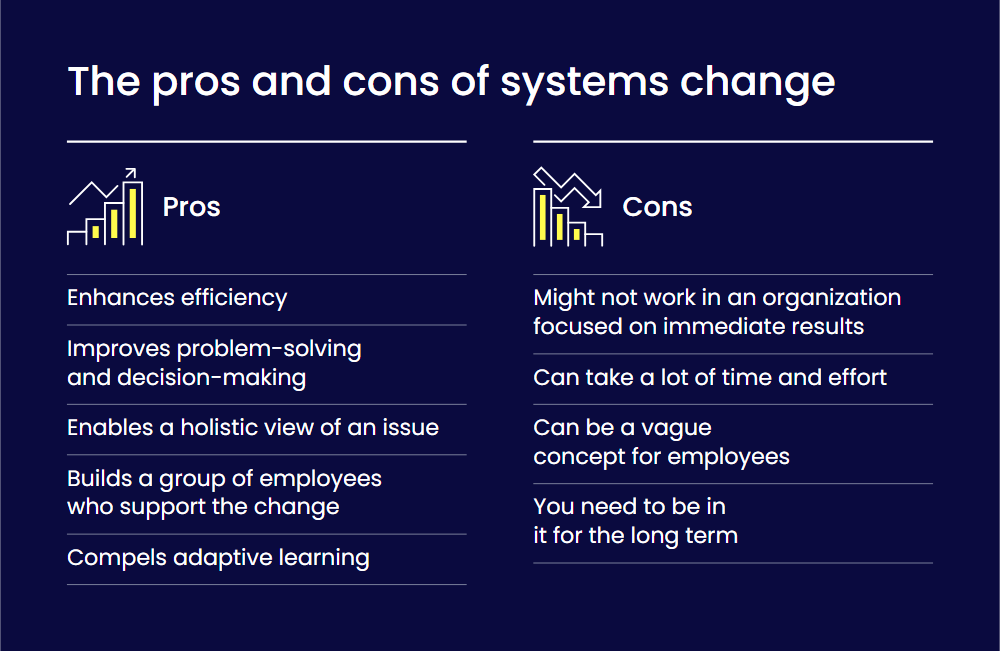
Adopting a systems change approach offers numerous advantages in addressing enduring people and performance challenges during transformational change efforts.
These are:
Enhances efficiency
Systems change introduces novel methodologies to boost efficiency and maximize available resources. By examining an organization’s structure and the interplay among its components, systems change opens avenues for new ideas and innovations.
This process helps quickly pinpoint problems and test solutions, strengthening the organization’s ability to adapt and evolve. Through this lens, systems change drives continuous performance improvement, helping businesses stay ahead in a competitive landscape.
Improves problem-solving and decision-making
Systems change helps you consider new and improved ways to craft strategies for solving complex problems. This approach not only supports problem-solving but also improves decision-making.
Systems change ensures strategies are impactful and aligned with the organization’s goals by pinpointing the points of greatest influence within the system and closely monitoring desired outcomes and objectives. It transforms the strategic change process, making it more dynamic and responsive to the challenges.
Enables a holistic view of an issue
At the heart of systems change lies the principle of systems thinking, which offers a holistic view of a problem. This perspective compels us to consider a system within its environment and context, striving to grasp the bigger picture.
By embracing the complexity of systems rather than attempting to simplify them, systems thinking enables a deeper understanding of a system’s myriad dimensions and facets. This comprehensive approach is crucial for recognizing the interconnectedness of elements and the potential impacts of change.
Builds a group of employees who support the change
A key goal of systems change is establishing ecosystems of actors who share an understanding of the system, enabling them to collaborate. Developing shared system diagrams and a common language is vital for building everyone’s awareness and fostering collective intelligence.
This process enhances the group’s collective agency and ensures all employees can contribute effectively. Such ecosystems are fundamental for achieving synergy and collaboration across the system, allowing diverse actors to synchronize their activities in ways that amplify their impact.
Compels adaptive learning
To support a continuous learning culture and adaptation, systems change emphasizes building adaptive learning feedback loops within the network. These loops facilitate an ongoing exploration of the problem space and potential solutions, encouraging experimentation and learning.
This approach keeps the network flexible and responsive to new information and challenges, strengthening its capacity for systemic change. Through adaptive learning, the group’s collective agency is strengthened, making it better equipped to navigate the system’s complexities and effect meaningful change.
However, systems change often has its challenges:
It might not work within an organization focused on immediate results
An existing focus on quick results and immediate action can inadvertently undermine a system-wide mindset, where the urgency and preference for quick wins may lead to overlooking the nuanced, less visible actions that contribute to systemic change. This impatience risks sidelining the comprehensive thinking and actions necessary for genuine systems transformation.
It can take a lot of time and effort
Adopting a systemic approach entails integrating systemic thinking, analysis, and action throughout the change process, considering the dynamics of the more comprehensive system and its effects on your initiatives.
This approach demands time, space, and energy, which may be scarce, particularly among frontline staff who often face significant time constraints and limited opportunities for reflection.
Their enthusiasm and optimism are crucial to successful project execution, so organizations must address this challenge head-on in communications and actively carve out time in staff schedules for systems change activities. Ensuring staff have the time and space for reflection and systemic action is crucial in moving initiatives forward.
It can be a vague concept for employees
For many employees, ‘systems change’ may appear vague and abstract, especially amidst higher-level debates about defining a ‘system’ and the scope of systems change efforts.
Clarifying what systems change entails for individual roles and the organization is crucial for demystifying the concept and fostering a shared understanding. Clear explanations and examples can help employees see how systems thinking applies to their work and the broader organizational goals.
You need to be in it for the long term
Systems change is often mistaken for a static destination rather than an ongoing journey. This perspective can cause momentum to stall during implementation if employees don’t recognize that systems are inherently dynamic, with components constantly interacting and evolving.
It’s essential to educate employees about the continuous nature of systems change, emphasizing the need to constantly sense, respond, and adapt to changes within the system. Training should prepare employees to engage with systems change as an iterative, responsive process rather than a linear progression toward a fixed endpoint.
Final steps on systems change
In tackling multifaceted challenges globally, systems change emerges as a strategy and a critical pathway to crafting sustainable, impactful solutions. This approach is predicated on a deep, holistic comprehension of the intricate systems that underpin your organization.
It requires addressing root causes rather than merely mitigating symptoms, recognizing that these causes are often deeply embedded in the interconnected fabric of social, economic, and environmental systems. To navigate this complexity, systems change uses strategic points within these networks, where targeted actions can catalyze widespread enterprise transformation.
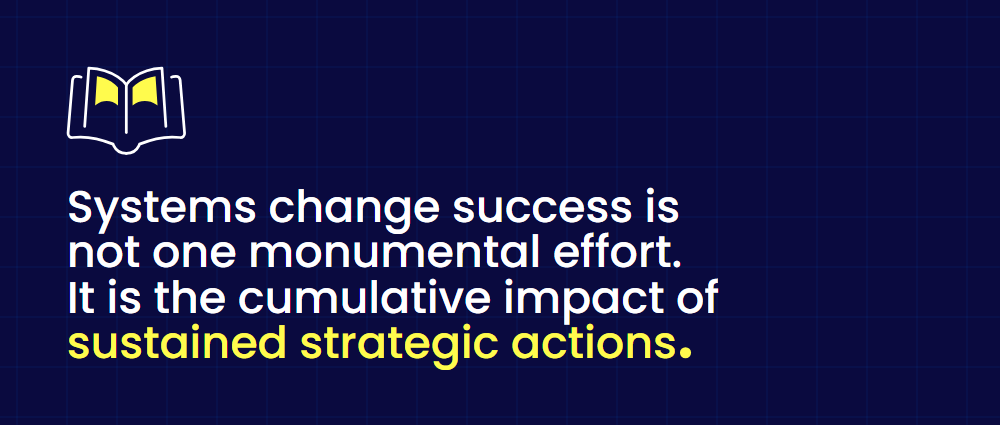
However, the journey towards systems change is fraught with challenges. It demands resilience, creativity, and a willingness to experiment and learn from failure. Success in this endeavor is not the result of a monumental effort but rather the cumulative impact of sustained strategic actions.
The collective effort of individuals and organizations, each contributing uniquely, is indispensable. By pooling our resources, knowledge, and energies, we can pave the way for a more resilient future in the face of adversity and sustainability for future generations.
Furthermore, systems change is inherently dynamic. It does not conclude with achieving a set goal but continues to evolve in response to new challenges and insights. This necessitates an ongoing commitment to reflection, learning, and adaptation.
Our strategies and interventions must evolve as our understanding of complex systems deepens and the global context shifts. Collaboration remains a cornerstone of this process, enabling us to share insights, pool resources, and coordinate efforts across sectors and disciplines.

FAQs
Systems change addresses underlying structures, mindsets, and power dynamics and aims for long-term transformation. Traditional change management often focuses on specific projects or processes without altering foundational systems.
Effective systems change requires leaders across the organization to collaborate, inspire, and drive transformation. Distributed leadership ensures diverse perspectives and shared ownership of change initiatives.
Without a deep understanding of current systems, interventions may address symptoms rather than root causes, leading to ineffective or unsustainable changes.
Enterprises should consider systems change when facing persistent challenges that resist conventional solutions, indicating the need for fundamental shifts in structures and processes.
Systems change provides a holistic framework that aligns organizational culture, policies, and structures, facilitating the adoption and integration of digital technologies.