
The 5 shifts that changed how I approach digital adoption

Digital adoption professionals are strategists. We spend our days figuring out why people aren’t using the tools in front of them, finding where the friction actually is, and fixing it. That skill set matters more now than ever, as more organisations take on AI adoption and try to make good on their investments.
When I started running WalkMe at TUI, there was no job description to inherit and no one who’d done this before me. I built the programme as I went. Looking back, five specific shifts changed what I was able to deliver, how the business sees the work I do, and the impact I could have.
Shift 1: Stop building content, start solving problems
Early on, my answer to almost every request was “yes, I can build something for that.” In fact, I would be halfway through designing the solution before the stakeholder had finished explaining the problem. As DAP professionals, we’re builders by nature, and for a while I measured success by how much I was delivering.
As our programme grew, I realised I was running a content factory. Every challenge seemed to produce another SmartTip, Walk-Thru, or Launcher. Being a team of one didn’t help. There’s nobody to gently ask, “Laura, are we sure this needs another piece of content?”
The shift came when I started looking more closely at the data. More content wasn’t automatically leading to more adoption, and some of the solutions I was most proud of weren’t delivering the impact I’d expected. It was a humbling lesson.
That’s when my mindset changed. The goal isn’t to create more content. It’s to understand the real problem and solve it in the simplest, most effective way possible.
One example that stuck with me: employees were entering incorrect bank details, causing issues downstream for payroll. The “easy” fix would’ve been a full walkthrough from the homepage to the bank details screen and back. Instead, I really looked at the process to find the root cause. It wasn’t the navigation, employees found where to enter the information, it was a singular drop-down field causing the mistakes. The fix ended up being a small pop-up with a GIF for that one field.
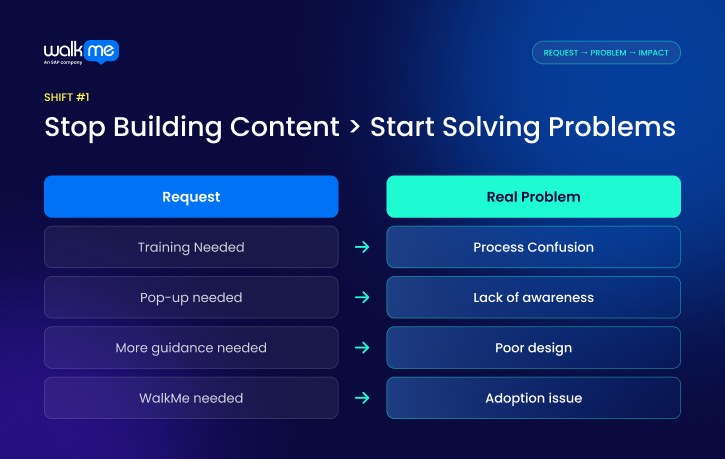
It’s tempting to build before you understand where the actual breakdown is. That instinct gets even stronger with AI, where the pressure is to roll out broad support for a new tool before anyone’s confirmed where people are actually getting stuck or where they need the most support. But smaller, targeted solutions that address the root problem almost always outperform broad ones, whether the tool is new or legacy.
Shift 2: Speak business, not WalkMe
I used to describe my work in terms of what I’d built: SmartTips, Launchers, Walk-Thrus. None of that means much to a stakeholder who isn’t in WalkMe every day. Now, I talk about the problems these solutions are solving and business outcomes instead: time saved, risk reduced, errors prevented, productivity increased.
It’s fundamentally the same work, but a completely different conversation with the business.
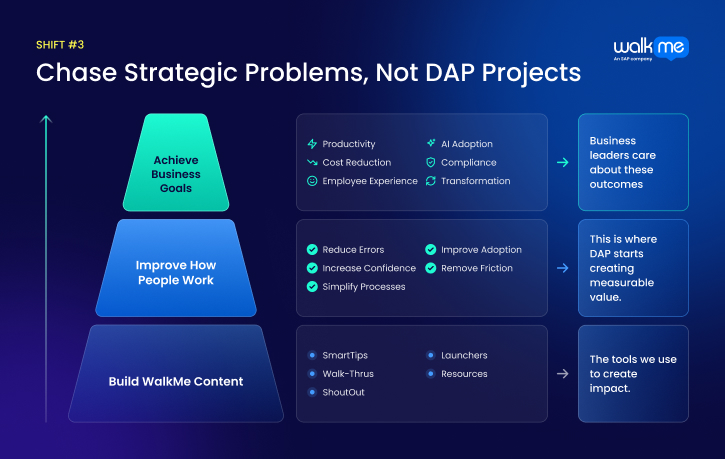
Shift 3: Chase strategic problems, not DAP projects
I think about this like a pyramid: at the bottom, there’s the content we build. The technical specifics of our builds that we love to speak about with each other and get excited about the latest capabilities. When we’re here, we’re speaking about “Can you build me a Launcher for XYZ?”
Then, above that, there’s improving how people work: reducing errors, increasing confidence, removing friction, and all the great process and workflow improvements our solutions can deliver. When we’re here, we’re talking about solving common friction points and delivering measurable value to our stakeholders. For example, we can share how we’re making a process 50% faster or reducing errors by 70%.
Then, at the very top of the pyramid, we start talking about business goals: productivity, transformation, and now, AI adoption. When we get to the top, we start having conversations about “Can you help us improve productivity?” or “How can we accelerate AI adoption?” and these are the macro problems that business leaders really care about.
I think this is where DAP Professionals have an opening, most of us haven’t fully claimed yet. We already know how to figure out why a workflow isn’t sticking and have the expertise to build solutions that address the root causes. That skill is about to matter a lot more, as more of our organisations start asking how to make sure the AI investments they’ve made actually pay off.
Shift 4: Become the person who sees around corners
One of the things I love about being a DAP Professional is that we’re sitting on information most of the business never sees: where friction is happening, where errors cluster, and which new processes are likely to cause confusion. Once I started surfacing that proactively to my stakeholders, I stopped reacting to requests and became a strategic partner. I was helping to shape decisions before the problem had a chance to grow.
Most teams rolling out an AI tool will face the same challenges we as DAP Professionals have been solving for years: awareness, trust, change fatigue, and process friction. All four are very different problems with different fixes, and these are opportunities for us as DAP Professionals to offer our insights and help the business accomplish its goals.
Shift 5: Don’t wait for a seat at the table
Nobody invited me into strategic conversations. I earned my way in by bringing
insights and solutions that were hard to ignore. That’s the biggest career lesson in all of this: the seat doesn’t come from a title or the tool you use. It comes from consistently showing up with something the business needs.
None of this happened overnight, and I’m still learning plenty of it myself. But the shift from building content to solving problems has helped me grow my programme and my
role into what it is today, and it’s the same shift I’d point anyone toward.
I shared more on all of this at WalkMe’s DAP Pro Show. Catch the on-demand
recording here if you want the full conversation.