
8 Organizational change management examples from real companies

Change management examples are real cases of change management: how an organization plans, communicates, and embeds a change in strategy, structure, technology, or ways of working so that people adopt it.
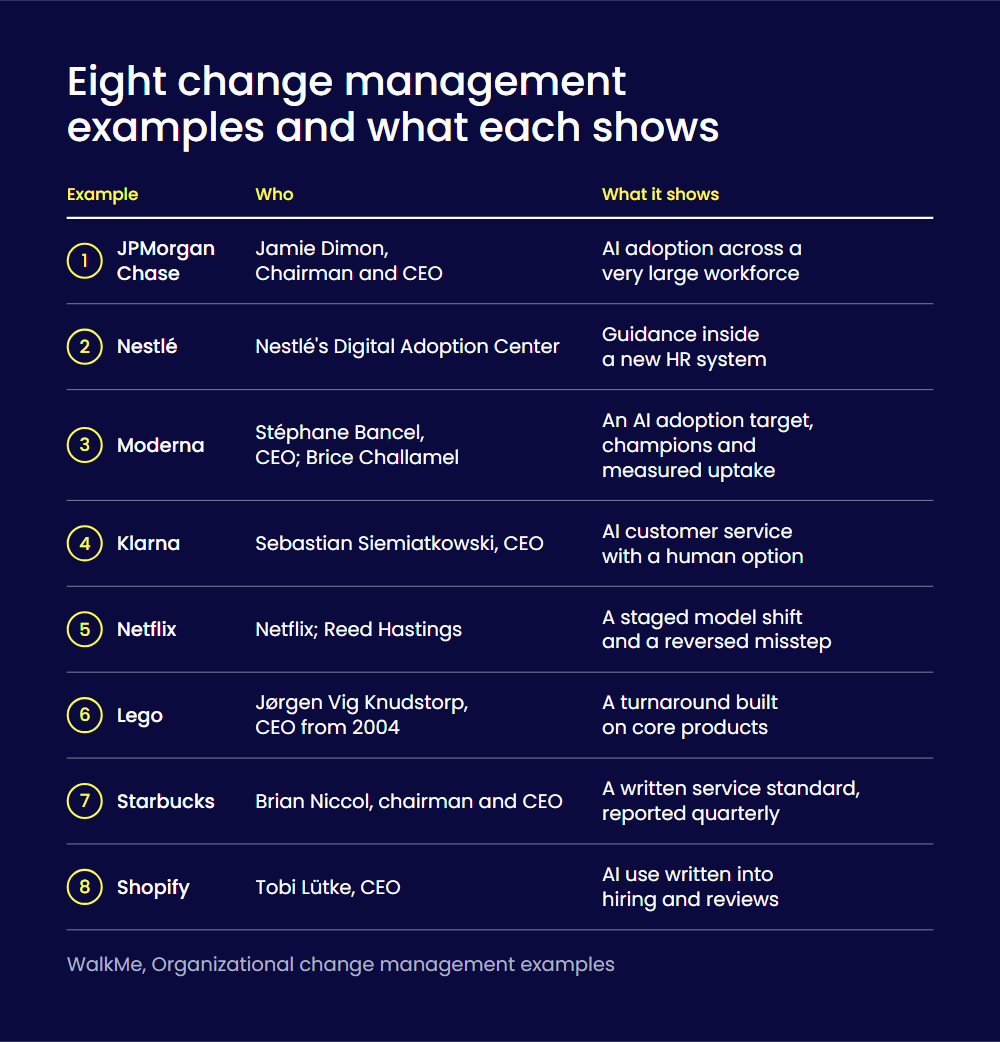
The eight examples cover AI and technology adoption (JPMorgan Chase, Nestlé, Moderna and Klarna), business model change and turnaround (Netflix, Lego and Starbucks), and culture and ways of working (Shopify).
| Example | Who | What it shows |
| 1. JPMorgan Chase | Jamie Dimon, Chairman and CEO | AI adoption across a very large workforce |
| 2. Nestlé | Nestlé’s Digital Adoption Center | Guidance inside a new HR system |
| 3. Moderna | Stéphane Bancel, CEO; Brice Challamel | An AI adoption target, champions and measured uptake |
| 4. Klarna | Sebastian Siemiatkowski, CEO | AI customer service with a human option |
| 5. Netflix | Netflix; Reed Hastings | A staged model shift and a reversed misstep |
| 6. Lego | Jørgen Vig Knudstorp, CEO from 2004 | A turnaround built on core products |
| 7. Starbucks | Brian Niccol, chairman and CEO | A written service standard, reported quarterly |
| 8. Shopify | Tobi Lütke, CEO | AI use written into hiring and reviews |
These examples are for leaders and for change, HR, IT and transformation teams who want named cases to learn from, not a definition or a vendor list. Each example is a company that went through organizational change with a documented reason, method, date, and result, backed by a primary source.
The list is grouped by kind of change and isn’t ranked. If you want the kinds of change themselves, see the guide to types of organizational change.
AI and technology adoption examples
In these changes, a large workforce had to adopt a new system or artificial intelligence capability. The same people questions come up in any cloud transformation or AI adoption program.
1. JPMorgan Chase
What it is: JPMorgan Chase & Co. went from more than 300 AI use cases in production in 2022 to deploying generative AI at enterprise scale in 2025, across a workforce of more than 320,000 employees. In his 2022 letter to shareholders, Chairman and CEO Jamie Dimon set out the reason: “AI and the raw material that feeds it, data, will be critical to our company’s future success,” and “the importance of implementing new technologies simply cannot be overstated.”
Who and when: Jamie Dimon, from his letter for 2022 (published April 2023) to the 2025 annual report (letter dated April 6, 2026). The bank’s 2026 technology budget is about $19.8 billion.
Why it’s a good example: The bank stated its rationale in writing and paired technology with people: an internal generative AI tool, LLM Suite, an AI-powered Employee Assistant, and training, including AI upskilling. Chief Operating Officer Jennifer Piepszak’s 2025 letter says tools like its homegrown LLM Suite are “simplifying work, giving employees time back and improving quality.”
What to take from it: Write down why the change matters before you scale it, and fund training alongside the tools.
2. Nestlé
What it is: When Nestlé moved from an older SAP HR system to SAP SuccessFactors, a business-critical system that affected thousands of people, early rollouts showed that traditional learning methods weren’t enough. With six weeks until the next rollout, Nestlé’s Digital Adoption Center learned WalkMe and mapped 15 key business processes. On the next rollout, task completion rates rose 200%, and SuccessFactors’ internal NPS rose 40 points.
Who and when: Nestlé, the world’s largest food and beverage company, with about 270,000 employees, through its Digital Adoption Center, a center of excellence it created in 2016. The team kept extending WalkMe to other SuccessFactors modules through 2020.
Why it’s a good example: The change was concrete: it moved hiring and onboarding tasks from administrators to line managers, introducing new terminology and complex business processes, so the training moved inside the system people were learning. Nestlé also reports a 50% reduction in training needs for specific applications and processes. Patrick Fueldner, IT Product Manager, Digital Adoption, says WalkMe made it “easier for us as a tech organization to be nimble and quick and react to application and process changes.” The limits: one customer, figures reported by Nestlé and WalkMe, and a system rollout rather than a company-wide restructuring.
What to take from it: When traditional training can’t keep up with a system change, put guidance inside the system people are learning, and measure task completion before and after.
3. Moderna
What it is: In 2024, Moderna rolled out ChatGPT Enterprise across the company with a goal of full adoption within six months, and OpenAI’s customer story, which carries no date, reports that within two months Moderna had 750 GPTs across the company. The goal was “100% adoption and proficiency of generative AI” among people with access to digital solutions.
Who and when: CEO Stéphane Bancel and Brice Challamel, Head of AI Products and Platforms. Moderna launched its own mChat tool at the beginning of 2023, then deployed ChatGPT Enterprise in 2024, the year its shareholder letter says it entered into a collaboration with OpenAI. Also in 2024, Tracey Franklin, Chief Human Resources Officer, became Chief People and Digital Technology Officer, which Moderna’s 2024 shareholder letter says emphasizes “the profound ways in which AI and digital platforms will reshape our ways of working.”
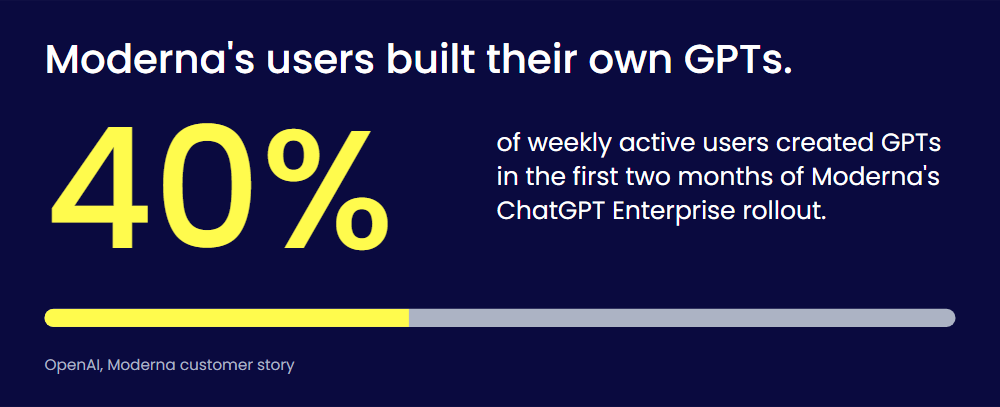
Why it’s a good example: The method is named: “Their approach combined individual, collective and structural change management initiatives.” A prompt contest found the top 100 AI power users, who became internal Generative AI Champions, and Moderna ran trainings in person, online, and with dedicated AI learning companions. OpenAI reports that 40% of weekly active users created GPTs. The vendor published these figures, and they cover the first two months.
What to take from it: Set an adoption goal with a date, then make your early power users the teachers.
4. Klarna
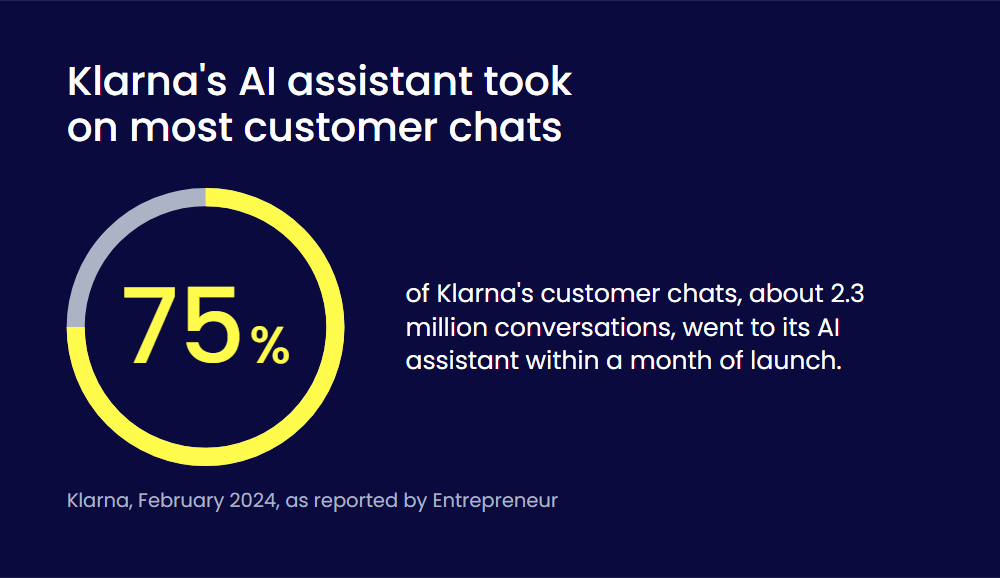
What it is: In February 2024, Klarna said its AI assistant had taken on 75% of its customer chats, about 2.3 million conversations, within a month of launch. The CEO later reversed course and began hiring human customer service agents again, so customers can always reach a person.
Who and when: Klarna Group plc and CEO Sebastian Siemiatkowski, from February 2024. In a Bloomberg interview, as reported by Entrepreneur, he said customers must know “that there will always be a human if you want,” and that “investing in the quality of human support is the way of the future for us.”
Why it’s a good example: It’s a large AI rollout in one function, with a public result and a visible correction. Klarna claimed the assistant could do the work of 700 customer service agents and paused hiring while it invested in AI; headcount fell 22% to 3,500, mostly through attrition. Siemiatkowski then told Bloomberg that while AI chatbots were cheaper than human staff, they resulted in “lower quality” output.
What to take from it: Before you automate a customer-facing job, set a quality measure alongside the cost measure, and keep a route to a person.
Business model change and turnaround examples
In these cases, the company changed what it sells, how it sells it, or how it runs, which makes them transformational change examples. For cases that center on reporting lines and structure, see the guide to organizational structure change.
5. Netflix
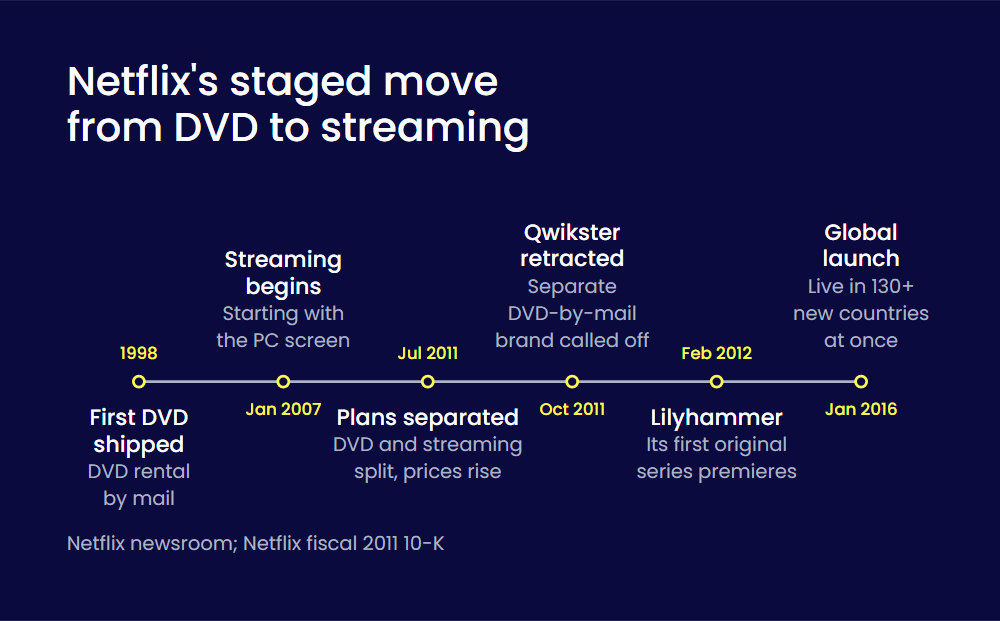
What it is: Between 2007 and 2016, Netflix moved from DVD rental by mail to streaming and its own shows, then went live in more than 130 new countries at once in January 2016.
Who and when: Netflix shipped its first DVD in 1998 and began streaming in January 2007. Reed Hastings explained the starting point: “The PC screen is the best Internet-connected screen today, so we are starting there.” Lilyhammer, Netflix’s first original series, premiered on Netflix in February 2012.
Why it’s a good example: Netflix moved in stages and corrected a misstep. In July 2011, it separated its DVD and streaming plans, which raised prices for members. In the third quarter, it announced a plan to rebrand DVD-by-mail on a separate website, Qwikster, then retracted it in October 2011. Its fiscal 2011 10-K reports “higher than expected customer cancellations.”
What to take from it: Stage a big change so each step can prove itself before the next. If a step costs you customers, reverse it quickly and openly, as Netflix did in 2011.
6. Lego
What it is: After its worst year in its history in 2003, the LEGO Group ran a recovery plan that “included increased focus on its classic products,” and returned to a net profit of 505 million kroner in 2005, after a net loss of 1.93 billion kroner in 2004.
Who and when: The LEGO Group. In March 2004, owner Kjeld Kirk Kristiansen announced about 500 redundancies worldwide. Jørgen Vig Knudstorp took over as CEO in October 2004, when Kristiansen stepped down and handed over control.
Why it’s a good example: The reason and the new focus were stated plainly. Putting the LEGOLAND parks up for sale, the group said its “main thrust will be in the field of classic construction toys, which represent its core business.” It turned from computer games back to key products, and in 2005 it sold its four LEGOLAND parks to Blackstone. Knudstorp set the order of priorities: “Not until satisfactory profitability has been ensured will we turn towards sales growth.”
What to take from it: When a business is in trouble, say how serious it is and what you’ll stop doing. A short list of what stays core gives people a test for every decision that follows.
7. Starbucks
What it is: Since September 2024, Starbucks’ new CEO, Brian Niccol, has led “Back to Starbucks,” a turnaround of the coffeehouse experience, staffing, and service standards; by the third quarter of fiscal 2026, Starbucks reported four consecutive quarters of comparable sales growth.
Who and when: Brian Niccol, chairman and CEO, from September 2024. His first letter said: “We’re getting back to Starbucks.” Two years on, Starbucks had “brought back cup writing, condiment bars, ceramic mugs and free refills,” and made Green Apron Service its operating standard.
Why it’s a good example: The reason was visible to customers and staff, and the standard was written down. Starbucks invested in “bigger rosters, better staffing and smarter scheduling,” and in 2025 decided to eliminate about 900 non-retail roles and close some coffeehouses. In the third quarter of fiscal 2026, global comparable store sales rose 7.9%. Revenue fell 1% in the same quarter, so this is progress, not a full recovery.
What to take from it: Name the standard you’re returning to as a few concrete behaviors, fund the people who deliver it, and report progress every quarter.
Culture and ways of working examples
These changes alter what’s expected of people and how they work, which makes them useful HR change management examples. They show how a company gets employees embracing change through the routines that shape daily work.
8. Shopify
What it is: In April 2025, Shopify CEO Tobi Lütke told staff that “reflexive AI usage is now a baseline expectation at Shopify,” and in October 2025, Shopify reported universal adoption of AI code editors.
Who and when: Tobi Lütke, CEO. According to CNBC, the memo went to staff in late March and was posted on X on April 7, 2025. Daniel Beauchamp, a Distinguished Engineer, reported the result in Shopify’s newsroom on October 28, 2025.
Why it’s a good example: It writes down expectations and ties them to routines people already follow. According to CNBC, teams must show they “cannot get what they want done using AI” before asking for more headcount. CNBC and The Logic both reported that AI usage will be part of employee performance reviews. Shopify also gave people the tools: “Every team has unlimited access to top AI models.”
What to take from it: If a new way of working matters, write it into the routines that already shape behavior, such as hiring, reviews, and budget requests. Give people the tools first, then hold them to the expectation.
What the strongest examples have in common
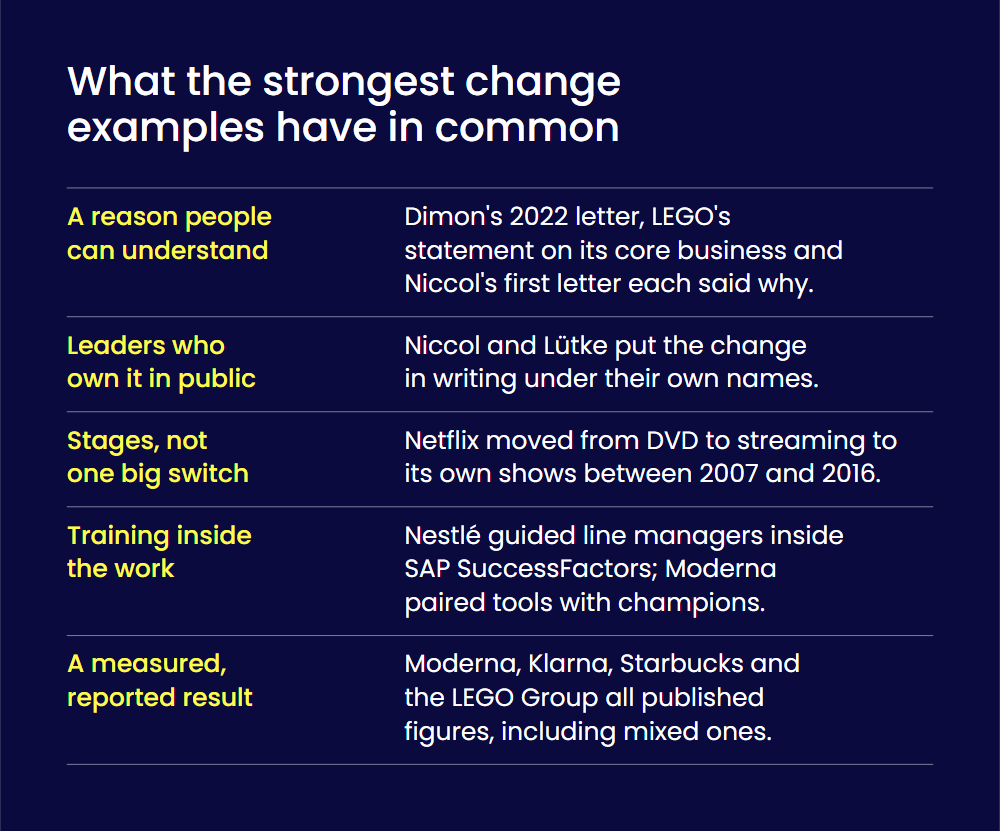
Across the eight, five patterns stand out. They match the stages most change management frameworks and change management models describe.
- A reason people can understand. Dimon’s 2022 letter, the LEGO Group’s statement on its core business, and Niccol’s first letter each said why the change had to happen.
- Leaders who own it in public. Niccol and Lütke put the change in writing under their own names, and the LEGO Group handed control to a new CEO to deliver its plan.
- Stages, not one big switch. Netflix moved from DVD to streaming to its own shows between 2007 and 2016, and the LEGO Group cut jobs in 2004, then sold its parks and returned to profit in 2005. For staged, iterative delivery, see agile change management.
- Training inside the work. Nestlé guided line managers inside SAP SuccessFactors, and Moderna paired its tools with champions and training.
- A result that was measured and reported. Moderna, Klarna, Starbucks, and the LEGO Group all published figures, including mixed ones.
For what to do week to week, see these change management activities.
Reasons organizations undergo change
Organizations undergo change for many internal and external reasons. Four come up most often, and the eight examples show three.
- Market conditions. Customer demand shifts, and companies follow it, as Netflix did when it began streaming in 2007.
- New technology. A new capability changes how work gets done, as AI did at JPMorgan Chase, Moderna, and Klarna.
- Internal performance. Falling results force a rethink, as the LEGO Group’s losses in 2003 and 2004 did.
- Regulation. New rules can force changes to processes or reporting; none of the eight examples here was driven mainly by regulation.
The reasons are varied and can be complex. Organizations that watch all four can respond on their own terms rather than when change is forced on them.
Benefits of change management
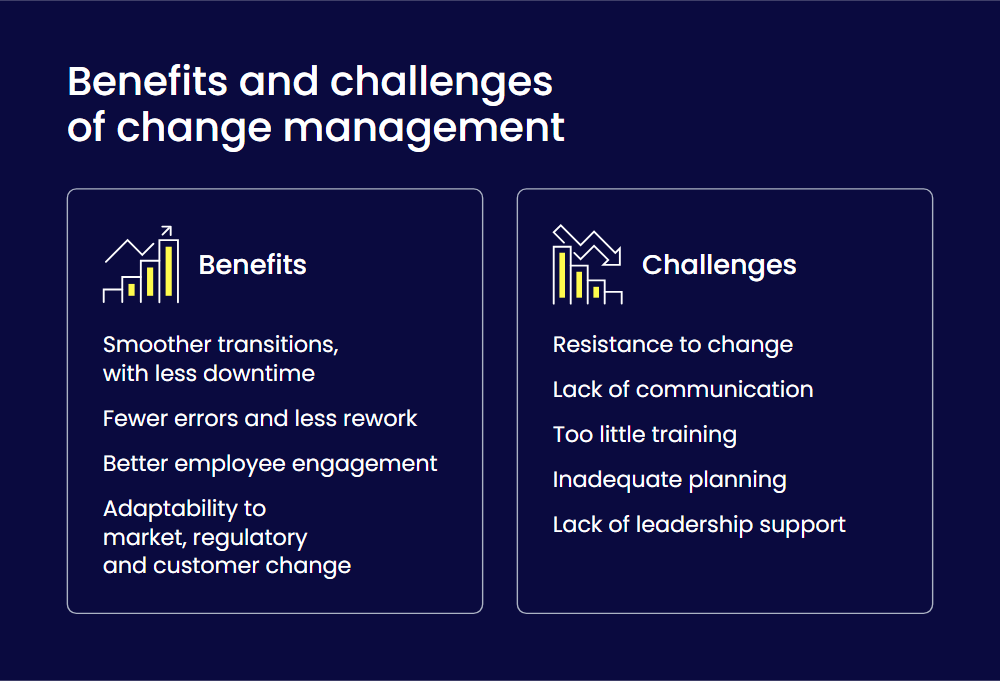
Change management helps people move from the old way of working to the new one with less disruption. Four benefits stand out:
- Smoother transitions. Employees are informed and trained on the new systems, reducing downtime and errors.
- Fewer errors and less rework. People trained in the new process make fewer mistakes.
- Better employee engagement. Involving people in the change, as Moderna did with its AI champions, builds commitment.
- Adaptability. Organizations can respond to changing market trends, regulatory requirements, and customer demands.
Challenges of change management
Change management brings real benefits, but it also presents challenges. These five come up most often:
- Resistance to change. Many employees are set in their ways and may feel threatened by the proposed changes.
- Lack of communication. When goals aren’t clear, confusion and misunderstanding create more resistance.
- Too little training. Telling people about a new system isn’t the same as helping them use it.
- Inadequate planning. Without proper planning, the process can turn chaotic.
- Lack of leadership support. If leaders aren’t fully committed, employees lose motivation.
Make the next change stick
The eight examples share a stated reason, visible leadership, a staged plan, training in the flow of work, and a reported result. Most also had to get a large workforce to adopt a new system or way of working.
When a change lands inside enterprise software, people need help in the application they’re adopting. WalkMe’s AI-enabled Action Bar reads context across the screen and suggests the next best action inside the applications people use, so employees can master change in the flow of work with less need for ongoing training and support. To see how that works, explore WalkMe for change management. If you’re building your own skills, the guide to change management certifications is a good next step.
Frequently Asked Questions
Good examples of change management have a clear reason, a method, and a reported result. For examples of successful organizational change, look at the LEGO Group’s 2004 to 2005 turnaround, Netflix’s staged move from DVD by mail to streaming, and Moderna’s 2024 generative AI rollout with internal champions. Starbucks’ “Back to Starbucks” turnaround is a recent case that is still in progress.
Organizational change covers any shift in how a company is structured or how it operates. Common kinds include technology and AI adoption, business model change, turnarounds, culture change, mergers, and leadership changes. JPMorgan Chase shows AI adoption, Netflix shows a business model change, the LEGO Group shows a turnaround with new leadership, and Shopify shows a change in employee expectations.
Nokia’s handset business is a widely cited case. On February 11, 2011, Nokia said it would adopt Windows Phone as its principal smartphone strategy. In September 2013, Microsoft agreed to buy substantially all of Nokia’s Devices & Services business substantially, and Nokia completed the sale on April 25, 2014. The lesson is the cost of responding too slowly to a platform shift.
Moderna’s 2024 generative AI rollout is one example. The company deployed ChatGPT Enterprise with a goal of full adoption and proficiency within six months. It ran a prompt contest to find its top 100 AI power users, made them a cohort of internal champions, and ran trainings in person, online, and with AI learning companions.
It depends on what you need, and the examples are company cases rather than vendors. If you want outside help planning and running a change, compare change management consultants. For AI tools that support adoption, training, and communication, see the guide to AI tools for change management. For controlling changes to IT systems, see IT change management software. No single provider suits every change.
The change management process is the sequence of steps an organization follows to move people from the current way of working to a new one. It usually has five steps: define the change and the reason for it, plan for its impact on people, communicate and train, support people as they adopt it, and measure and reinforce the results. The guide to the change process sets out a five-step version.