
10 Best AI tools for change management in 2026

The best AI tools for change management depend on the part of change you need help with. To guide people through new software, consider WalkMe. For answering questions and sharing news during change, Glean and Leena AI fit. For planning and impact assessment, Issoria and Kaiya help, and for measuring how employees feel, Culture Amp, Microsoft Viva Glint, and Qualtrics Employee Experience fit that job.
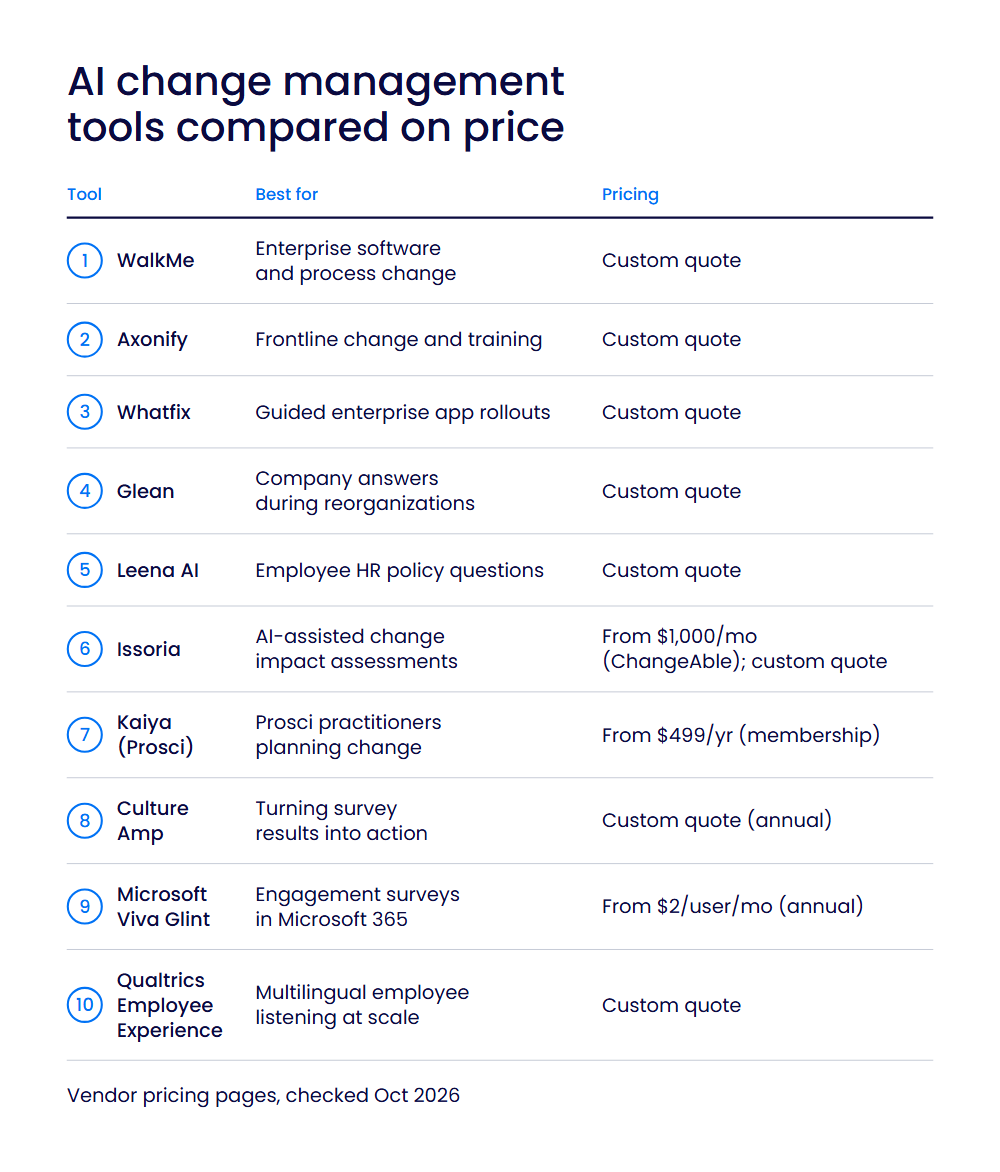
| Tool | Best for | Pricing |
| WalkMe | Enterprise software and process change | Custom quote |
| Axonify | Frontline change and training | Custom quote |
| Whatfix | Guided enterprise app rollouts | Custom quote |
| Glean | Company answers during reorganizations | Custom quote |
| Leena AI | Employee HR policy questions | Custom quote |
| Issoria | AI-assisted change impact assessments | From $1,000/mo (ChangeAble); custom quote |
| Kaiya (Prosci) | Prosci practitioners planning change | From $499/yr (membership) |
| Culture Amp | Turning survey results into action | Custom quote (annual) |
| Microsoft Viva Glint | Engagement surveys in Microsoft 365 | From $2/user/mo (annual) |
| Qualtrics Employee Experience (EX) | Multilingual employee listening at scale | Custom quote |
This list is for change, HR, learning, and transformation leaders who want AI tools that help people through change. For the wider question of managing change when AI arrives, see our guide to AI change management.
AI for digital adoption and training
These tools use AI to guide people inside the software and processes they’re adopting, and to build training faster.
1. WalkMe
Best for: Enterprises managing software and process change across many applications.
What it is: WalkMe is a digital adoption platform that overlays applications with real-time context, cross-app workflows, and automation. Its Contextual AI Assistance puts AI-powered guidance inside the applications people already use, on web, desktop, and mobile.
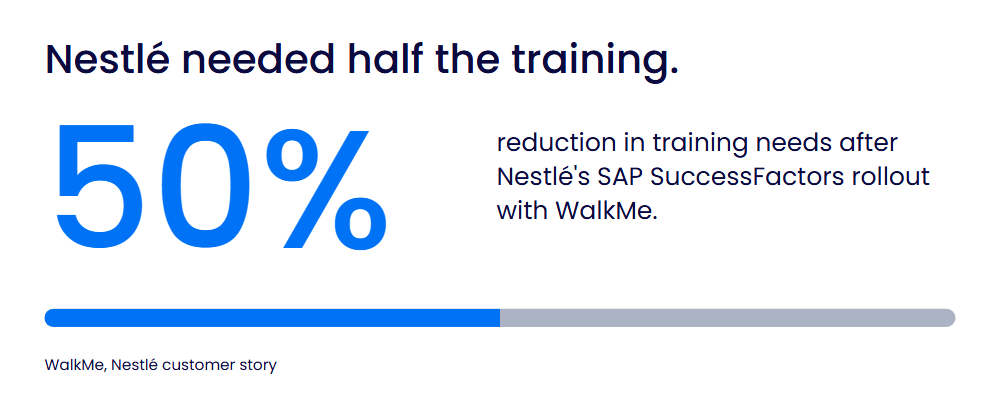
WalkMe, an SAP company, helps organizations navigate change across any application or system. WalkMe’s Nestlé customer story reports a 50% reduction in training needs and a 200% rise in task completion rates after its SAP SuccessFactors rollout (Nestlé customer story).
Key features:
- AI-Enabled Action Bar: brings WalkMe’s AI help into the applications employees already use.
- AI authoring: builders create, edit, and extend WalkMe content with free-text prompts, which speeds up support for each new process.
- AI insights: teams ask questions about workflow performance or program ROI, within or across applications.
- In-app guidance and automation: personalized guidance meets users at the point of friction.
- Usage analytics: shows what people actually use, so change teams can see where adoption stalls.
Limitations: Pricing isn’t published, so you’ll need to request a quote. On web apps where you can’t add WalkMe’s code, it runs through a browser extension that IT deploys to each user.
Pricing: Custom quote; no free plan or trial (checked Oct 2026).
2. Axonify
Best for: Frontline teams that need to learn about changes quickly.
What it is: Axonify is an AI-powered frontline enablement platform. It makes sure frontline workers know what’s changing, why it matters, and what to do next. Its AI features include Max Assistant, Max Coach, Co-Creator, and agentic AI.
Key features:
- Co-Creator: turns raw inputs into training content in hours, not weeks.
- Max Assistant: gives workers instant answers on the job in more than 60 languages.
- Agentic AI: surfaces readiness gaps and recommends the right intervention to the right manager.
- Direct change updates: sends updates straight to employees, so messages don’t get diluted or delayed.
Limitations: Pricing depends on team size, locations, and features, and isn’t published. Max Coach is available only in the Pro and Premium plans. It’s built for frontline teams in retail, grocery, hospitality, and logistics, not desk-based software rollouts.
Pricing: Custom quote across the Core, Pro, and Premium plans; no free plan or trial listed (checked Oct 2026).
3. Whatfix
Best for: Organizations rolling out and training people on enterprise applications.
What it is: Whatfix guides users inside applications, provides simulation training, and tracks adoption across enterprise software. Its AI agents for authoring, guidance, and insights run on its ScreenSense technology, and Whatfix says they adapt guidance as processes and systems evolve.
Key features:
- Authoring Agent: speeds up the creation and management of in-app guidance.
- Guidance Agent: delivers contextual knowledge and real-time help in the flow of work.
- AI Roleplay: builds skills and confidence with AI-powered roleplay and simulations.
- Mirror: provides hands-on training environments that replicate your applications.
- Adoption analytics: tracks how employees use new systems and processes.
Limitations: Pricing isn’t published; you request a demo or talk to sales. Some features depend on the tier, such as Auto Translation in Premium. Web delivery can rely on a browser extension that IT deploys across the organization.
Pricing: Custom quote across the Standard, Premium, and Enterprise plans; no trial (checked Oct 2026).
AI for change communication and knowledge
These tools use AI to answer employees’ questions and keep them informed while things change.
4. Glean
Best for: Organizations that want company-wide answers during reorganizations.
What it is: Glean is an enterprise AI platform connected to a company’s data. Glean says it gives employees a trusted AI coworker to help them ramp up faster, find the right experts, and navigate change, including reorganizations and role changes.
Key features:
- Grounded answers and drafts: responses draw on the company’s own knowledge.
- Permission-aware search: users only see what they’re allowed to see.
- App connectors: connects to more than 250 business applications.
- Agent building: teams build their own agents in the Core Suite seat.
Limitations: There’s no public price, only a demo. Some advanced features are charged on top at model or hosting provider rates. Answers depend on connecting the company’s applications.
Pricing: Custom quote, priced per user per month (checked Oct 2026).
5. Leena AI
Best for: HR teams answering employee policy questions at scale.
What it is: Leena AI is an enterprise AI platform with prebuilt AI colleagues for HR, IT, and finance. Its HR AI colleague handles onboarding, leave, payroll, and policy questions. It can also write short announcements, such as policy introductions and training reminders, for each audience.
Key features:
- HR knowledge assistant: answers HR questions with generative AI, and its knowledge base updates from employee interactions.
- Targeted announcements: adds polls and scheduling, and tracks acknowledgment rates.
- Languages: works in more than 100 languages.
- Integrations: connects to more than 200 enterprise systems.
Limitations: There are no public prices; Leena AI prices a proposal on headcount, use cases, and volumes. AI colleagues are billed as a platform fee plus usage, so cost varies. The average go-live takes 45 days.
Pricing: Custom quote, based on headcount, use cases, and volumes (checked Oct 2026).
AI for change planning and impact assessment
These tools use AI to plan change, assess its impact, and prepare the accompanying messages. Some teams call this AI-powered change intelligence: using data to see where a change will land before it does.
6. Issoria
Best for: Organizations that want AI-assisted change impact assessments with expert support.
What it is: Issoria is a change consultancy whose AI tools automate impact assessments and benefits tracking, delivered with its consultants. It also offers ChangeAble, a change management analytics tool that provides a single source of truth for change impact data, with dashboards and heatmaps. ChangeAble works with any methodology and runs on Microsoft’s Power Platform, hosted on Azure.
Key features:
- AI impact assessments: automates complex impact assessments, reducing manual effort.
- AI benefits tracking: measures project outcomes quickly.
- ChangeAble dashboards: show change impact across the organization with dashboards and heatmaps.
- Methodology agnostic: fits whichever change method your team uses.
Limitations: The AI tools come through consulting engagements rather than as a self-serve product, and ChangeAble’s own page doesn’t mention AI. ChangeAble adds a one-time fee for stakeholder data migration. It runs on Microsoft Power Platform and Azure.
Pricing: ChangeAble starts at $1,000/month (enterprise fee), with no license cost when you work with Issoria consultants; AI work is by custom quote; no free trial found (checked Oct 2026).
7. Kaiya (Prosci)
Best for: Prosci-certified practitioners planning change.
What it is: Kaiya is Prosci’s AI-powered change management assistant. It gives on-demand guidance and answers drawn from Prosci’s knowledge base, trained on more than 25 years of Prosci research and methodology.
Key features:
- ADKAR blueprints: builds guided change blueprints for a project.
- Change messages: drafts key messages and customizes them for different audiences.
- Resistance management: develops tactics for sponsorship and resistance management.
Limitations: Membership access requires completion of the Prosci Change Management Practitioner Program. The Essentials tier includes 20 prompts a month; unlimited use requires Premier. Answers come from Prosci’s knowledge base, not your company’s own data.
Pricing: From $499/year with Prosci Membership (Essentials); $999/year for Premier; Enterprise License by custom quote (checked Oct 2026).
AI for employee sentiment and engagement
These tools use AI to measure how employees feel about change and turn feedback into action.
8. Culture Amp
Best for: Managers turning survey results into action plans.
What it is: Culture Amp Engage combines employee surveys with Culture Amp AI. Pulse surveys assess how well organizational changes and initiatives are landing, and AI Coach drafts clear messages for each audience and channel.
Key features:
- AI comment summaries: summarizes thousands of survey comments into clear, actionable insights.
- Sentiment analysis: shows how employees feel about the topics they raise.
- AI Coach: suggests themes, next steps, and communications from survey results.
- Survey templates: more than 40 ready-to-use templates.
Limitations: AI comment summaries need at least 5 meaningful comments per question and work on Engagement surveys only. AI Coach doesn’t create action plans automatically; managers create and track them.
Pricing: Custom quote, based on employees, products, and service tier, billed annually (checked Oct 2026).
9. Microsoft Viva Glint
Best for: Microsoft 365 organizations running engagement surveys.
What it is: Microsoft Viva Glint is Microsoft’s employee survey platform, formerly LinkedIn Glint. It runs surveys for engagement, onboarding, exits, change management, and 360 feedback, and Copilot in Viva Glint helps leaders find the themes and actions employees ask for.
Key features:
- Copilot Highlights: summarizes scores, trends, and top opportunities.
- Comment summarization: identifies key themes across up to 8,000 comments per summary.
- Languages: supports more than 60 languages.
- No extra Copilot license: you don’t need a Microsoft Copilot license to use Copilot in Viva Glint.
Limitations: There’s a 50-seat license minimum. Comment summaries can’t compare survey cycles or employee groups. Trials aren’t public; they go through a Microsoft account team.
Pricing: From $2/user/month, paid yearly; also included in Microsoft Viva Suite at $12/user/month, paid yearly (checked Oct 2026).
10. Qualtrics Employee Experience (EX)
Best for: Large organizations listening to employees in several languages.
What it is: Qualtrics Employee Experience helps companies understand the employee journey, prioritize the key drivers of engagement, and take action. Its AI summarizes open feedback for engagement, lifecycle, pulse, and ad hoc research projects, which helps teams see how change is landing.
Key features:
- AI comment summaries: creates summaries and highlights key topics in English, German, French, Spanish, and Japanese.
- Personalized Action Recommendations: gives managers guidance tailored to their team’s feedback.
- Conversational Feedback: uses AI to ask targeted follow-up questions.
- Dashboards: brings engagement and pulse results together for leaders.
Limitations: Comment summaries are only available on Qualtrics’ new simplified pricing and packaging plans for Employee Experience. Topics with more than 300 comments are summarized from a random sample of 300.
Pricing: Custom quote; demo only (checked Oct 2026).
How to choose AI tools for change and transformation management
Start with the part of change you need help with, then see how each tool fits how your people work. Transformation management AI tools cover different jobs, so many organizations will need more than one.
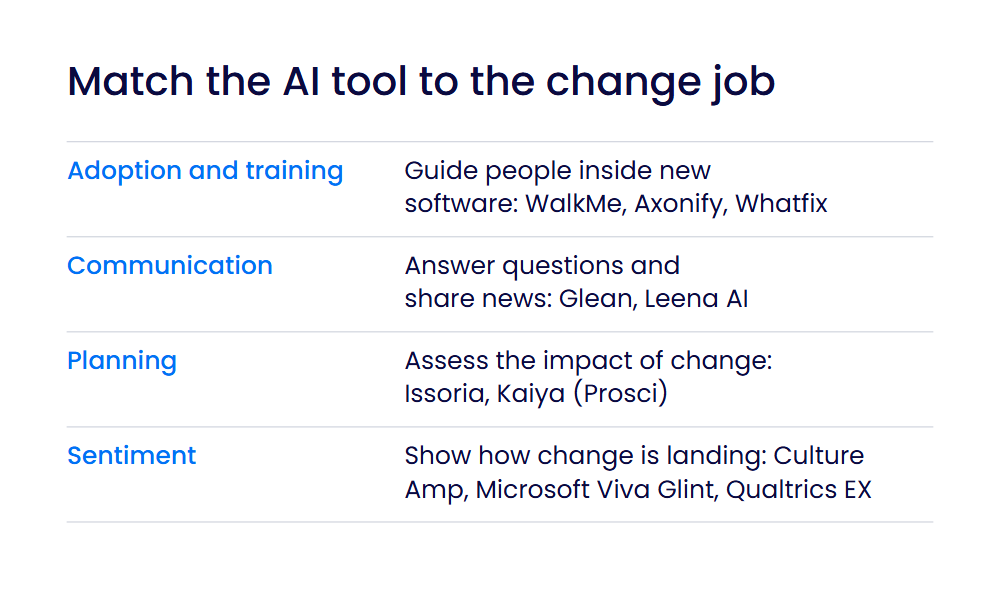
- The change job. Adoption and training tools guide people inside new software. Communication tools answer questions and share news. Planning tools assess impact. Sentiment tools show how change is landing.
- Where your people work. Desk-based teams on enterprise applications need in-app guidance, while frontline teams need short, mobile-friendly training.
- The AI and its data. Check what each AI feature draws on: your company’s data, the vendor’s knowledge base, or survey comments.
- Integrations. Make sure the tool connects to your HR, collaboration, and business applications.
- Employee data governance. Survey and HR tools handle sensitive employee data, so review permissions and privacy settings.
- Pricing model. Most tools here are quoted, while Kaiya, Viva Glint, and Issoria’s ChangeAble publish entry prices.
If you’re comparing change management software more broadly, see our guides to change management tools and IT change management software. For planning methods, our overview of change management frameworks explains the main models, and our list of change management activities offers practical communication ideas.
How we chose these tools
We compared each tool on these criteria:
- a documented AI capability for a change management job,
- fit with how organizations run change (adoption, communication, planning, sentiment),
- integrations,
- governance of employee data,
- pricing transparency.
Features, plans, and prices come from each vendor’s own product, pricing, documentation, help, and customer-story pages. We checked every fact in October 2026. IT service management change-control tools and general AI assistants are out of scope. WalkMe is listed first, so its group comes first; the other groups, and the tools within each group, are in alphabetical order.
WalkMe is our product. We’ve included it alongside other options and described each against the same criteria.
Make AI change stick with the right tools
AI only pays off when people change how they work. The tools above cover different parts of that job: guiding people, informing them, planning change, and listening to them. Most organizations will combine a few.
WalkMe focuses on the moment of work itself. It puts AI-powered guidance inside the applications people use, so they can adopt new processes and AI capabilities without leaving their work. To see how that could support your next change, explore the WalkMe Digital Adoption Platform.
Frequently Asked Questions
AI helps change teams at several points. In-app AI guides employees through new software, and training tools build content faster. Assistants answer employees’ questions and draft announcements. Planning tools assess the impact of a change, and survey tools summarize comments to show how people feel. Together, they help teams spot problems early and respond before resistance grows.
It depends on the job. For adoption and training, WalkMe, Axonify, and Whatfix are the options on this list. For communication, Glean and Leena AI answer questions and share updates. For planning, Issoria and Prosci’s Kaiya help assess impact and draft plans. For sentiment, Culture Amp, Microsoft Viva Glint, and Qualtrics Employee Experience measure how change is landing.
Several tools on this list do both. Axonify trains frontline workers and sends change updates straight to them. WalkMe and Whatfix guide people inside applications while change happens. Leena AI writes targeted announcements and answers HR questions. Culture Amp’s AI Coach drafts messages for each audience after a survey, which connects listening with communication.
AI supports change in four main ways. It guides people inside the tools they’re adopting, so they learn while they work. It answers questions and drafts communications at scale. It speeds up planning tasks such as impact assessments. It summarizes employee feedback so leaders see where support is needed and can act quickly.
Some tools help you rehearse changes before they go live. Whatfix Mirror provides hands-on training environments that replicate your applications, so employees can practice new processes safely. Its AI Roleplay builds skills with simulations. Issoria’s AI tools automate impact assessments, which helps teams see who a change will affect before rollout.
Behavior changes when people get in-the-moment support and leaders act on feedback. In-app guidance from WalkMe or Whatfix helps people form new habits inside their daily tools. Survey tools such as Culture Amp, Microsoft Viva Glint, and Qualtrics Employee Experience show how attitudes are shifting. Prosci’s Kaiya helps practitioners plan resistance management.