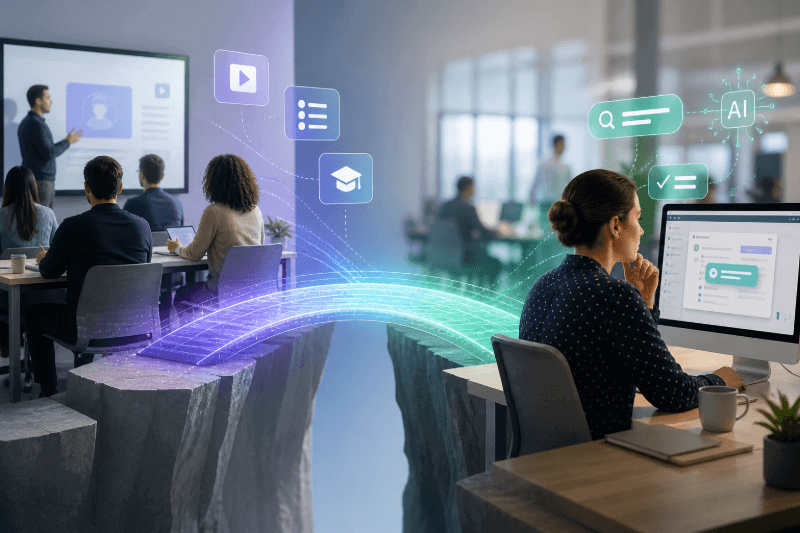
Closing the gap between workplace learning and daily work
Formal training keeps happening but the number of workdays lost to everyday technology friction keeps climbing anyway.
Highlights
- After two years of improvement, WalkMe’s State of Digital Adoption 2026 found that friction reversed course in 2026. Employees now lose 51 workdays a year to it, the highest level in three years, with AI adding a new source of drag on top of the old ones.
- Gartner projects that 85 percent of learning leaders expect a surge in skills development needs over the next three years, driven by AI and broader digital change, a pace most training calendars were never built to match.
- Closing the gap isn’t about choosing one training format. It’s about matching the format to the moment: microlearning for immediate needs, bite-sized learning for building skill over time, and real-world guidance for the parts that only make sense inside the tool itself.
Employee training budgets have grown. Course libraries are fuller than they’ve ever been. And yet, according to WalkMe’s State of Digital Adoption 2026 report, the time employees lose to technology friction went the wrong direction this year. After dropping from 43 workdays lost in 2024 to 36 in 2025, as organizations invested more in adoption support, the number jumped back up to 51 workdays in 2026, a 42 percent increase and the highest level the report has recorded.
A meaningful share of that reversal traces back to AI. Workers are spending more time reworking prompts, verifying outputs, and moving context between systems that don’t talk to each other, friction that didn’t exist in the same form even two years ago. Training built around a fixed calendar and a static curriculum simply isn’t built to keep pace with that.
Why workplace learning keeps losing ground
Formal employee training has always had a pacing problem. Course content gets built, reviewed, and approved on a cycle measured in weeks or months, while the tools and processes it’s meant to prepare people for keep changing underneath it. By the time a course reaches an employee’s desk, some of what it teaches may already be out of date, and workplace learning research consistently finds that people prefer approaches that adapt to their pace rather than a fixed course structure.
That mismatch shows up as a skills gap that has very little to do with employee effort. One widely cited Gartner estimate puts the number as high as 70 percent of workers lacking the skills to do their job properly, a gap that’s less about ability and more about how far training has drifted from the actual moment of use.
“It’s our first-line solution for enabling change.” — Alan Davie, Transformation Learning Lead, KPMG UK
Employee training in practice: two organizations closing the gap
KPMG UK: 116,000+ hours reclaimed across a 16,000-employee transformation
KPMG UK ran its largest digital transformation to date, spanning ten enterprise applications and 16,000 employees. The guidance the firm built falls into both formats described above, used for different purposes. Quick, single-purpose notifications, like the alert the team pushed out in under 10 minutes to stop a wave of help desk calls during a data migration, work the same way microlearning does: one prompt, delivered at the exact moment it’s needed, with no extra context required. Other guidance is closer to bite-sized learning: walking employees step by step through engagement setup and project coding so they understand the correct sequence, not just the immediate action, which prevents the kind of misclassified projects that would otherwise need manual correction later.
The firm also uses guidance as reinforcement rather than a one-time event. Ahead of the annual year-end feedback process, employees get prompts inside the relevant system at the moment they need them, a reminder tied to actual usage rather than a training session someone attended months earlier. That combination, in the moment for quick fixes, sequenced for process understanding, and repeated at the point of recurring need, is what helped the firm reclaim more than 116,000 hours of productivity in a single year.
Rich Products: 65% projected reduction in errors and delays, 35% drop in training time
Rich Products needed a way to support a wide range of employees, from plant managers to maintenance staff, completing procurement workflows consistently across dozens of locations. The real-time validation built into those workflows functions as microlearning in its purest form: a single flag and correction prompt, delivered the instant an entry is wrong, with nothing for the employee to absorb beyond the fix in front of them. Guidance through more involved steps, like selecting the right vendor and commodity code, works more like bite-sized learning, giving employees enough context to get the full sequence right rather than just the one field that triggered the error.
Because that guidance lives inside the workflow itself, it also reinforces the same lesson every time an employee runs the task again, rather than relying on a single training session to stick. Change Management Lead Sinead Scanlon described the effect as guidance that “meets them right where they are.” The projected result is a 65 percent reduction in errors and delays, a 70 percent increase in first-time submission accuracy, and a 35 percent drop in training time.
Microlearning for employees vs. bite-sized learning
Closing this gap also means being precise about which format actually fits the moment, since microlearning and bite-sized learning solve two different problems and get treated as interchangeable more often than they should.
| Microlearning | Bite-sized learning | |
| Purpose | Solves an immediate need | Builds skill and understanding over time |
| Depth | Minimal context, one prompt or action | Small but complete, enough context to explain the why |
| Structure | Standalone prompt or reminder | Part of a broader learning sequence |
| Best used when | Someone needs quick guidance in the moment | Someone is developing a skill deliberately |
Microlearning strips things down to the smallest useful unit, a single prompt or reminder that gets someone unstuck without asking them to absorb anything extra. Bite-sized learning does more work than that: it gives someone enough of the why alongside the how, so each unit stands on its own while still building toward a larger skill. Programs that use both, microlearning for the in-the-moment assists and bite-sized modules for deliberate skill building, tend to get further than programs that lean on just one.
What to look for in a continuous learning approach
A few questions worth asking before choosing how to close this gap in your own organization:
- Does the format match the moment? Quick, in-the-moment needs call for microlearning. Deliberate skill building calls for something with more depth, like bite-sized modules.
- Can content be created and updated quickly enough to keep pace with how often systems and processes change?
- Is guidance available where the employee is actually working, or does it require a separate trip to a portal?
- Are modules short enough to fit inside a workday without requiring someone to step away from their priorities?
- Is there a way to measure whether the training is actually changing what happens on the job, not just completion rates?
The bottom line
Training completion and job performance keep drifting apart because most training is still built around a calendar rather than a moment. The organizations closing that gap fastest, like KPMG UK and Rich Products, are the ones putting support directly where the work happens, so employees don’t have to translate a course they took weeks ago back into the task in front of them.
WalkMe Learning Arc was built around that same idea, giving employees in-workflow guidance alongside structured learning so training and daily work stop pulling in opposite directions.
See how WalkMe Learning Arc fits into your stack
Frequently asked questions
State of Digital Adoption 2026 report found that employees now lose 51 workdays a year to technology friction, up from 36 the year before. Much of that increase is tied to AI-related friction: reworking prompts, verifying outputs, and moving context between systems that don’t connect to one another.
Microlearning solves an immediate need with minimal context, a single prompt or reminder. Bite-sized learning builds toward a broader skill through small, complete units that still carry enough context to explain the why. Most mature employee training programs use both, depending on what the moment calls for.
Modules generally work best kept short, in the range of a few minutes, long enough to cover one clear idea and let someone apply it right away without pulling them out of their workday.
Yes. Complex topics can be broken into a sequence of smaller units, layered with practice and reinforcement, so large-scale training stays manageable without asking employees to sit through long sessions disconnected from their actual work.