
Social learning: Definition, benefits & strategies

People often make progress at work in the moments between tasks and in small exchanges that build confidence.
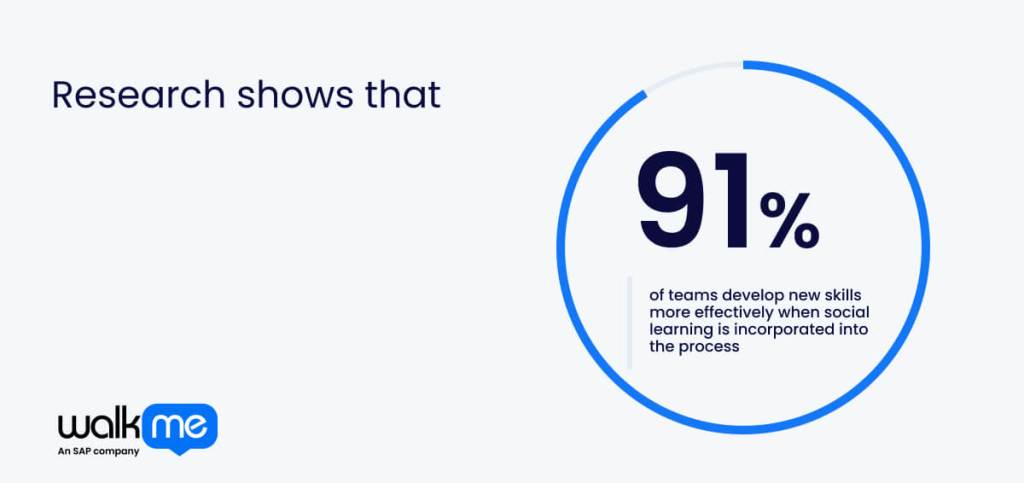
Research shows that 91% of teams develop new skills more effectively when social learning is incorporated into the process. This suggests that people learn and retain information better when they can ask questions, compare strategies, and observe how others solve problems.
When learning reflects how we naturally make sense of ideas, the material is much more likely to stick. eLearning approaches such as social learning convert casual exchanges into guided moments where people can test the water, get rapid feedback, and lock in practical skills.
This article explores how social learning works in practice, how it strengthens eLearning, and how organizations can introduce it in a structured, measurable way.
Social learning refers to how people acquire skills by observing others, sharing ideas, and trying things out in real-world situations.
Knowledge often develops through interaction rather than in isolation, so learners pick up behaviours, techniques, and problem-solving methods by observing how colleagues approach tasks and adapting those patterns to their own work.
Feedback, discussion, and real-world examples shape understanding, helping people connect concepts to practice.
The social learning process is continuous, informal, and reflects daily tasks. However, it can be supported with more structured activities that encourage collaboration, like digital adoption platforms (DAPs)
In brief, social learning integrates human behaviour, communication, and experience into a natural training approach to developing greater confidence and business capability.
Social learning theory explains how people adopt new behaviours by observing others and understanding the outcomes of their actions.
Introduced by psychologist Albert Bandura in the 1960s, the theory challenged the idea that learning occurs only through instruction or personal trial and error. It showed that people interpret, imitate, and adapt what they see, especially when the model is trusted or skilled.
Over time, the concept expanded into the workplace, shaping how knowledge is shared and building habits together.
Organizations can apply the theory through methods such as collaborative learning platforms, mentorship, scenario walkthroughs, and everyday peer exchanges that help employees refine skills through observation and reflection.
Most modern workplaces will inevitably upgrade their software, introduce new automation features, and use AI-driven tools, creating a stream of unfamiliar tasks.
Social learning is highly important in this context because it provides teams with a practical way to stay current, turning familiar conversations into guidance during moments of uncertainty.
Quick, human exchanges help people interpret everything from new dashboards and fresh prompts to troubleshooting unexpected behaviour without waiting for employee training manuals.
Insight spreads intrinsically, which means usable methods don’t stay siloed with a single specialist. When shared problem-solving is ingrained into the psyche, it reduces the hesitation that often slows the adoption of new systems, because no one is left to figure things out alone.
As technology continues to shift, social learning keeps knowledge agile and helps foster confident, adaptable employees ready for inevitable workplace changes.
People use the following three terms interchangeably, yet each describes a distinct way we make sense of behaviour and skill development. Understanding how they differ provides clearer insight into how organizational learning works in practice:
Social learning theory
Social learning theory explains how people acquire behaviours by observing others and understanding the consequences of their actions. The focus sits on modelling, imitation, and the conditions that make someone likely to adopt a new approach. It also highlights the role of social influence and shared experience when shaping practical skills.
Social cognitive theory
Social cognitive theory extends the original concept by incorporating attention, memory, motivation, and self-belief into the process. It emphasises how people interpret what they see, assess their own capability, and decide whether to replicate a behaviour. The theory stresses internal reasoning as much as external observation.
Observational learning
Observational learning (like social learning) refers to learning by observing another person complete a task. It focuses on the sequence of noticing an action, understanding its purpose, and trying it independently. The idea is simpler and more direct than the wider theories, giving a clear view of how copying and practice support critical employee skills.
Understanding the key components of social learning makes it easier to translate the theory into actions that can be used in the workplace. These elements reveal how progress occurs in day-to-day interactions, providing a more straightforward way to design learning moments that feel natural and genuinely useful in fast-moving environments:
Attention
Attention is where social learning begins and must be given proper thought. Start with a concrete problem people recognize and focus on it. Use a short screen share, a concise walkthrough, or a single screenshot that reveals a clear before-and-after.
Keep demonstrations compact and repeatable so observers notice the action without distraction. Then pose a pointed question that invites watching and comparison rather than passive reading. Remember to remove extra steps that dilute focus and make joining immediate. When the purpose is obvious and the effort is small, familiar cues stand out, and noticing becomes usable attention.
Retention
Retention depends on the repetition of functional patterns in context, so the initial observation becomes part of working memory. Anchor new techniques to daily tasks through short refreshers, microlearning aids, and moments where the observer applies the step soon after seeing it.
Add simple cues, such as labels or concise checklists, that surface under pressure and trigger information recall. Encouraging reflection and asking individuals to summarize their observations in their own words strengthens memory. Space out practice opportunities so the pattern resurfaces over time and settles into a reliable habit people can reach for when needed.
Reproduction
Reproduction is an important step that moves observed behaviour into repeated action. After watching an example, people need a low-stakes chance to copy the steps and receive prompt correction.
Provide guided practice in which tasks are broken into clear steps, and allow participants to try early on while a more experienced colleague offers feedback. Use scaffolded tasks that gradually remove support so the worker completes the whole process without prompts. Finally, capture any common errors in one place, record examples of successful performance, and make them easy to replay on demand.
Motivation
Motivation decides whether an observed action becomes routine. Make the payoff concrete by showing how a small change saves time, prevents a standard error, or simplifies the next step. You can do this by celebrating helpful contributions so that attempts feel noticed, and by keeping feedback short and actionable to reinforce effort.
Link practice to tasks that matter in the moment rather than distant objectives, and normalize early mistakes as experiments that produce useful signals. Reduce barriers to trying something new by making successes obvious and by providing constructive feedback.
Modern workplaces are shifting toward AI tools, workflow automation, and faster software updates, requiring employees to adapt more often and with less notice.
Social learning supports this reality by allowing teams to explain changes to one another through conversation, ironing out any uncertainties in the moment.
When helpful tips are surfaced through social exchanges, fixes and workarounds don’t disappear when someone moves teams or leaves the business. The knowledge remains visible, making it far easier for others to follow established methods rather than repeat mistakes arising from gaps in understanding.
As people discuss new features, experiment with tools, and compare approaches, patterns begin to emerge. These signals show where extra guidance is needed, which steps slow people down, and where process automation could remove unnecessary effort. Approached in this way, each conversation becomes a small piece of intelligence that nudges the wider system forward.
When social learning is treated as a playbook employees can tap into at any time and is anchored to digital strategy, it works alongside other initiatives to keep everyone aligned as tools and training needs inevitably evolve.
Once you’ve committed to weaving social learning into your training, the next step is choosing the approaches that align with your learning and development goals.
The strategies you choose depend on how you want people to interact, the outcomes you’re aiming for, and the type of support your digital learning solution can offer:
| Social learning strategy | How to apply |
| Designing for social interaction | Add short prompts that nudge people to comment, compare notes, or answer questions during a module. |
| eModerating | Assign someone to guide discussions, highlight key points, and keep the conversation moving at a steady pace. |
| Leaderboards | Display progress badges or simple rankings so employees can see where they stand and stay motivated to continue. |
| Learning groups | Create small circles of learners who meet regularly to talk through modules and exchange viewpoints. |
| Knowledge sharing | Set up simple spaces where employees can post examples, tips, or brief explanations that others can reuse immediately. |
Designing for social interaction
Workplace eLearning is more engaging when courses intentionally guide people to talk, react, and compare ideas. Real conversations help employees make sense of new information and spot voids in their understanding. When learning paths encourage natural exchanges, confidence builds more quickly, and knowledge is retained longer.
eModerating
A good eModerator keeps discussions focused, inclusive, and grounded in real workplace moments. Their presence helps learners stay on track, ask better questions, and explore topics with genuine purpose. They support momentum, reduce confusion, and ensure that digital conversations feel structured rather than disorganized, providing a more straightforward path through complex subjects.
Leaderboards
Leaderboards introduce a gentle sense of progress that encourages individuals to remain engaged. Seeing peers complete modules or earn recognition provides a relatable benchmark, making learning feel active rather than siloed or isolated. This social awareness can lift participation and reinforce consistent habits without adding pressure or competition.
Learning groups
Learning groups provide space for people to explore topics together in a consistent, supportive manner. Regular touchpoints help employees exchange interpretations, clarify confusing ideas, and build on understanding. These groups add rhythm to training, turning interactive eLearning into an ongoing conversation rather than a one-off task set for completion by a manager.
Knowledge sharing
A strong knowledge-sharing culture helps knowledge workers surface insights that rarely appear in formal training. Employees can use knowledge management exercises to share tips, shortcuts, and examples that make learning feel more practical. When people contribute their experience in an open format, eLearning is richer and more grounded in the realities of daily processes.
Social learning brings a wide mix of advantages to digital training, so it helps to understand each one before deciding which outcomes matter most to you. A clear view of these benefits makes it easier to design eLearning that aligns with how people naturally acquire new skills:
- Stronger learning retention: Material is remembered more easily when ideas are reinforced through real exchanges that help anchor new information in practical moments.
- Higher learner engagement: Stamina rises when learning feels conversational, pulling individuals into the topic rather than leaving them to work through content alone.
- Reduced turnover and withdrawal: A sense of shared progress minimizes the likelihood of employee attrition, as people feel supported rather than left to figure things out in isolation.
- More cost-efficient training: Knowledge circulates faster when insight comes from multiple voices, lowering the need for repeated instruction or extra resources.
- A learner-led experience: Curiosity is the driver as individuals follow threads that matter most to them, shaping a learning path that feels relevant.
- Healthier organizational culture: Open interaction naturally encourages trust, creating an environment where people feel comfortable raising ideas, asking questions, and offering help.
- Broader knowledge sharing: Every conversation uncovers insight that may not appear in formal materials, widening access to tips that streamline daily tasks.

Introducing social learning in the workplace comes with many moving parts. The steps that follow break the process into usable actions so you can weave social habits into training in a way that feels natural and easy to maintain:
Introduce a social learning platform
Choose a social learning platform that makes sharing quick and visible. Prioritize lightweight posting, short video clips, threaded comments, and searchable archives. Integrations with existing tools reduce digital friction. Remember, the platform should also highlight recent wins, make it easy to replay demonstrations, and keep discovery clean.
Flipped teaching
Flip formal instruction on its head and give people concise pre-work they can skim, then use live moments for feedback and troubleshooting. Keep pre-work short and directly tied to what they will try together. Use scheduled sessions to focus on doing rather than listening, turning prep into an applied experience that accelerates competence.
Collaborative gamified learning
Layer playful challenges onto real tasks to make practice social and rewarding. Design missions with clear outcomes, peer checkpoints, and rapid social feedback. Gamified contests that reflect problems rather than abstractions are a great way to involve large numbers. Lastly, reward helpful contributions and clever solutions so people chase progress while solving work problems.
Team-focused eLearning
Form small, recurring cohorts who meet around specific goals and projects. Keep gatherings brief, agenda-driven, and outcome-oriented. Then rotate facilitators to ensure insight flows from different perspectives. It’s helpful to use shared job aids and quick retros to capture what worked and what didn’t. In this way, short rituals become reliable practices for knowledge transfer.
Shared organizational wiki
A living, searchable knowledge hub that collects how-tos, before-and-after examples, and troubleshooting notes is essential. Allow anyone to contribute bite-sized guidance and tag entries for easy discovery. Keep pages concise, use clear headings, and link to recordings.
You should also surface recent updates so useful fixes aren’t buried and remain quickly discoverable.
Expert-led guidance
Bring subject experts, such as managers and team leaders, into focused sessions in which they present real-world scenarios and answer targeted questions. Avoid long lectures and instead utilize live problem-solving and rapid responses. Record these interactions and index them by task. You can even rotate experts to broaden exposure and make rare skills accessible through clear examples.
Measuring the impact of social learning is the only way to really gauge workplace effectiveness. After the initial training rollout, use the following indicators to see whether behaviour is shifting in the right direction:
| Metric | How to Calculate | Formula Example |
| Engagement | Compare the number of learning interactions before and after social learning | New interactions − Old interactions |
| Quality | Compare the average learner rating before and after social learning | New score − Old score |
| Change | Compare the performance output before and after social learning | Old number − New number |
Engagement
Track how often people interact with shared learning spaces or tools. Look at participation in discussions, completion of peer-supported modules, and the frequency of uploads, comments, or reactions. Rising activity over time indicates that people are choosing to learn from one another rather than relying solely on static materials.
Quality
Review the usefulness of shared insights by analyzing accuracy, clarity, and value. Spot patterns in upvotes, endorsements, or moderator reviews to understand whether contributions solve problems. Short surveys after collaborative tasks help reveal whether shared explanations made concepts easier and faster to apply.
Change
Observe workplace behaviour before and after the introduction of social learning. Compare error rates, task completion times, and the volume of support requests. A steady improvement in performance indicators indicates that people are applying what they have learned rather than viewing it as a compulsory requirement.
Understanding social learning, especially in workplace environments, is tricky. It might look easy to enforce early on, but a limited understanding of the subject won’t capture the nuanced benefits it offers.
To really get the most out of social learning, you need to recognize that implementation is only a small part of what makes up the whole picture. Longer-term value comes from aligning social learning initiatives with digital strategy and employee training plans.
When these areas are linked, social learning informs technology adoption and reveals the moments when people hesitate, repeat steps, or find more efficient shortcuts. Then, a learning management system (LMS) can be used to surface timely prompts, streamline unclear steps, and reinforce practices that have already proven effective in real-world situations.
Only when all of these elements work in concert does social learning alter from a standard training add-on to a system that sharpens and strengthens employees with every interaction.
FAQs
Social learning helps people settle into new tools faster because they can compare notes, swap fixes, and share small discoveries. These quick exchanges remove the guesswork that often slows digital adoption. As people talk through new workflows, confidence grows, and unfamiliar systems start to feel far more approachable.
Social learning translates well to remote settings when communication is easy and visible. Short screen recordings, message threads, and shared walkthroughs enable people to learn from one another without being in the same room. It turns everyday conversations into a stream of support that feels accessible, even across different time zones.
Social learning applies to even detailed, technical skills because it breaks complexity into observable, discussable moments. Seeing a colleague walk through a tricky process makes abstract steps tangible. Over time, repeated examples and shared problem-solving reveal patterns that help employees understand not only what to do but also why it works.