
Experiential learning: Types, examples & best practices

The modern workplace is facing a familiar learning and development (L&D) challenge. Time and again, employees complete training but still feel unprepared when difficulties arise or when they are put under pressure.
The gap between knowing and doing is becoming more pronounced as expectations for functional skills rise and traditional training fails to keep pace.
Research shows that 60–70% of development programs are expected to be based on experiential learning by the end of 2024, reflecting a major shift toward learning by doing rather than passive instruction.
Embracing real-world practices creates an innate ability to learn in the flow of work. This means knowledge becomes more intuitive, and outcomes are more reliable. Experiential learning embeds skills through action and reflection so people feel prepared and confident in often unpredictable work environments.
This article explores experiential learning, focusing on how real involvement, sustained reflection, and structured guidance turn everyday tasks into indicative growth.
What is experiential learning?
Experiential learning is an eLearning method that develops employees’ skills through direct action, instantaneous feedback, and structured reflection.
Rather than treating training as separate from daily responsibilities, experiential approaches use real tasks as the core learning material. Pragmatic challenges, successes, and mistakes are the raw input for understanding how a process works.
Learning deepens when those experiences are consciously reviewed, and reflection clarifies cause and effect, highlights why certain choices led to better outcomes, and uncovers habits that may be limiting performance.
Insight from this review then shapes the next attempt, creating a continuous cycle of practice and refinement.
Kolb’s learning theory describes this cycle as experience, reflection, conceptualization, and experimentation. When all four stages are present, skills develop in a manner that is durable and ready for application under pressure.
Experiential learning, therefore, constitutes a comprehensive system for translating real-world activity into lasting expertise.
Why is experiential learning important?
Learning through direct action builds confidence that scripted or traditional training rarely delivers. Real tasks expose pressure points, unexpected variables, and the decisions that shape outcomes, giving people a far deeper grasp of what success looks like in practice.
Concepts stop feeling abstract once they’re tested in live workplace situations, and the understanding that emerges tends to stick for longer.
Practical experience also exposes weaknesses that would otherwise go unnoticed. When someone gets hands-on experience with a new tool or method, their questions highlight where instructions were unclear or where extra guidance would remove friction.
These insights stimulate improvement more readily because they derive from genuine use rather than assumptions, and progress is more predictable when skills develop in this way.
Each learning attempt sharpens judgment and strengthens adaptability to changing conditions.
Over time, experiential learning establishes a solid foundation for consistent, reliable employee performance.
What are the differences between experiential, immersive, and traditional learning?
Understanding how the following learning types differ helps clarify what each method can realistically deliver. Clear distinctions make it far easier to choose the right approach for hands-on skill development rather than relying on guesswork or outdated assumptions:
Experiential learning
Experiential learning builds proficiency through action. Skills develop as individuals undertake tasks, reflect on outcomes, and adjust their approach. The strength of this method lies in exposing challenges early, so that improvements arise from lived experience rather than theory. Learning is practical, adaptable, and shaped by direct engagement with the task itself.
Immersive learning
Immersive learning places individuals in a simulated environment that replicates real-world conditions. Virtual scenarios, branching choices, and controlled challenges create a sense of presence that boosts focus and memory. It’s ideal when hands-on practice carries risk or cost, offering lifelike repetition without disrupting responsibilities or exposing anyone to errors that matter.
Traditional learning
Traditional learning delivers information through structured instruction. Content is presented first, with practice usually happening later. This approach is appropriate for situations in which clarity, sequencing, and foundational explanations are paramount. It provides stability and consistency, though it relies on learners to transfer theoretical understanding into practical action once they leave the training setting.
What are the different styles of experiential learning?
Experiential learning comes in many forms, each offering a different way to practise, test, and refine skills through workplace action. Understanding these styles clarifies which approach provides the appropriate level of challenge, guidance, or realism for the outcome you aim to achieve:
| Style | Best Suited For |
| Experiencing | Hands-on tasks that rely on real-time trial, error, and adjustment |
| Imagining | Mapping out scenarios or potential choices before taking action |
| Reflecting | Post-task review, where insights appear after stepping back |
| Analyzing | Breaking down complex situations into smaller, understandable parts |
| Thinking | Moments that require deeper reasoning or careful interpretation |
| Deciding | Situations with several viable options that need a clear direction |
| Acting | Tasks where momentum and direct feedback accelerate progress |
| Initiating | Projects that stall due to overplanning or hesitation |
| Balancing | Work involving shifting conditions or competing priorities |
Experiencing
Experiencing centres on learning through direct involvement, where someone steps into a digital workflow or task and navigates it moment by moment. Progress comes from observing outcomes as they unfold, adjusting instinctively, and forming a natural feel for the work. It’s a style that builds confidence through exposure, helping skills sink in through repeated real-world encounters rather than through theory alone.
Imagining
Imagining encourages exploration before action by picturing scenarios, constraints, and possible outcomes. Individuals map situations in their minds, rehearse decisions, and consider alternative routes to success. This style offers space to test ideas without consequence, creating mental models that make future actions clearer and more intentional once it’s time to apply them.
Reflecting
Reflecting focuses on stepping back after an experience to evaluate what worked, what didn’t, and why. It slows everything down so insights can materialize without pressure. Patterns are then easier to spot, enabling adjustments to approaches with greater awareness. This style turns ordinary tasks and processes into sources of long-term insight and more thoughtful behaviour.
Analyzing
Analysis involves a deeper examination by breaking situations into smaller parts and studying how they connect. Managers seek underlying causes, review evidence, and evaluate options based on facts rather than intuition. It suits situations in which clarity depends on structured thinking and a measured approach helps prevent rushed decisions or repeated oversights.
Thinking
Thinking provides individuals with space to process ideas, weigh scenarios, and develop reasoning that supports future decisions. It’s less about gathering new information and more about organizing given knowledge. This style strengthens judgment by helping people form clearer conclusions and articulate why a particular path feels right before committing to any action.
Deciding
Deciding is about narrowing choices and selecting a viable path forward. It consolidates input from earlier exploration and articulates a clear direction. Deciding also sharpens accountability, encouraging individuals to act with purpose rather than hesitation, especially when time-sensitive tasks demand commitment.
Acting
Acting converts intention into movement. For example, when someone takes a planned step, observes the immediate outcome, and adjusts quickly. It reinforces learning by pairing every decision with a visible result, making progress easy to interpret. Situations in which momentum matters more than lengthy consideration and where practical feedback drives improvement will be most suited.
Initiating
Initiating emphasizes taking the first step without waiting for complete certainty. It teaches individuals to recognize when “good enough to start” is preferable to delaying in pursuit of perfect outcomes. This style nurtures confidence by showing that clarity often emerges after action begins, not before, and that early movement unlocks opportunities that planning alone can’t reach.
Balancing
Balancing blends awareness, judgement, and adaptability. Someone mulls over competing priorities, adjusts their pace, and chooses actions that maintain stability under pressure. It’s a style that rewards composure, helping individuals stay focused on broader goals while managing shifting demands. Balance then becomes a skill shaped through practice rather than by prescribed rules.
How to implement experiential learning in the workplace

Experiential learning works best when people can build real understanding through direct involvement. Learning how to implement experiential learning in the workplace provides a clear route to apply, test, and reflect based on experience:
Experiential learning activities
Practical tasks work best when they mirror something employees recognize or form part of their daily role. Start with a simple scenario that reflects a real challenge and let people walk through it step by step. Keep the task small enough to finish in one sitting so nobody feels lost. Then, give a clear goal at the start so participants know what they’re building toward.
Built-in moments for reflection
Short pauses help people identify what has honestly changed for them during an activity. Ask direct, easy questions such as “What felt unfamiliar?” or “What would you tweak next time?” Encourage people to write quick notes so their thoughts don’t slip away. A simple, relaxed chat after each exercise helps them connect the experience to future tasks.
Space to try, fail, and improve
Learning is more effective when people feel safe enough to experiment. Set up low-risk tasks where nothing breaks if someone gets it wrong. Make it clear that early attempts are only practice rounds. Once employees are comfortable, offer gentle pointers rather than fixes so approaches are shaped organically. Always try to give them another go straight away while the experience is fresh.
Learning from others’ experiences
Real stories grounded in reality stick better than long-winded explanations. Invite team members to share a moment when they solved a tricky issue and explain what sparked their breakthrough. Keep these stories short and honest, and encourage listeners to pick one takeaway they can try themselves. A quick follow-up meeting makes it easier to turn someone else’s experience into personal progress.
On-the-job guided practice
Coaching helps people apply new ideas with confidence. Start with a small task and stand by while they take the lead, offering brief prompts only when they’re stuck. After the task, provide clear, specific feedback focused on one area for improvement. Let them try the same task again with their new insight, so the improvement sets in.
What are some workplace examples of experiential learning?
Looking at examples of experiential learning in the workplace is the best way to give you a feel for how different scenarios play out in real life:
- Internships, apprenticeships, and management training: Hands-on placements give newcomers responsibilities early on. Someone in a rotational program may run a short stand-up, adjust based on feedback, and return with a stronger approach.
- Case-study self-study: Scenario-based learning invites readers to examine real challenges. A case study showing a delayed rollout prompts readers to diagnose the cause and consider how to remedy it.
- Parent and caregiver returnships: Returners rebuild confidence through gradual re-entry. Shadowing a colleague for the first week helps them regain rhythm before taking on their own workflow.
- Role-play exercises: Simulated conversations offer a safe space to practise interactions. Rehearsing a difficult client exchange helps refine tone and clarity before handling the actual call.
- Buddy programs and peer learning: Paired learners benefit from informal guidance woven into everyday tasks. A newcomer might follow a colleague through a workflow and pick up practical shortcuts along the way.
- Stretch assignments: Temporary responsibilities introduce unfamiliar challenges that encourage growth. Leading a short project for the first time gives someone a genuine taste of planning and follow-through.
- Project management tool practice: Using a live tool demonstrates how work progresses. Updating tasks and identifying bottlenecks create practical awareness that theory alone can’t achieve.
- Video-call audits and follow-ups: Watching recorded calls highlights real communication habits. Someone reviewing their own recording may notice rushed explanations and adjust their pace in subsequent discussions.
- Group change projects: Improvement initiatives expose people to real problem-solving. Joining a team redesigning a handover process reveals how ideas are tested and refined.
- Feedforward processes: Forward-focused guidance builds confidence without revisiting mistakes. A mentor might offer one simple adjustment for the next attempt, making the next step clearer and easier to act on.
- Creative problem-solving sessions: Workshops encourage experimentation with ideas. Groups explore multiple routes to a nagging issue, prototype the most promising one, and refine it through quick feedback cycles.
- Projects outside someone’s comfort zone: Cross-functional tasks widen experience. A person with expertise in operations may assist with a marketing activity, gaining exposure to planning, messaging, and new tools.
- Structured leadership programs: Guided pathways blend real practice with ongoing reflection. Participants run small initiatives and track changes, creating a reliable foundation for larger responsibilities.
- Job shadowing: Observing a colleague in action reveals unspoken techniques. Following someone through their day uncovers how they adapt and resolve challenges in real conditions.
What are the best practices for experiential learning?
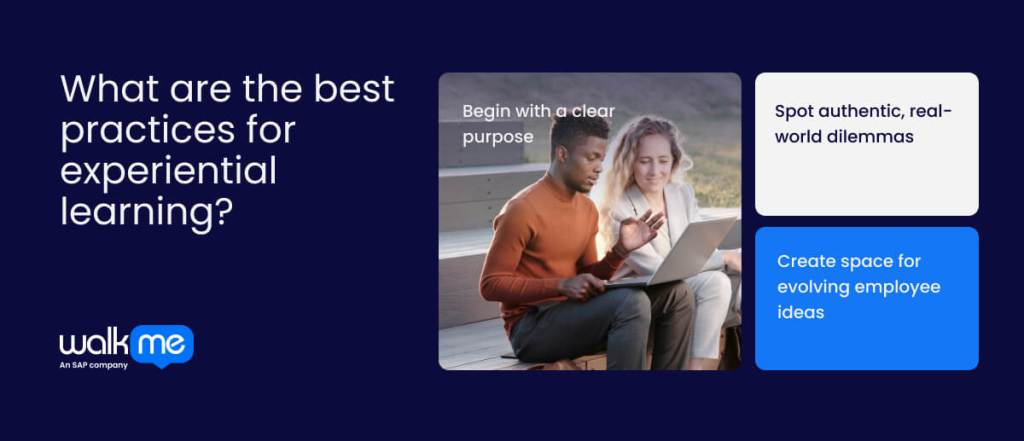
After implementing experiential learning, you’ll want to keep an eye on the habits that keep your efforts aligned with your day-one goals. Faltering here is easy, so this section clears up the best practices that help your approach stay focused and useful over time:
Begin with a clear purpose
Strong experience requires clear direction that everyone can understand. A clear purpose helps people recognize what the activity aims to strengthen, whether it’s judgment, creativity, or confidence.
When the goal is obvious, participants tune in faster and stay engaged because they know what they’re building toward. It also helps mentors or managers give more grounded guidance, since everyone is pulling toward the same destination rather than guessing what matters.
Spot authentic, real-world dilemmas
Meaningful growth often comes from tackling situations that feel messy, uncertain, or slightly uncomfortable. Real dilemmas reveal how people think when the outcome isn’t handed to them, which makes the learning more concrete.
Choosing relatable challenges allows you to explore different approaches without getting lost. These moments also spark natural discussion, because people can easily compare what they tried and what they noticed, turning a single task into a source of insight.
Create space for evolving employee ideas
Ideas can develop slowly when people feel rushed or judged. A steady space encourages learners to talk through their thoughts and test new angles as they go.
Allowing room for exploration also shows respect for different working styles, giving quieter thinkers as much influence as fast decision-makers. A steady rhythm of sharing and adjusting helps people trust their instincts and feel more confident experimenting with unfamiliar tasks or viewpoints.
Bringing experiential learning into everyday business practice
As with other interactive eLearning methods, experiential learning is turning employee training on its head and providing innovative ways to gather and share knowledge.
However, most businesses overlook the need for structured plans that feed directly into existing L&D initiatives. Taking a siloed approach to experiential learning defeats the objective; therefore, taking a holistic view of your organization’s training needs is essential.
The information gleaned should directly inform your implementation strategy. This means deciding how knowledge is transferred and shared between colleagues and ensuring that oversight is maintained and controlled.
Results from the first round of experiential training should inform the next and so on. This way, a cycle of innovative learning is built around tried-and-tested methods that deliver real results.
Don’t waste time by rushing into new activities without first understanding how each one strengthens the skills people rely on. Keeping every exercise purposeful rather than built for novelty helps the entire program grow in a way that feels intentional and easy for people to trust.
FAQs
Confidence is said to grow when people handle tasks in conditions that feel close to their real workload. Guided steps help them understand what to expect and how to respond when things inevitably change. Each attempt builds familiarity, and that familiarity turns into assurance because they’ve already tested themselves in situations that matter.
Experiential learning is well-suited to distributed teams when activities are built around digital workflows. Screen recordings, shared walkthroughs, and live demonstrations give people the opportunity to observe, replicate, and adjust in real time. Remote teams also benefit from this structure because every exercise mirrors the tools and interactions they already use.
Technology creates space for hands-on practice without disrupting work. Interactive guides, sandbox environments, and automated prompts help employees test steps safely and revisit tricky tasks whenever they need a refresher. These tools make learning feel lighter and more accessible, especially when people juggle changing systems or unfamiliar processes.