
Corporate blended learning: Models, benefits & best practices

Businesses often juggle multiple training formats, including in-meeting training, eLearning modules, and live workshops, while trying to keep people productive. That tension between learning and applying it is familiar to anyone responsible for workforce capability.
Research indicates that approximately 53% of organizations already use blended learning in some form, combining in-person and digital elements in employee training courses.

Put simply, more than half of companies have moved beyond purely classroom or online training to incorporate methods that suit different people and contexts.
Even with good digital adoption, many workplaces still struggle to connect learning with everyday processes. Corporate blended learning addresses that need by combining different training models so employees can learn in ways that align with their tasks.
This article explores what corporate blended learning means in practice, the most effective models used by enterprises, and how combining digital, in-person, and on-the-job learning supports real skill application at work.
What is corporate blended learning?
Corporate blended learning is an approach to workplace training that intentionally combines in-person instruction with digital learning solutions within a single program. It includes live workshops, virtual classrooms, self-paced online modules, guided practice, and on-the-job training, all designed to work together rather than in isolation.
Delivery methods are selected based on the skill being developed, the role’s context, and how employees learn in the flow of work.
Unlike standalone interactive eLearning or classroom training, blended learning is designed as a cohesive experience with clear sequencing, shared objectives, and consistent measurement across all learning components.
Why is corporate blended learning important?
Corporate blended learning is important because corporate skills now change faster than formal training cycles can keep up with.
Roles often evolve mid-year, tools are updated at short notice, and teams are expected to adapt while continuing with responsibilities. Training that sits outside workflows struggles to reflect that reality.
Gartner recently reported that 70% of employees have not mastered the skills they need for their current roles. This means that most people are expected to perform tasks for which they have not been trained, often learning informally as they go. That creates uneven capacity, frustration, and avoidable risk for businesses.
Corporate blended learning addresses these issues by enabling learning across structured sessions, digital access, and practical application, without diverting people from their responsibilities. It also provides organizations with a means to develop skills while daily work and processes continue uninterrupted.
What is the difference between corporate blended learning and hybrid learning?
The two terms are often used interchangeably because they encompass both in-person and digital elements. The difference lies in intent, design, and training outcomes. One concerns how learning is coalesced, while the other focuses on participants’ locations during delivery. Let’s take a closer look:
| What’s being compared | Corporate blended learning | Hybrid learning |
| Learning style | Designed learning journey | Live session format |
| Skill growth | Skills built over time | Learning happens once |
| Planning | Stages planned in advance | No learning sequence |
| Format | Mix of formats by step | Same format for all |
| Progress tracking | Progress tracked across the program | Progress tracked per session |
| Focus | Focus on how learning fits together | Focus on where people join from |
Corporate blended learning
Corporate blended learning is designed as a single training journey that uses different formats at various points. Each element plays a distinct role: preparation, practice, reinforcement, and application. Learners progress through formats in a deliberate sequence, often at different times, with progress measured across the whole program rather than within a single session.
Hybrid learning
Hybrid learning refers to a delivery model in which participants attend the same training simultaneously from different locations and is sometimes referred to as hybrid work. Some participants are in a meeting room, while others join remotely. The learning experience itself is usually the same for everyone, with location being the main variable rather than structure or progression.
What are the key components of corporate blended learning?
Corporate blended learning is built from several distinct elements that work together to support skill development. Each component affects how people absorb information and apply what they’ve learned. Here are the key components of corporate blended learning:
- Instructor-led training (ILT): Provides guidance and shared understanding through live interaction by creating a safe space for discussion and feedback. ILT is used to introduce complex topics or support moments where human dialogue adds clarity.
- eLearning modules: Give employees controlled access to learning outside scheduled sessions, allowing them to revisit material, move at a comfortable pace, and fit learning around commitments. Digital modules support preparation, reinforcement, or follow-up rather than standing alone.
- Collaborative activities: Create opportunities for learners to exchange ideas and solve problems together. They help translate insights that formal instruction may not cover and strengthen understanding by connecting learning content to workplace realities.
- Mentoring and coaching: Supports development through guidance, reflection, and real-world application. These relationships help learners translate training into action, especially for soft skills such as behavioural traits.
What are the different models for corporate blended learning?
Corporate blended learning can take many forms, each shaped by how training is delivered and how learners engage with it. Understanding these models helps you accommodate specific skills, roles, and learning objectives, while aligning delivery methods with corporate learning and development. Here are the most popular models for corporate blended learning:
| Blended learning model | Best suited for |
| Flipped classroom model | Organizations with limited live training time that need discussion, judgment, or interpretation during sessions |
| Rotation model | Businesses onboarding new hires or moving employees into new roles with structured, repeatable training cycles |
| Individual rotation model | Enterprises with varied skill levels across similar roles that need personalised learning paths |
| Flex model | Fast-changing environments where teams need immediate access to evolving technical or product knowledge |
| A la carte model | Organizations offering optional development for specialists, cross-functional, or emerging skill areas |
| Enriched virtual model | Distributed or global businesses that need occasional in-person alignment without constant travel |
| Online driver model | Enterprises scaling consistent training across locations, time zones, or large workforces |
Flipped classroom model
The flipped classroom model reverses how time is used across learning activities. Core material is explored independently before live sessions. Employees already have prior knowledge, questions, and context. Classroom time is then reserved for discussion and applied exercises rather than presentation.
Rotation model
The rotation model moves learners through various formats on a fixed schedule. Sessions alternate between instruction, digital coursework, and hands-on tasks across a defined cycle.
The model builds momentum and predictability without locking learning into a single mode and is often used for employee onboarding or role transitions when exposure to multiple perspectives is essential.
Individual rotation model
The individual rotation model eliminates shared schedules with each learner following a personalized path based on needs, progress, or prior experience. Formats change, but timing and order differ between participants. Some may spend longer in sessions, while others move quickly into practice or digital work.
Flex model
The flex model places digital learning at the centre, with live support and learners in control of how they move through content, and facilitators step in to guide, review, or troubleshoot.
The structure exists, but it adapts to progress rather than enforcing a fixed schedule. The emphasis remains on responsiveness, learner autonomy, and human input rather than continuous instruction.
A la carte model
The a la carte model allows learners to select specific learning components in addition to their core responsibilities. Participation is optional rather than universal, with modules chosen based on role gaps or development goals. Learning sits alongside work instead of replacing scheduled time. It also supports continuous employee training while respecting autonomy and recognizing that not every worker needs the same instruction.
Enriched virtual model
The enriched virtual model blends remote learning with occasional in-person interaction. Most activity happens online, but physical sessions are scheduled at key moments. These touchpoints focus on alignment or complex discussion rather than content delivery. Enriched virtual models prioritize continuity across distance while preserving moments that strengthen trust and group cohesion.
Online driver model
The online driver model places digital delivery as the default rather than the supplement. Content, interaction, and assessment all happen online, with limited or no in-person elements. Live support exists, but learning is primarily self-directed and platform-based. This model prioritizes consistency, reach, and operational efficiency, with learning designed to function independently of physical presence.
What are the best practices for implementing corporate blended learning?
Corporate blended learning can be challenging to manage when there are many moving parts and limited familiarity with how components work together.
Best practices help structure complex decisions and make informed judgments from the start. Here are the best practices for implementing corporate blended learning:
- Set clear learning goals: Be specific about what participants should know or be able to do after training. Clear goals help people stay focused and help judge whether the training worked.
- Use the right delivery methods: Choose how learning is delivered based on the task at hand. Some topics need explanation, others need practice, meaning one method rarely works for everything.
- Encourage learner collaboration: Provide opportunities to talk, share views, and compare approaches. Learning often improves when people hear how others think through the same problem.
- Track progress regularly: check progress often and focus on key benchmarks. Small check-ins help spot confusion and reduce the chance of people falling behind unnoticed.
- Keep online and offline consistent: Use the same terms, examples, and instructions everywhere. When formats are disconnected, learners spend more time adapting than learning.
- Adapt content thoughtfully: Make changes based on how people use the material. Repeated confusion or drop-offs usually point to sections that need refining.
- Support different learning speeds: Allow flexibility in timing, pace, and brevity. People absorb information at different rates, and forcing the same pace can slow learning.
- Make content accessible everywhere: Ensure learning moments work on common devices and fit into short time windows. Easy access removes barriers before learning even begins.
- Mix tools and methods creatively: Use a small number of tools in purposeful ways. A clear structure matters more than adopting new technology.
- Reinforce learning across formats: Repeat ideas in different settings because seeing the same concept more than once helps it stay top of mind.
How to create your own corporate blended learning training program
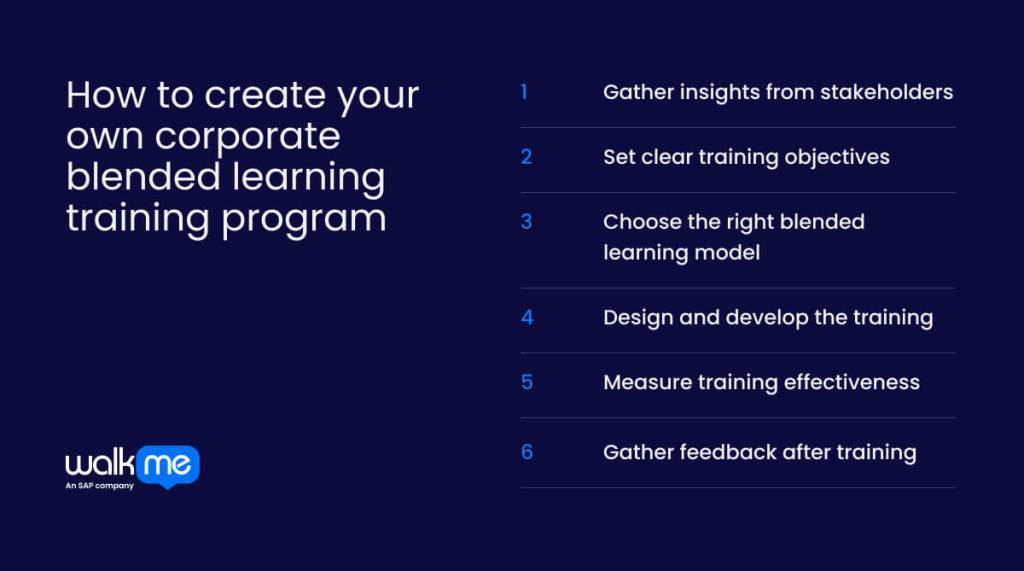
Creating a unique blended learning program is the best way to design training that aligns with your organization’s realities rather than forcing people into a preset structure. The steps below focus on making thoughtful choices that reflect the realities of learning, so the program feels built to last:
Gather insights from stakeholders
Before choosing tools or formats, consider how learning flows through the organization. Where does it stall? Who owns delivery? Blended learning exposes coordination gaps, so early stakeholder input helps prevent handoff issues among people, platforms, and facilitators.
Set clear training objectives
Objectives anchor blended programs when delivery often spans multiple formats. Without them, content expands in unclear directions. Transparent outcomes help determine what belongs in live sessions, what can stand alone, and what does not require formal training.
Choose the right blended learning model
Your model choice shapes everything that follows, so getting this right is a must. A structure that works for onboarding may fail for capability building. Consider scheduling limits, facilitator availability, and learner independence before settling on a model that sets expectations across the program.
Design and develop the training
Blended learning depends on timing and delivery as much as content. Decide when learners encounter information, when they practise, and when they revisit concepts. Thoughtful sequencing reduces overload and keeps formats united rather than competing for attention.
Measure training effectiveness
With multiple formats in play, effectiveness can appear uneven or be hard to interpret. One component may perform well while another drags engagement down. Reviewing patterns across sessions and platforms helps identify where the design needs adjustment rather than adding more content.
Gather feedback after training
Once learners return to their roles, you can gather feedback and restart the cycle.
What seemed clear during training may fall apart later or be forgotten. Post-training feedback highlights where transitions between formats worked and where blended elements felt disconnected or hard to apply.
Elevating enterprise performance with blended learning
As you’ve read, corporate blended learning is used by businesses that want to help their employees succeed in training.
Because we all learn in different ways, blending one or more formats allows training to adapt to roles, schedules, and experience levels without forcing everyone to follow the same path.
The ability to offer such variation is key, as the technology adoption curve ultimately reflects how quickly people understand, trust, and apply new tools in their day-to-day work.
One thing to take stock of is how blended learning integrates different training arrangements into a unified experience that supports understanding and use over time.
It’s a unique approach grounded in a simple truth that people learn more effectively when ideas are reinforced through multiple formats, giving them more opportunities to understand and apply what they’ve learned.
FAQs
Enterprises should look at how teams work, including schedules, locations, and access to facilitators. The right model fits naturally into existing routines, supports the skills being taught, and can be maintained without adding unnecessary complexity for learners or managers.
Scaling works best when core content stays consistent while delivery remains flexible. Shared materials, explicit standards, and simple tools help maintain quality, while local teams adjust timing or support to match their needs without changing the program’s intent.
Long-term impact shows up in behaviour over time. Look for fewer mistakes, faster task completion, and increased confidence in applying skills. Ongoing patterns matter more than single scores, as they reveal whether learning is being used effectively rather than merely checked off.