IT optimization: Definition, strategy and examples

IT optimization, also called technology optimization, is the practice of getting more value from an organization’s digital tools, services, infrastructure, and devices by cutting waste and improving performance.
An IT optimization strategy sets the outcome and timeline, evaluates current IT and business capabilities, then optimizes, streamlines, and moves suitable workloads to the cloud before measuring the impact. It is a practical step in digital transformation.
What is IT optimization?
IT Optimization is the strategic refinement of business processes to boost efficiency and effectiveness. By fine-tuning operations, streamlining processes, and minimizing resource use, businesses can gain a competitive edge, capitalize on strengths, and adapt to market changes.
Companies can execute IT optimization at any point. However, it typically happens when businesses undergo restructuring, such as mergers and acquisitions, evaluate assets, and optimize IT functions.
Your complete IT optimization strategy
A robust strategy is indispensable for the success of any IT optimization initiative. The aim is to make the process a one-time effort, and often the best way to do that is to establish Lean frameworks.
These systematic approaches, such as Kanban, Lean Six Sigma, and Scrum, prioritize efficiency by eliminating waste, improving processes, and fostering continuous improvement.
Once you have established your IT strategy, you can begin optimization with well-defined targets and the right tools.
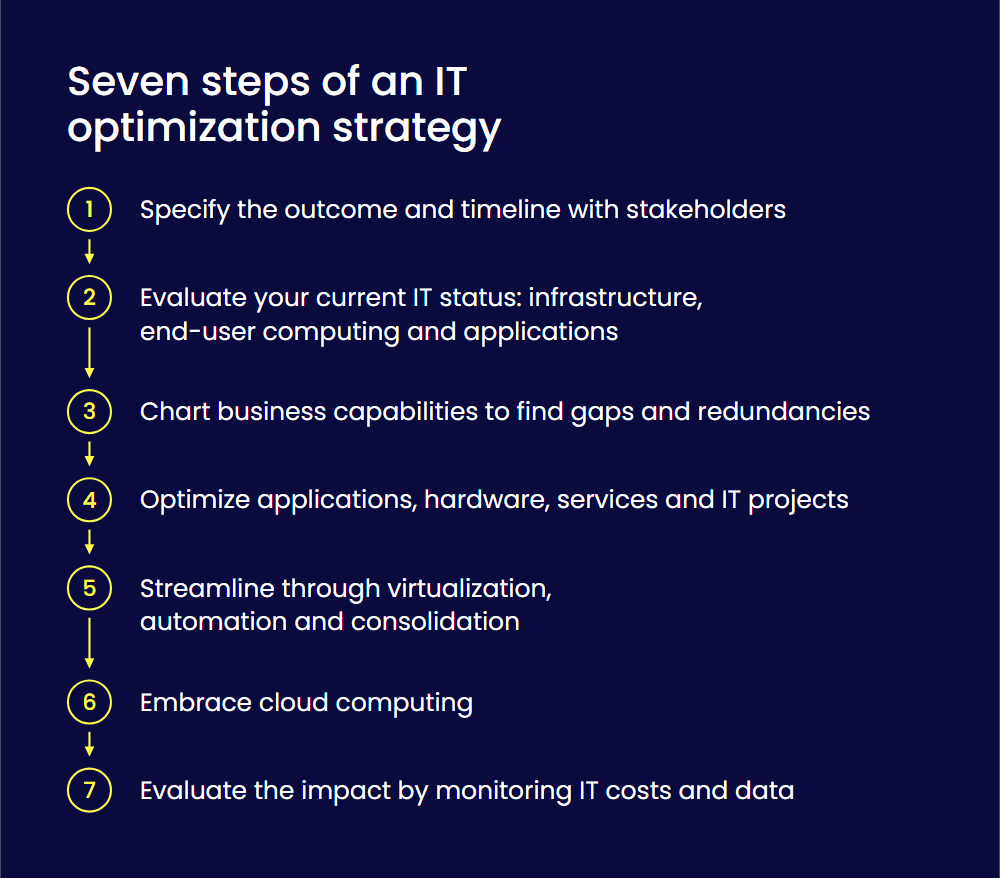
1. Specify the outcome and timeline
Before hands-on work begins, IT architects and strategists must define the desired outcome and project timeline for technology optimization.
This step involves collaborating with the relevant stakeholders to formulate a comprehensive plan.
This plan outlines the time and resources required to achieve successful IT optimization. During this phase, you identify your organization’s needs, encompassing processes, software upgrades, new technologies, and cloud migrations.
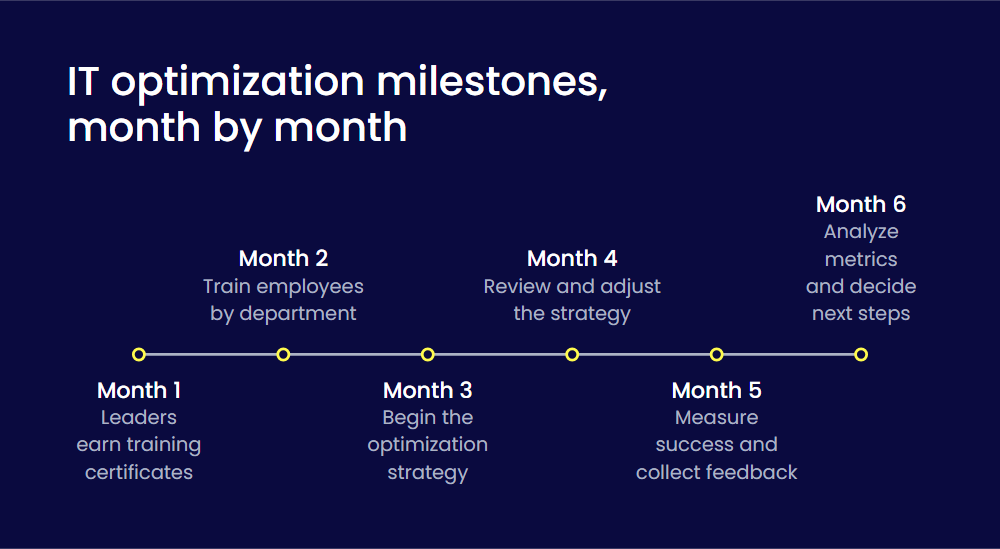
Incorporate monthly milestones as shown below:
- Month 1: All leaders must hold training certificates covering the IT optimization strategy and how to implement it.
- Month 2: Train employees on IT optimization with learning relevant to their department.
- Month 3: Begin the IT optimization strategy.
- Month 4: Review and adjust, continuing the IT optimization strategy.
- Month 5: Measure success, collect feedback, and continue the strategy.
- Month 6: Meet leaders and the IT department to analyze success metrics and decide the next steps.
2. Evaluate your current IT status
Assessing your current IT state is a pivotal part of IT optimization. IT assessments aim to identify gaps in current technology and highlight potential risks. Conduct comprehensive evaluations across all facets of the IT landscape.
Infrastructure
Every piece of hardware has a lifespan. Maintaining a checklist of company infrastructure, such as servers, networks, and storage, facilitates evaluating their value.
End-user computing
End-user computing includes printers, laptops, desktops, and smartphones. Given the rapid evolution of technology, many of these assets can quickly age or become obsolete/low-value.
Applications
Application inventory, especially Software as a Service (SaaS), has become integral to IT but can strain resources if not managed and accounted for effectively.
SaaS services are often procured without approval and remain unknown to the broader company. SaaS management platforms can help identify so-called shadow IT.
3. Chart business capabilities
Once you have established the IT state, the next phase involves mapping technology to business capabilities or processes.
The objective is to uncover gaps and redundancies, enhance value flow, and spotlight inefficiencies within business units.
Business capability maps offer IT experts a synopsis of their business and technology architecture. Through these maps, you can make informed decisions to optimize business units and align them with the envisioned future IT state.
4. Optimize
Subsequently, organizations should optimize their technology.
The optimization stage involves standardizing technology interfaces and portfolios, leading to system consolidation and a leaner, more cost-effective IT infrastructure.
Key areas for IT optimization include applications, hardware, services, and IT projects.
Optimize unused applications
By streamlining and rationalizing applications, organizations can enhance efficiency, reduce complexity, lower the total cost of ownership (TCO) of their application portfolio, and decrease software spending.
Application optimization through robust portfolio management practices identifies redundant, non-compliant, and shadow IT applications, laying the groundwork for further cost-saving initiatives.
Eliminate Unused IT Hardware
Removing unused or outdated hardware helps businesses avoid annual server fees and storage expenses.
Eliminating IT hardware is a straightforward way to cut costs and free up time to research and implement more cutting-edge, useful technology.
End-user hardware in workplaces, such as desktop computers, printers, landlines, servers, and data storage, can all be upgraded, eliminated, or optimized.
Removing irrelevant IT hardware, like a fax machine, frees up space for new systems with higher business value.
Eliminate or scale back services.
Large companies often rely on outsourcing, and shared services can quickly reduce costs. Access all service level agreements (SLA) to determine which IT services can be scaled back or temporarily eliminated.
Services include help desks, call centers, maintenance services, or contract workers.
SLA optimization involves auditing licenses, using cloud computing services with built-in cost-optimization tools, and shutting down or reducing usage on weekends, holidays, etc.
Optimize IT projects
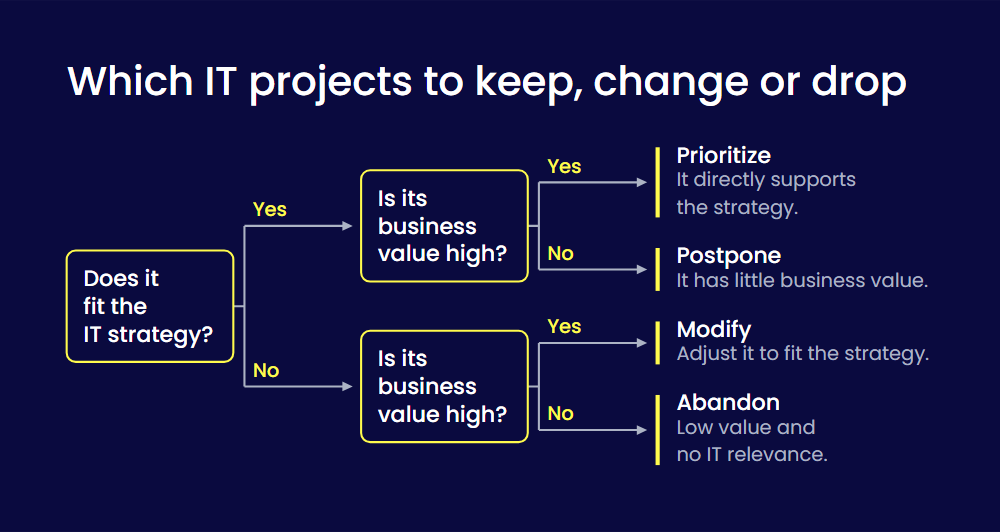
Eliminating, removing, or adjusting projects can save organizations significant resources. A business capability map helps identify which projects to prioritize or postpone based on their proposed value. Categorizing each project includes:
- High business value projects directly supporting the IT strategy.
- Increased business value projects do not directly comply with the IT strategy and require modification.
- Projects that comply with the IT strategy but have little business value can be postponed.
- Abandon projects with low business value and no IT relevance.
5. Streamline
Optimizing a company’s enterprise architecture efficiently establishes a lean portfolio and strengthens the organization’s overall business processes.
The application of three fundamental principles guides architecture optimization:
- Virtualization.
- Automation.
- Consolidation.
Virtualize
Making infrastructure more agile is crucial to IT optimization. Fine-tune infrastructure assets to meet current and future business growth. Examples of virtualization include:
- Eliminate redundant hardware by creating virtual desktop servers that operate on server pools accessible remotely.
- Enhance application services through grids that provide pools of application containers distributed across hardware servers.
- Improve business scalability at a lower cost by utilizing logical disk storage managers.
- Embrace Infrastructure-as-a-Service (IaaS) for automated IT system modernization.
Automate
Enterprise architecture and IT Asset Management (ITAM) facilitate the automation and modernization of all IT assets. Enterprise architecture aligns technology with business processes, creating solutions that align with business goals.
You can also use generative AI to optimize IT service via ChatBots, offering personalized responses and freeing customer support operators to focus on higher-level tasks.
Consolidate
Consolidating all data centers, applications, and systems is imperative for a robust IT infrastructure. Understanding resource allocation simplifies and improves system improvements, making them more effective.
6. Embrace Cloud Computing
By adopting cloud computing, businesses can access platforms, services, and tools from any internet-connected device.
Cloud computing services encompass:
- 1. Infrastructure-as-a-Service (IaaS)
- 2. Platform-as-a-Service (PaaS)
- 3. Software-as-a-Service (SaaS)
This eliminates the need for major spending on hardware and maintaining large IT teams. You can also save or redirect the financial resources to other business areas.
7. Evaluate the Impact
A comprehensive review is essential to assess the success of the implemented technology optimization strategy. Consistently revisiting changes and monitoring IT costs and data allows for ongoing evaluation.
This process helps determine the strategy’s effectiveness in targeted areas and identify areas that may require future adjustments.
If the optimization efforts prove successful, large-scale optimizations may not be necessary, as the IT infrastructure should now operate more efficiently than before.
What are some examples of successful IT optimization strategies?
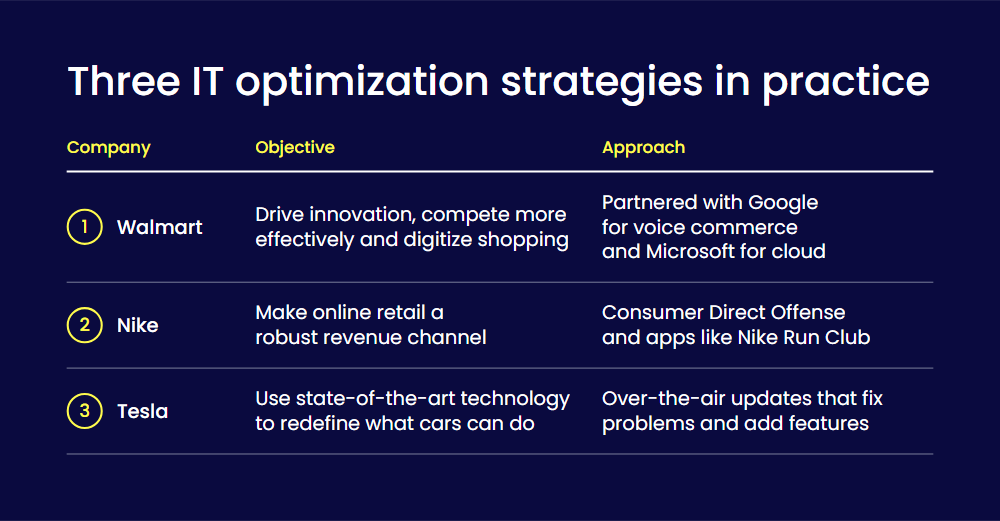
Examples of successful IT optimization strategies show what optimization looks like in practice and how different approaches work in various industries.
Walmart
Walmart offers the first example of a successful IT optimization strategy.
Background
Walmart, a retail behemoth keenly attuned to market dynamics and the pivotal role of technology in business, recognized the imperative to reshape customer interactions with the brand.
With extensive resources, the company began an IT optimization journey, targeting customer-facing and back-office operations.
Objective
Drive innovation, compete more effectively, and digitize the shopping experience.
Approach
The challenge of integrating technology into business operations unfolded on dual fronts. Walmart sought to enhance customer services while overhauling internal management and administrative processes.
As part of its strategic expansion, the company forged partnerships with industry leaders, including Google for voice-enabled commerce and Microsoft for cloud computing.
Nike
The second example of IT optimization comes from the famous clothing manufacturer Nike.
Background
Nike, a prominent apparel manufacturer, prioritizes innovation and customer experience, aligning with its core mission and digital transformation strategy. When the pandemic forced nearly all its stores to close in 2020, Nike accelerated its focus on e-commerce, and digital sales rose 75% for the quarter.
Objective
Enhance the e-commerce strategy to establish online retail as a robust revenue channel.
Approach
In June 2017, Nike unveiled the Consumer Direct Offense, a new company formation built to serve consumers faster and more personally, at scale. One of its goals was 2X Direct: strengthening direct connections with consumers through digital, membership, and personalization.
The brand developed an ecosystem to amplify the significance of Nike’s digital channels, exemplified by apps like Nike Run Club and Nike Training Club.
These apps offer training programs and foster a sense of community, turning Nike into a lifestyle brand that promotes health and excellence in sportswear.
Tesla
The following example comes from the innovative electric car manufacturer Tesla.
Background
From its inception, Tesla strategically leveraged technology to distinguish itself in the business landscape.
Positioned as a trailblazer, Tesla deviated from conventional industry norms, embracing transformative and innovative concepts.
The company offers its audience an array of impressive advantages: Tesla cars epitomize innovation, environmental consciousness, future readiness, and effortless maintenance.
The key to Tesla’s remarkable success lies in its adept use of IT optimization for its cutting-edge technology.
Objective
Utilize state-of-the-art technologies to redefine perceptions of cars and their functionalities.
Approach
All Tesla vehicles can download software to update their digital control systems, and Tesla has routinely used over-the-air updates to tweak onboard technology.
The same updates can fix safety problems without a dealer visit. When Tesla recalled nearly 300,000 Model 3 and Model Y vehicles sold in China over a driver assistance glitch, it planned to remotely download new software to fix the problem.
Over-the-air updates can also send new features to vehicles, much as smartphone makers add new apps and functions.
What are the opportunities for IT optimization?
Consider the best opportunities for IT optimization to minimize costs, such as those in the list below.
Applications
Applications encompass all in-house and third-party software the business employs for diverse functions. Rationalizing and modernizing these applications is crucial for IT cost savings.
Services
Services involve activities delivering IT services to the organization. Scaling down services during low usage optimizes resource allocation and enhances efficiency.
Infrastructure
Infrastructure, including servers, networks, and storage, represents the hardware needed for business activities. Optimization involves upgrading and replacing old hardware with newer versions to improve performance.
End-user computing
End-user computing involves all systems utilized by employees. These systems are identified and optimized through careful analysis or upgrades, enhancing overall efficiency and user experience.
What are the benefits of IT optimization?
Numerous advantages come with IT optimization.
Strategic IT optimization and management enable organizations to align with growing business demands. This technological enhancement supports core business success, lowers costs, speeds up or automates processes, and boosts productivity.
IT optimization is crucial for organizations, irrespective of size or growth stage.
Here are the benefits:
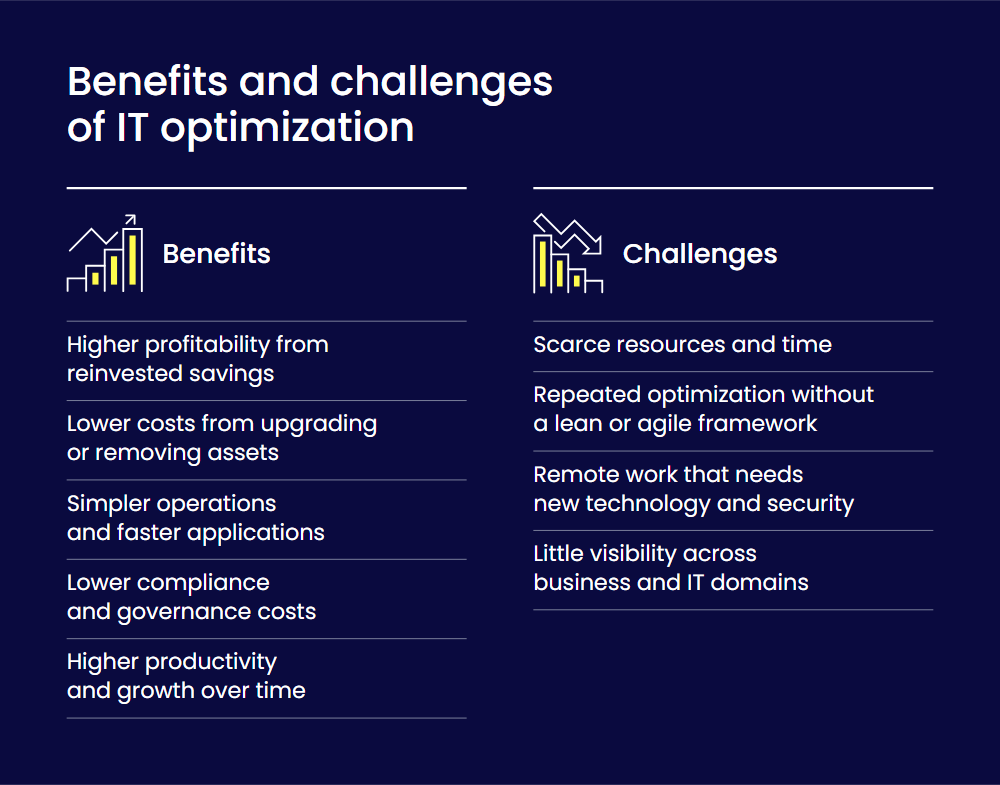
Enhance profitability
By reinvesting savings from IT optimization, businesses can improve development and service delivery and gradually increase profitability.
Cost reduction
After analyzing the current IT landscape, businesses can upgrade, modify, or eliminate assets, reducing unnecessary costs and delivering long-term savings.
Simplify operations
Streamlining IT processes is a crucial advantage of optimization. This simplification results in faster-running applications, increased agility, and an enhanced user experience.
Automating business processes effectively reduces complexity and frees up valuable time.
Cut compliance and governance expenses
Aligning the company’s technology strategy with its business goals is vital. IT optimization supports contract negotiations and the removal of low-value tools, keeping governance costs to a minimum.
Enhance productivity and facilitate growth
IT optimization aims to boost productivity and foster growth over time. Process automation, simplified internal operations, and overall cost reduction contribute significantly to achieving these goals.
What are the challenges of IT optimization?
IT optimization faces several challenges, including resource scarcity, heavy workloads, the surge in remote work, and insufficient visibility across IT domains.
Organizations may not recognize the importance of optimizing their IT infrastructure unless they adopt lean or agile principles to streamline processes.
Here are the challenges:
Scarcity of resources and time
A primary challenge in IT optimization is limited resources and time.
Successfully implementing an optimization strategy requires effort and time, but it is an investment in the business’s overall growth and success, strengthening its foundation.
Repetitive optimization
Organizations operating outside a lean or agile framework often use similar optimization efforts.
With a well-defined plan and targeted actions, comprehensive optimization becomes a periodic necessity, occurring only every few years.
Surge in remote work
The growing prevalence of remote work challenges organizations to streamline business activities and improve productivity.
Employees working outside the office necessitate new technology, security measures, and efficient operation applications, prompting extensive optimization measures.
Analytics and data management
Organizations lacking transparency across business and IT domains struggle to optimize their systems.
Before defining a technology roadmap, a thorough IT assessment is essential to identify the current state before you attempt to improve efficiency.
Transform your IT landscape today for long-term sustainability
Businesses should proactively adopt optimization strategies to improve agility, cost-effectiveness, and responsiveness. IT optimization success depends on a multifaceted approach aligned with organizational goals. Specifying outcomes, collaborating with stakeholders, and adopting lean frameworks create an environment where IT fuels business growth.
Understanding the importance of well-defined targets, appropriate toolsets, and collaborative planning helps organizations extract maximum value from IT investments.
Our examples, from cloud cost management to virtualization, illustrate the approach’s versatility. Businesses can elevate their IT performance by integrating these strategies into overarching plans.
As technology evolves, proactive adoption of IT optimization strategies is not only a best practice but a business imperative. The journey toward IT optimization is a continuous cycle of refinement, adaptation, and innovation, offering enterprises a resilient pathway to sustained success.