
Business transformation frameworks: A complete guide

Staying competitive requires more than a new management style or small tweaks to supply chain collaboration.
A real transformation demands digital adoption, a substantive organizational change, and cultural alignment. Success also depends on big shifts in processes, governance, the operating model, and everyday behaviors.
A business transformation framework provides a clear roadmap for this journey. The framework breaks change into manageable steps and adds rigor at each stage.
The result is a new operating model that touches every part of the business. Day-to-day work stays aligned, so the change holds and becomes business as usual.
This article explains the essentials. We cover what a business transformation framework is, why it matters, and its core components. You will also learn about the main types available, how to implement one, and how to choose the right fit for your company.
What is a business transformation framework?
A business transformation framework is a structured plan for the various types of organizational change. It guides strategy and execution to ensure they match long-term goals.
Organizations use this tool to handle complex projects while supporting growth and competitiveness. The framework provides a repeatable process for managing change, which builds the organization’s ability to handle future challenges.
A defined plan also improves communication across the company. It creates a shared understanding that encourages collaboration and buy-in from every team member. The organization becomes more agile because the framework encourages a culture of continuous improvement.
Leaders also use the framework for better resource management. They can identify the necessary time, budget, and investments early in the process. This careful planning significantly reduces risk. A clear roadmap ensures that all efforts stay focused on the strategic vision rather than relying on fragmented, short-term fixes.
Why is a business transformation framework important?
Understanding the value of a business transformation framework helps your company succeed. It allows you to align your team, improve efficiency, and reduce risks.
It also guides significant changes, such as technology upgrades. This ensures that they are part of a better strategy rather than just quick fixes.
Here are the reasons why it is important:
- Improves cross-functional teamwork: Departments often work in silos, which slows progress. These types of frameworks unite teams around shared goals. Everyone understands their specific role in the bigger picture.
- Reduces risk: Big changes often fail without a plan. Leaders use a business transformation framework to manage uncertainty. Teams can then spot problems early and fix them before they cause damage.
- Keeps transformation efforts in line with strategy: Organizations must make changes for a reason, not just to use new technology. A business transformation framework can connect every project to business goals. Resources are then allocated to the most critical tasks.
- Enhances resource allocation: Your business can waste money on scattered projects. This type of framework helps leaders prioritize budgets and people. They can direct tools and talent to the right areas.
- Allows progress tracking and accountability: Clear metrics show whether the transformation is working. Leaders use this data to measure results, hold teams accountable, and adjust plans when necessary.
What are the components of a business transformation framework?
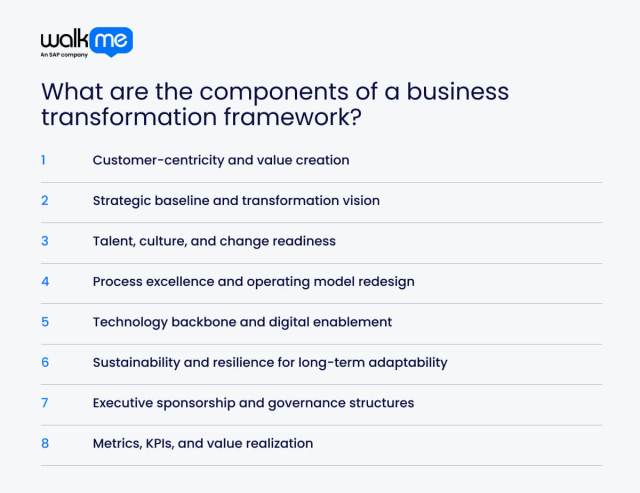
Understanding the various parts of a business transformation framework lets you break a project into smaller phases.
This allows your organization to assign resources more effectively and identify risks before they occur. It also provides your company with a decisive advantage over competitors. These are the components of this type of framework you need to understand:
Customer-centricity and value creation
Customer-centricity means you shape your organization around the customer. You align your processes and culture to meet their needs. This approach creates value for them, which drives success for your company.
You need to understand customer pain points and desires. This type of knowledge helps you improve products, services, and experiences. Teams can use data to make better decisions and build strong relationships. The goal goes beyond just making a sale. You aim for a win-win outcome in which customers achieve their goals and the business gains loyalty.
Strategic baseline and transformation vision
The strategic baseline acts as your starting point. It assesses current performance across people, processes, and technology. You use this data to find inefficiencies and measure future success. A strong baseline ensures everyone agrees on the facts and helps teams set realistic goals.
Your business can use a transformation vision to define your future destination. It explains why the company must change and aligns everyone around a shared purpose. Leaders use this vision to inspire employees and guide resource allocation. It establishes a clear model for how the business should function.
In other words, the baseline shows where you are now, while the vision clarifies where you are going. The gap between them shapes your entire transformation plan.
Talent, culture, and change readiness
Talent management aligns workforce skills with new business goals. Leaders identify future needs and fill gaps through hiring or upskilling current employees. Updated performance metrics and succession planning ensure the right people drive the transformation.
Next, culture serves as the glue that holds the transformation together. Values must support the new strategy to prevent failure. Executives model desired behaviors to build employee morale, while psychological safety encourages employees to speak up.
Change readiness measures the organization’s ability to adapt. Assessments spot resistance early, while clear communication explains the ‘why’ to reduce anxiety. Providing the right training tools, such as enterprise learning management systems, keeps the company agile.
Process excellence and operating model redesign
Process excellence involves the continuous improvement of work to improve customer value. Operating model redesign requires a strategic rethink of how an organization is structured and how it delivers value.
These two concepts form the core of a business transformation framework. Process excellence provides the how by guiding daily improvements. Operating model redesign defines the what by setting the structure.
Together, they support the why by helping the business align people, processes, and technology with its strategy. This type of alignment leads to better performance.
Technology backbone and digital enablement
The technology backbone underpins a company’s digital operations. This infrastructure connects a cloud ERP system and CRM to share data. Standardized processes automate tasks, while secure networks analyze real-time data to support better decision-making.
Digital enablement ensures teams use this technology well. It aims to align tech investments with business goals and equips employees with the necessary skills. Companies can empower staff through SAP software training and support. Effective change management guides the culture through these shifts.
Sustainability and resilience for long-term adaptability
Sustainability and resilience are vital to any business transformation framework. This type of approach integrates environmental, social, and governance (ESG) factors directly into your strategy. Companies use this method to build the strength needed to succeed in an uncertain world.
Executive sponsorship and governance structures
The executive sponsor acts as the senior leader who champions the transformation. This type of sponsor sets the vision, secures resources, and drives accountability. They also make decisions to resolve conflicts.
Governance processes provide the rules and processes that guide this work. These structures define roles so everyone understands who makes specific decisions. It establishes processes for identifying and solving problems and sets performance goals. Strong governance also keeps the project aligned with business goals and prevents unnecessary scope expansion.
Metrics, KPIs, and value realization
Metrics and key performance indicators (KPIs) can measure the progress of your transformation. Your company realizes the value of a framework when these changes deliver the intended business benefits. All these elements ensure initiatives stay on track and enable leaders to make data-driven decisions. This component can ensure that they achieve their desired return on investment.
What are the different types of business transformation frameworks?
Understanding different business transformation frameworks is vital, as it provides companies with a clear plan for handling complex changes.
By knowing these options, leaders can pick the best method for their specific goals. This helps them overcome challenges and stay on track with their strategy. Below are the different types of frameworks you need to know:
Operational transformation frameworks
An operational business transformation framework is a step-by-step guide for changing how a company works. It helps organizations update their core processes and systems to run more effectively, adapt to market changes, and achieve their goals.
This framework is also essential because it removes outdated, wasteful habits, making the company stronger. These are the types of operational frameworks you need to know:
| Framework | Focus | Best For | Complexity |
| Business Process Reengineering (BPR) | Radical redesign of core processes | Achieving major performance breakthroughs | High |
| Lean Six Sigma | Waste elimination and defect reduction | Efficiency, quality, and cost reduction | Medium |
| End-to-End (E2E) Operating Model | Value-chain-wide process redesign | Customer-centric operating models | High |
Business process reengineering (BPR)
Business process reengineering (BPR) offers a strategic approach to rethinking how a company operates. Organizations use this method to achieve bigger gains in performance, quality, cost, and speed. BPR calls for a full redesign of core processes instead of minor tweaks.
A straightforward, step-by-step approach guides BPR. Teams first identify the processes that need redesign. Leaders then analyze how these processes work today while employees reimagine better ways to do the work and design the new processes. Companies implement the changes, monitor results, and continue to improve.
Lean Six Sigma
The Lean Six Sigma framework combines two powerful methods. The first is lean, which focuses on removing waste and speeding up workflows. Then, Six Sigma targets defects and reduces variation.
This approach uses data and a structured plan called DMAIC (define, measure, analyze, improve, control). Teams can use this system to improve processes, cut costs, and make customers happier.
End-to-end (E2E) operating model transformation
An end-to-end (E2E) operating model transformation framework helps businesses redesign their entire value chain. This process covers everything from a customer’s initial need to the final delivery and feedback.
This approach aligns internal processes with a customer-first mindset. Companies often integrate digital technologies to improve the customer experience and create a more agile organization.
Strategic transformation frameworks
A strategic business transformation framework is a clear plan that connects a company’s big goals with the actions needed to reach them. This structure is vital because it helps organizations adapt quickly to market shifts and changing customer needs.
By targeting specific areas for improvement, this type of framework improves revenue, lowers costs, and increases employee productivity. It also manages the complexity of change by ensuring that leaders and teams share a common understanding and direction. Here are some types of strategic transformation frameworks you could adopt:
| Framework | Focus | Best For | Complexity |
| Balanced Scorecard | Performance measurement across financial, customer, internal, and learning perspectives | Aligning execution with long-term strategy | Medium |
| TOGAF | Business–IT architecture alignment | Large enterprises with complex IT landscapes | High |
| Porter’s Five Forces | Industry and competitive analysis | Assessing market position and competitive pressure | Low |
Balanced scorecard
The balanced scorecard (BSC) framework measures performance through four key perspectives. These include financial, customer, internal processes, learning, and growth. Leaders use this method to turn their vision and strategy into clear objectives, initiatives, and targets.
This type of process guides transformation by aligning all activities with long-term goals. The approach balances financial data with non-financial metrics to provide a complete view of performance.
TOGAF (The Open Group Architecture Framework)
TOGAF (The Open Group Architecture Framework) provides a structured approach to designing, planning, and managing a company’s IT architecture. This approach aligns technology with business goals.
Organizations use TOGAF to improve efficiency through a set of standard tools, principles, and processes. The architecture development method (ADM) sits at the core of the framework.
Porter’s Five Forces Famework
Companies can use Porter’s five forces framework to assess their competitiveness and determine whether an industry is attractive. The model assesses profitability by examining five specific areas.
These include competitive rivalry, the threat of new entrants, supplier power, buyer power, and the threat of substitutes. Leaders use these insights to make better decisions and position their companies for higher profits.
Organizational/cultural transformation frameworks
An organizational or cultural transformation framework is a plan for changing how a company works. It shifts the company’s strategy and culture to meet new goals. This might mean improving results, adapting to the market, or planning for the long term.
These frameworks are important because they help companies manage external pressures, such as new technologies or changing customer needs. Let’s dive into examples of these frameworks:
| Framework | Focus | Best For | Complexity |
| ADKAR Model | Individual change adoption | Driving employee-level change | Low |
| Kotter’s 8-Step Model | Structured change leadership | Overcoming resistance to change | Medium |
| Five Cs Framework | Leadership, communication, and culture | Internal alignment and engagement | Low |
ADKAR model
The ADKAR model serves as a five-step framework that guides individuals through change. It focuses on awareness, desire, knowledge, ability, and reinforcement.
The model emphasizes that organizational success depends on each person navigating these stages. Employers can use this structured approach to manage the human side of business change, from the first announcement to long-term results.
Kotter’s 8-step change model
Kotter’s 8-step change model provides a framework for leading successful enterprise transformation. The steps include creating urgency, building a guiding team, forming a vision, and rallying volunteers.
Leaders then remove barriers to action, generate short-term wins, sustain momentum, and make the changes permanent. This sequential approach guides businesses through complex transitions.
Five C’s framework
The Five C’s business transformation framework appears in two main versions. One version guides strategic marketing, while the other focuses on change management.
The change management version focuses on internal elements that drive a successful transformation. This approach highlights committed leadership, clear purpose, communication, culture, and capabilities.
Hybrid/cross-functional frameworks
A hybrid business transformation framework combines methods like Agile, Lean, and Waterfall. This approach unites teams from IT, marketing, and HR to work toward a shared goal. Organizations use it to navigate complex changes more effectively than single-method strategies allow.
This framework breaks down departmental barriers and provides a complete view of the process. Companies can mix rigorous planning with quick adjustments to fit specific needs. This balance helps them manage risk while responding fast to market shifts. Here are some examples of this approach you need to know:
| Framework | Focus | Best For | Complexity |
| McKinsey 7-S | Alignment of strategy, structure, systems, and culture | Holistic organizational alignment | Medium |
| MIT Digital Transformation | Digital strategy across customers, operations, and business models | Enterprise-wide digital transformation | Medium |
McKinsey 7-S framework
The McKinsey 7-S model is one of the change management models that analyzes seven interconnected parts of an organization. The model emphasizes that success depends on aligning hard elements such as strategy, structure, and systems. These go with soft elements, including shared values, skills, style, and staff.
It highlights that a change in one area creates a ripple effect across the others. This insight makes the framework a powerful tool for building a balanced and high-performing organization.
MIT digital transformation framework
The MIT digital transformation framework helps organizations improve in three main areas: customer experience, operational processes, and business models. Companies must link technology investments to business goals instead of buying tech just to have it.
The framework treats transformation as a way to build new skills. These skills improve the customer journey. They also make internal operations faster using real-time data and automation.
How to implement a business transformation framework
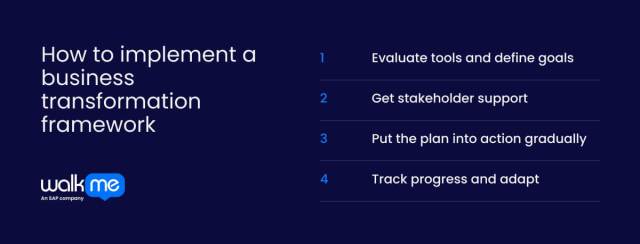
Business transformation succeeds more often when you follow a clear framework. The right steps ensure that everyone aligns with the company’s vision. This alignment guides ongoing improvements and helps companies adapt to market changes.
Here are the steps you need to put a business transformation framework in place:
- Evaluate tools and define goals
Companies start by reviewing issues with their current tools to identify gaps. You then define the future state of the business and what success looks like. Strategic objectives break the transformation down into specific goals, such as better efficiency. The SMART criteria make these goals clear and measurable. Alignment with the overall strategy ensures these goals create real impact. You must involve all stakeholders in this process to guarantee their support.
- Get stakeholder support
Successful transformation relies on strong support from your team. You can achieve this through four key actions. First, list all stakeholders and prioritize them by their influence. Then, your business should share updates openly and address concerns quickly. Stakeholders support projects more when they help make decisions. You build trust by keeping promises and maintaining open dialogue.
- Put the plan into action gradually
Organizations should start with small pilot programs as part of a change control process. You need to focus on high-impact areas and use data to measure success. A detailed roadmap breaks the plan into small steps and assigns specific roles to each. Management needs to set concrete goals, such as reducing data entry, rather than vague wishes. You should align these goals with the strategy and track progress using key performance indicators.
- Track progress and adapt
Successful transformation requires clear goals and simple routines. You should define key performance indicators (KPIs) that match your business objectives. These metrics track finance, customer satisfaction, and efficiency.
Regular reviews of this data help you monitor performance. Employee feedback helps you understand what works and what fails. Adaptability starts with an agile mindset, as a flexible framework works better than a rigid plan. You can test strategies using SAP testing tools first to fix mistakes before a full rollout.
Choosing the right business transformation framework
A good framework provides a clear plan for managing change and connects daily work to business goals. This approach increases the chance of a lasting, positive result.
Your business can also benefit from the right framework, as it prevents scattered or short-term efforts. It ensures that changes remain complete and repeatable. Your organization becomes more agile and ready for future shifts.
Here’s what you need to take into account when making that choice:
- Know your current capabilities and transformation gaps: Your company needs to understand its current strengths and weaknesses before any change. A gap analysis shows where the business needs the most work. This clarity helps you choose a framework that addresses real problems.
- Be clear about your transformation objectives and required outcomes: Leaders must define specific, measurable goals. This is done so they know exactly what success looks like before the work begins. Clear outcomes guide every decision and keep the team focused on the result.
- Ensure your framework selection aligns with your culture: A framework must reflect your company culture. A system that fights against your team’s habits will likely fail. The best choice fits naturally with how your people already operate.
- Adopt established frameworks before building your own approach: Use proven methods first, as they offer safety and best practices. Customization can happen later, after the team understands the basics.
- Test any framework with a pilot before committing: A pilot test significantly reduces risk. You can try the framework in a small business area first to see how it works. This trial reveals issues before the full rollout and saves money in the long run.
Pivot to your desired future state with a business transformation framework
A business transformation framework connects strategy to action. It uses clear rules, measurements, and training to help companies stay competitive. This system embeds improvement into daily work, helping leaders make better decisions.
You can avoid common mistakes, like rushing without a plan or ignoring employee feedback. Your action plan starts with setting clear goals. A dedicated team leads the effort, tracks progress, and launches a test project. Once the test works, you can expand the plan to the rest of the company. This method turns change into lasting future success.
FAQs
Business transformation has four main pillars: technology, processes, people, and data. These pillars help a company change. Technology updates the systems. Processes make the work easier. People are trained and supported. Data is used to guide decisions with clear insights.
A business transformation framework is a step-by-step approach to managing significant changes so teams work faster, serve customers better, and adapt more quickly. It keeps efforts aligned with company goals, improves how resources are used, and makes performance easier to track, leading to steady growth. It also supports the people side of change with clear communication and guidance, so employees feel included and positive.
The biggest challenges in business transformation are employee resistance to change, unclear leadership and strategy, and not enough resources or budget. Other common hurdles include poor communication, difficulty handling complex projects, and trouble measuring results or proving ROI.