
Self-paced learning: Benefits, examples & implementation

The remote and hybrid workforce has created new training challenges as your teams live across different time zones. Traditional training schedules don’t fit everyone’s calendar anymore.
Self-paced learning provides a solution as it allows employees to learn whenever and wherever works best for them. This flexibility supports faster digital adoption since employees can master new tools when they’re ready to focus.
Instead of sitting through mandatory team training sessions at fixed times, employees can access courses when their schedule allows. This type of learning also lets employees create their personalized skills-based journey.
In this article, we’ll explore what self-paced learning is, why it matters, how to implement it effectively, and how it compares to traditional instructor-led training.
What is self-paced learning?
Self-paced learning is a form of corporate e-learning in which individuals progress through training materials at their own speed. Learners choose when and where to engage with content, without relying on a fixed schedule or live instruction. The approach typically uses digital resources, such as videos, interactive modules, and quizzes, available on demand.
Because there is no set pace, learners can spend more time on challenging topics and move quickly through material they already understand. This model is often used in organizations with distributed teams or varied work schedules, as it allows training to occur alongside daily responsibilities.
From an organizational perspective, self-paced learning can reduce the need for travel, classrooms, and repeated live sessions. It also supports consistent delivery of training content and is commonly used for onboarding, compliance, and skill development programs where flexibility and standardization are priorities.
Why is self-paced learning important?
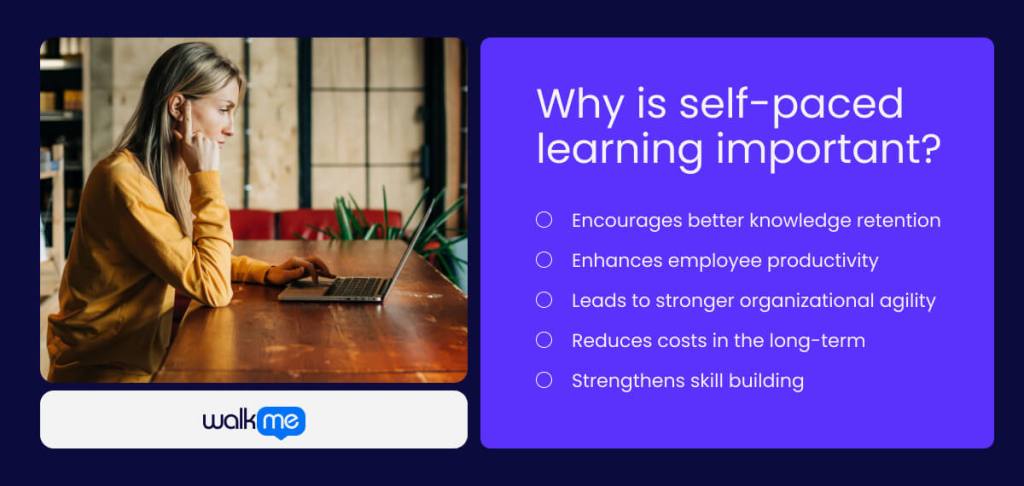
Understanding self-paced learning helps your employees get the most out of it. It offers flexibility, lowers stress, and helps you remember what you learn. When your company sees its value, you can take control of your learning rollout. This approach allows your employees become motivated, lifelong learners.
Here are the reasons why self-paced learning is vital:
- Encourages better knowledge retention: People remember more when they set their own speed. They can stop and review hard topics whenever they need to. This type of method removes barriers to learning.
- Enhances employee productivity: Your staff can learn during their workday without stopping their main tasks. They pick the best times to study based on their energy. This freedom allows them to continue their day-to-day tasks while they still learn new things.
- Leads to stronger organizational agility: Businesses react faster to changes when teams learn quickly. Companies can launch new training without worrying about schedules. Employees pick up new skills exactly when the company needs them.
- Reduces costs in the long-term: Your company saves money because digital lessons can be rolled out without extra fees. The company also avoids losing money since any training can fit into an employee’s regular day.
- Strengthens skill building: Your workers can focus only on the skills they need for their jobs. They can skip what they already know and spend more time on hard topics. This contextual learning method helps them become experts and feel more confident.
What is the difference between self-paced and instructor-led learning
It is essential to know the difference between learning on your own and learning with a teacher. This helps you pick the best method for your schedule and goals.
Employees might need the structure of a live class. But others prefer the freedom to study at their own pace. Choosing the right path helps your business succeed and avoids frustration.
Let’s compare the differences between self-paced and instructor-led learning:
| Factor | Self-Paced Learning | Instructor-Led Learning |
| Interaction | Low — primarily individual study | High — live discussion and group interaction |
| Flexibility | High — learn anytime and from any location | Low — fixed schedule and set location |
| Scalability | High — can support large or unlimited audiences | Limited — constrained by class size |
| Cost | Lower over time with no travel or instructor fees | Higher due to venues, travel, and facilitation costs |
| Feedback | Delayed — mainly through automated quizzes | Immediate — questions answered in real time |
| Pace | Controlled by the learner | Controlled by the instructor |
| Accountability | Requires self-discipline | Supported by instructor oversight |
Examples of self-paced learning in the workplace
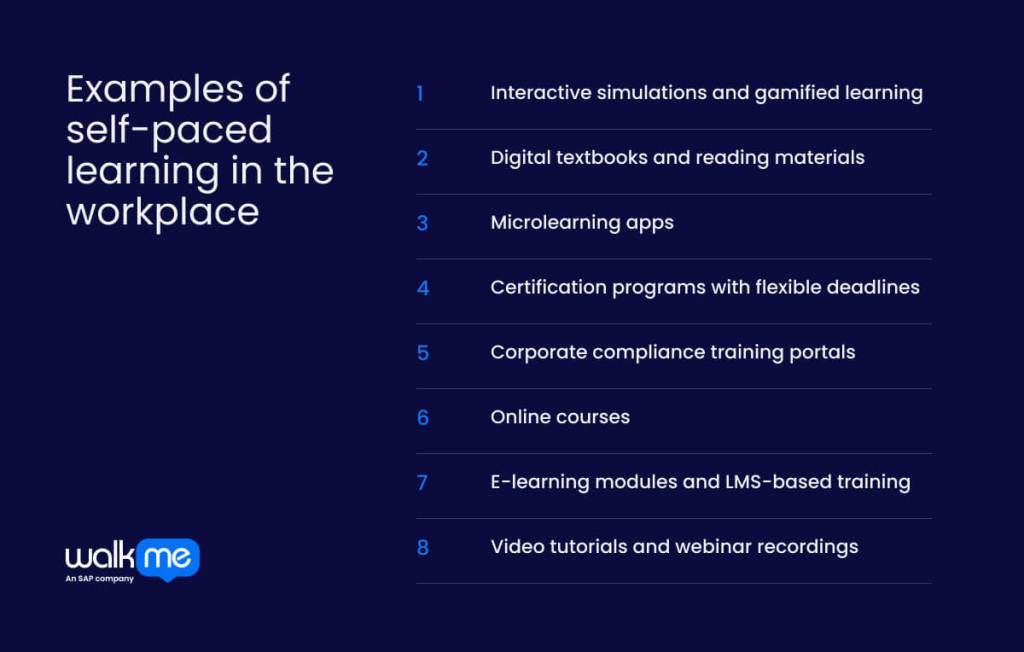
By using self-paced learning, companies show they care about their people. This leads to a happier, more skilled team that is ready for anything.
This type of on-the-job training builds functional skills such as problem-solving and saves money on training. It creates a team that is constantly learning and improving.
Here are examples of self-paced learning you could adopt:
- Interactive simulations and gamified learning: These tools turn training into engaging activities so that employees stay motivated and remember more.
- Digital textbooks and reading materials: Employees can access in-depth content anytime and read at their own speed.
- Microlearning apps: Short lessons fit easily into busy schedules and deliver quick bites of knowledge.
- Certification programs with flexible deadlines: Individuals can earn valuable credentials without the stress of rigid timelines.
- Corporate compliance training portals: These types of platforms deliver structured training and ensure everyone meets legal and company requirements.
- Online courses: Users can benefit from programs that cover basic skills and advanced expertise.
- E-learning modules and LMS-based training: A central learning management system organizes all learning resources in one accessible place.
- Video tutorials and webinar recordings: Visual learners can watch content repeatedly until they master the material.
How to implement a self-paced learning strategy for your business
Self-paced learning helps employees build good habits, such as discipline and time management. It lets them learn whenever they want and go at their own speed.
For organizations, this style of learning is a cost-effective and easy way to train many people at once. Knowing how to put this type of learning system in place makes sense. Here’s how you can do that:
Assess organizational needs and objectives
A successful self-paced learning strategy begins with the organization’s mission and future plans. This focus highlights the specific skills employees need for success. The analysis then looks at the company, specific jobs, and individual people. You can compare current performance against future goals to find gaps.
Surveys, interviews, and manager feedback also help gather the necessary data. Everyone, from leadership to staff, should participate in these discussions. The process ends by setting clear, measurable goals. These objectives link learning directly to business results.
Develop or curate quality content
Effective self-paced learning requires clear goals and a logical structure. You must state exactly what students will learn. The content needs to match the audience’s background and use real-world examples. Big topics work best when you break them into short, manageable chunks. This approach prevents information overload.
The design should guide learners with visual cues and a friendly tone. Varied media, such as videos, keep students interested. Learners succeed when they actively apply knowledge through scenarios and quizzes. They also need support options, such as a knowledge base, to avoid frustration.
Provide support resources
A strong self-paced program should include FAQ pages or AI chatbots that provide quick answers to common questions. Discussion forums and group projects also allow learners to connect and support one another.
Organizations can help further by holding virtual office hours and checking in on anyone who seems stuck. Motivation improves when students receive timely feedback and can clearly see their progress. Simple technical training on how to use the system ensures everyone stays on track.
Create clear learning paths and milestones
Learners can navigate their education better when you define a clear learning path. List the necessary background knowledge and the final skills they will gain. A large goal becomes manageable when you divide it into a logical path of smaller modules. The structure works best when it moves from basic concepts to advanced topics.
Specific milestones mark progress along the way, which connect to completed units or projects. Quizzes and exams confirm that the student understands the material, while answer keys allow them to check their own work. Progress bars or checklists show how far they have come.
Set realistic timelines with soft deadlines
A realistic timeline begins with a clear goal. You can break this main objective into smaller, more manageable tasks. Learners can estimate how long each part takes, and you can add extra time for unexpected delays.
Soft deadlines encourage progress without the pressure of strict deadlines. Employees benefit from blocking out regular study times every day. Your business can also offer them short meetings to check progress and offer support. You can celebrate small wins to keep motivation high.
Integrate multimedia and interactive elements
A successful employee development strategy swaps long blocks of text for short videos. These clips could feature experts or simple animations to help visual learners. Infographics and charts make complex data easier to understand and remember, while audio summaries allow people to listen while they commute.
Digital books can also include videos and links directly on the page. Quizzes with instant feedback help students quickly spot knowledge gaps. Your employees can benefit from virtual labs, which provide a safe place to practice technical skills without risk.
Pilot before full rollout
To test a self-paced learning strategy effectively, start by identifying the specific skills your pilot group needs. You should also define clear success metrics, including completion rates or test scores, and select a diverse group of learners to participate. Next, build a high-quality core module on your chosen platform and prepare support resources.
When you launch the program, communicate the goals clearly to the participants. As they progress, you can track their engagement and scores using analytics. Once they finish, gather feedback through surveys and interviews to understand their experience. Your business can also use this data to fix any issues or improve the content before rolling out the training to the entire organization.
What are the best practices to help you put a self-paced learning process in place?
Using best practices is key to successful self-paced learning. It makes the process more efficient and personal, helping you remember more and stay motivated.
They also give employees a clear structure for managing their time and setting goals. This leads to a deeper understanding and a much better employee experience. Let’s look at the best practices you need to consider:
| Best Practice | What to Do | Why It Matters |
| Use varied formats | Combine video, text, audio, and quizzes | Supports different learning styles and improves retention |
| Add progress tracking and dashboards | Show progress bars, goals, and next steps | Helps learners manage time and stay motivated |
| Incorporate gamification | Use badges, levels, and rewards tied to skill mastery | Encourages engagement and sustained participation |
| Build in knowledge checks | Include short quizzes with clear feedback | Reinforces understanding and identifies gaps early |
| Gather learner feedback | Use short surveys at key points | Identifies issues quickly and improves course quality |
| Ensure mobile-friendly access | Optimize content for phones and tablets, allow offline access | Enables learning anytime and across devices |
| Continuously update content | Refresh examples, activities, and information regularly | Maintains accuracy, relevance, and learner trust |
Use varied formats (video, text, quizzes)
A blended media approach creates a better learning experience for everyone. Different people learn in different ways, meaning a mix of videos, audio, text, and quizzes helps more individuals succeed. This variety keeps the content interesting and prevents boredom or screen fatigue.
You also remember information better when you see it in multiple formats. A video might introduce an idea, while text explains the details. This method also manages mental effort by breaking complex topics into smaller parts.
Add progress tracking and dashboards
Your company can improve the learning experience by incorporating tools such as dashboards. These types of tools display progress bars and badges that motivate employees to keep going.
Learners understand how their daily work connects to their main goals. Dashboards also help them manage their own schedules and make better study choices. This allows them to feel less overwhelmed when they can see exactly what to do next.
Incorporate gamification
Self-paced learning systems can mimic video games to keep learners motivated. Features including badges and level-ups provide instant feedback, helping employees fix mistakes right away. Meaningful rewards highlight skill mastery instead of just time spent.
Learners feel more in control when they pick their own paths and speed. Lessons that get harder over time keep students focused without overwhelming them.
Built-in knowledge checks
Built-in knowledge checks allow learners to test their understanding as they learn. These short quizzes show exactly which topics need more review. This process strengthens memory and keeps employees engaged with the material.
A mix of question types also keeps the experience interesting. Detailed feedback explains why an answer is correct or incorrect. Low-stakes practice reduces anxiety, while mandatory completion ensures everyone grasps the basics before moving forward.
Gather learner feedback
Learner feedback plays a vital role in self-paced courses, helping companies quickly spot learning gaps and unclear topics. You can fix confusing content right away, which makes learners feel valued. This connection improves employee engagement in a solitary learning environment.
Short surveys at key moments help catch problems early. These checks work best when they focus on specific issues and take only a few minutes. Your business can also build trust by showing exactly how it will put the suggestions into practice.
Ensure mobile-friendly access
Mobile-friendly programs help people learn on their own schedule. The layout and text size should automatically fit the screen. Touch screens require large buttons and simple menus for easy navigation.
Learners can also benefit from downloading materials to study offline. The system must sync progress across devices so students can easily switch between a phone and a computer.
Continuously update content
Up-to-date information builds trust in the course and the provider. Employees can rely on content that matches current facts. Fresh material, such as new examples and activities, keeps learners interested.
Many industries, including finance, also require current content for legal and certification purposes. Employees can also apply their new skills to real-world situations.
Encourage learning agility with self-paced learning
Self-paced learning allows employees to master new skills on their own schedule. This flexibility fits perfectly in modern workplaces where time is limited. While some learners may struggle with motivation or isolation, companies can solve these issues with the right support.
Leaders should provide clear goals, engaging materials, and regular check-ins to keep everyone on track. Simple steps, such as setting deadlines and offering bite-sized lessons, help teams stay focused. When organizations plan carefully, they empower their digital workplace to grow without interrupting daily tasks.
FAQs
Self-paced learning can work well. It can improve motivation, memory, and performance by allowing people to spend more time on complex topics. But it only works if the learner is disciplined and has support. This support includes clear goals, set deadlines, and helpful resources to use when they need assistance.
A typical example of self-paced learning is taking an online course on a website like edX. You can watch videos, read lessons, and do quizzes at any time that works for you.
Self-paced learning is often called self-directed learning, and related terms include self-education, self-study, and self-teaching. A more formal word for this is autodidacticism, and a person who learns this way is called an autodidact.
Cohort learning is when a group of students studies together on a set schedule. It helps them build a sense of community and engage in real-time conversation. Self‑paced learning is when people study alone and progress through the material at their own pace. This gives them the most flexibility.