
Bite-sized learning: Examples, microlearning & best practices
Formal employee training courses struggle to keep pace with what is needed in the moment, so learning often feels slow and disconnected.
LinkedIn research found that most prefer tech-enabled approaches to skill development, signalling a clear shift in how people want to learn. That preference suggests traditional methods of training and development no longer align with employee needs.
Bite-sized learning addresses the gap by giving people quick, targeted guidance they can absorb without breaking their flow. It also meets the ongoing demand for flexible eLearning that matches the functionality of modern teams.
This article explores bite-sized learning, showing how short, focused modules fit naturally into workflows, boost retention, and deliver practical skills through flexible eLearning.
What is bite-sized learning?
Bite-sized learning is a growing part of learning and development (L&D) and breaks complex topics into standalone modules designed for quick use.
Each unit targets one area of skill development, uses concise examples, and ends with a practical task learners can try in the moment. Modules are usually platform-friendly and often mobile-ready so that instruction can be delivered at the point of need.
A simple design emphasizes low cognitive load, quick retrievals, and repetition spaced across short intervals to boost memory and function.
Assessments for bite-sized learning are lightweight and include micro-checks that confirm understanding without lengthy exams. Content is modular, meaning units can be combined into custom sequences that match specific roles or projects.
This helps steer learning solutions and ensure they focus on pertinence, speed, and measurable improvement.
The result is a learning approach that fits into tight schedules, levels up critical employee skills, and converts small moments of attention into a work-ready competency model.
Why is bite-sized learning important?
Bite-sized learning is important because employee skills now need to be updated far more often than traditional training cycles allow. Digital adoption is accelerating faster than most teams can keep up, and the tools employees rely on evolve at the same pace.
Gartner found that 85% of learning leaders expect a surge in skills needs over the next three years due to AI and digital trends. It means that rolling out new technology without timely upskilling risks low use and poor outcomes.

Overflowing skills demand also widens the gap between what employees know and what their roles require. SBite-sized learning modules narrow that void by providing guidance they can apply straightaway, without waiting for a full course or a scheduled workshop.
Most importantly, bite-sized learning feeds into time management techniques and can easily
fit around meetings, deadlines, and project shifts. It gives teams a way to grow without stepping away from their priorities, while supporting digital capability.
What is the difference between bite-sized learning and microlearning?
Many people, including senior decision-makers, often conflate bite-sized learning and microlearning. The confusion is understandable, especially when both formats deliver short bursts of instruction. Here are the differences between bite-sized learning and microlearning:
| Aspect | Bite-Sized Learning | Microlearning |
| Purpose | Build understanding and skill over time | Solve an immediate need |
| Content depth | Small but complete learning units with context | Very focused, minimal context |
| Structure | Part of a broader learning progression | Standalone prompts or reminders |
| Best used when | Developing skills in a controlled, intentional way | Providing quick guidance at the moment of need |
| Learning outcome | Deeper understanding of the why and how | Fast action or recall |
Bite-sized learning
Bite-sized learning gives people a small but complete piece of a larger skill. It offers enough depth for someone to understand the why and the how behind a task, so each segment can stand on its own while still feeding into a wider progression. It’s the better fit when the goal is controlled development rather than quick fixes.
Microlearning
Microlearning strips everything down to the fastest possible point of usefulness. It doesn’t try to build depth or carry someone through a sequence; instead, it focuses on one prompt, reminder, or action that solves an immediate need. Rapid bursts of instruction give learners exactly what they need in the moment, without background or extended context.
Examples of bite-sized learning in the workplace
Seeing bite-sized learning in action means exploring real-world examples and how they function. Understanding the different approaches makes it easier to choose the methods that best match your situation. Here are examples of bite-sized learning models in the workplace:
| Learning Model | What It Looks Like | Suitable For |
| Microlearning modules | Short, focused lessons | People who want quick guidance and fast skill pickup |
| Infographics and quick guides | Visual summaries and checklists | Teams that need instant reminders at a glance |
| Podcasts and audio summaries | Short audio content | Learners who listen while commuting or multitasking |
| Short how-to guides | Step-by-step instructions | Employees who need support while doing the task |
| Interactive quizzes and exercises | Practice with feedback | Learners who learn best by doing |
| Virtual workshops and webinars | Brief live sessions | Groups that benefit from discussion and demos |
| Dynamic, adaptive content | Content that adjusts to the learner | People with different skill levels who need a personalized path |
| Bite-sized social posts | Short learning posts | Staff who learn during short breaks or scrolling |
| Peer learning circles | Small group discussions | Teams that grow through shared experience |
| Automated email prompts | Timely reminders | Employees who benefit from nudges during daily work |
Microlearning modules
The microlearning modules mentioned earlier in the article focus on delivering a single skill or concept and are designed for immediate application. They prioritize brevity and repetition to embed knowledge quickly.
These modules allow learners to act on insights as soon as they finish a segment, reinforcing real-world competency. Unlike traditional courses, they respect attention spans and make learning less daunting. In doing so, employees develop tangible abilities that can be directly applied to daily responsibilities.
Infographics and quick guides
Infographics and guides distill complex processes into visually digestible content and transform abstract workflows into reference tools employees can use at a glance. Well-designed visuals stick in memory far longer than text alone.
Enhanced visualization paired with concise context shows how bite-sized learning can be delivered in ways that reduce mistakes, speed up task execution, and maintain consistency. Infographics should be integrated into daily routines and help turn reference points into lasting improvements in employee performance.
Podcasts and audio summaries
Podcasts and short audio summaries turn idle moments into opportunities for skill-building. Listening during commutes or breaks transforms passive time into active learning without taking attention away from work.
The most effective audio content emphasizes story, example, and application, delivering practical takeaways in under ten minutes. Experts know that auditory learning reinforces memory differently than visual input, and incorporating this format diversifies skill acquisition, helping employees absorb insights while staying engaged in their own rhythm and workflow.
Short how-to guides
How-to guides deliver just the information employees need to complete certain tasks. Practical instructions that have an onus on simplicity work best and allow each guide to focus on one action or process.
Employees can refer to them during the workday without losing momentum. The simplicity allows for instantaneous application, turning a single interaction into a lasting habit and ensuring knowledge sticks.
Interactive quizzes and exercises
Quizzes and exercises are a great way to turn learning into sessions with active participation. Feedback helps learners identify cracks and reinforce understanding while the content is fresh.
Targeted exercises then encourage repetition without feeling burdensome. When used regularly, they embed skills into daily habits. Testing knowledge in context strengthens employee retention and confidence. Even a few minutes of well-designed exercises can shift theory into practice.
Virtual workshops and webinars
Virtual workshops and webinars take advantage of the online learning environment and
deliver concise sessions that fit into busy schedules. Participants explore tasks in real time,
discuss challenges, and apply ideas immediately.
Skilled facilitators integrate polls, case studies, and examples to maintain high attention and engagement. Learners also grasp concepts quickly and use them in their workflow. The structure encourages participation, reinforces key points, and ensures knowledge transfers beyond the session.
Dynamic, adaptive content
Adaptive content adapts to foundational knowledge, creating a personalized path through the material. It challenges each person at the right level, avoiding exasperation or boredom.
This approach maintains engagement and improves skill acquisition by evolving the content as users progress. You can also enforce prior lessons and introduce new concepts at the right pace. It’s also a great way to inject actionable insights that make each interaction meaningful. Content can also be adapted to the specific needs of each use with relative ease.
Bite-sized learning posts on social media
Employees encounter learning where they already engage, including their social feeds. Carefully crafted posts introduce a single insight or technique in a story-like or visual format.
The goal is a practical takeaway in under a minute in a setting that feels familiar. Regular posts keep skills top of mind without requiring formal attention, turning passive scrolling into moments of meaningful learning while subtly reinforcing best practices.
Peer learning circles
Group or peer learning circles gather around a shared problem or task, with each participant offering examples from their experience. Questions, discussion, and immediate application of new approaches are encouraged in a safe learning space.
Collective insight uncovers nuances that manuals often miss, while repeated cycles of sharing and reflection build confidence. This method creates a living network of knowledge, where lessons learned ripple through the group and slowly reshape how work is approached.
Automated email prompts
Targeted emails are sometimes overlooked but can reach employees at precisely the right moment, delivering one practical action or reminder. These prompts reinforce specific behaviors or skills without disrupting workflows.
Embedded links, examples, or micro-challenges allow recipients to engage pretty quickly, making small adjustments that compound over time. Regular cadence maintains momentum and ensures knowledge is retained and applied consistently, supporting skill growth in a subtle, continuous way.
How do you create effective bite-sized learning materials?
You’ll need a clear approach to build bite-sized learning from the ground up. The table below highlights the steps and key considerations that guide the creation of content, making it easy to absorb and practical:
| Step | What to Do | Why It Matters |
| Define focused learning objectives | Choose one clear skill or concept per module | Keeps learning targeted and outcomes measurable |
| Break content into manageable chunks | Cover one idea at a time in a logical order | Makes content easier to absorb and remember |
| Add supportive multimedia | Use visuals or short videos that reinforce the message | Improves understanding without distraction |
| Use short assessments | Add quick checks for understanding | Confirms comprehension without overloading learners |
| Design for mobile use | Optimize content for phones and tablets | Ensures learning works wherever people are |
| Create social learning spaces | Encourage discussion and peer feedback | Reinforces learning through real-world context |
How to implement bite-sized learning in your organization
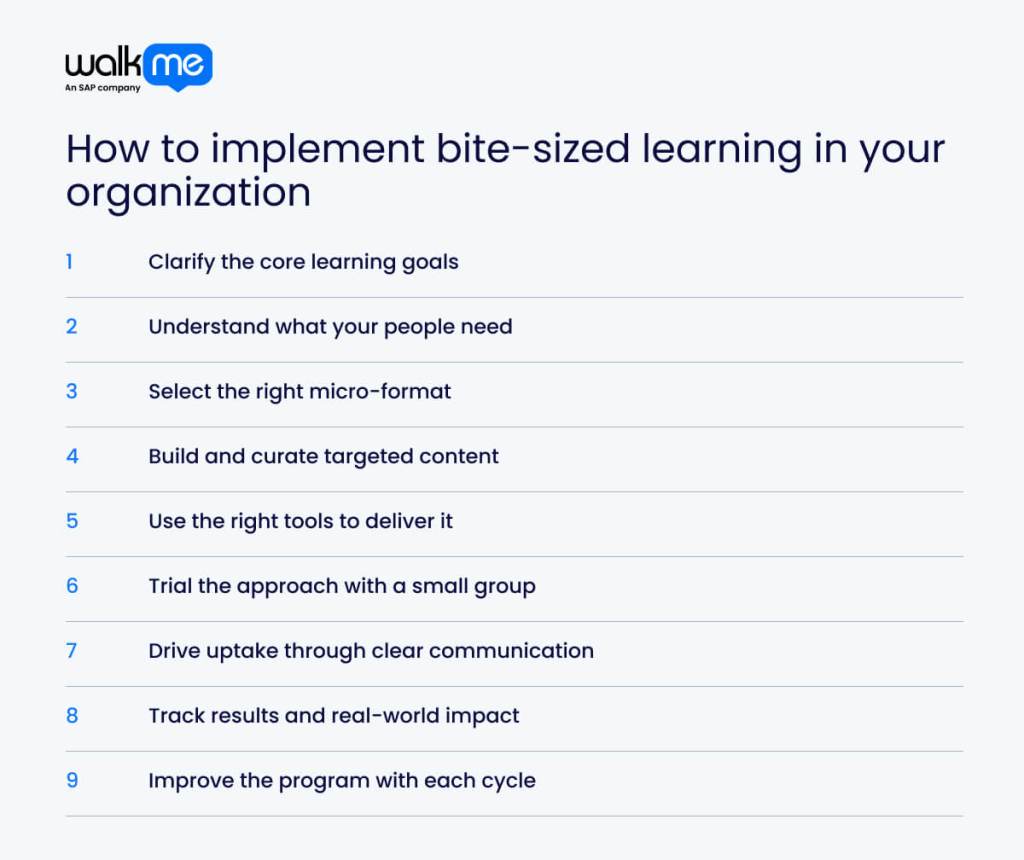
The next step is to implement your newly built bite-sized learning modules into your organizational training. This might seem straightforward at first, yet rolling it out effectively takes planning and a conscious effort to understand the different ways people learn. Here is a catch-all understanding of how to implement bite-sized learning:
- Clarify the core learning goals: Give every module a clear purpose, so people know exactly what skill or action they’re meant to pick up.
- Understand what your people need: Look at where people struggle in their work and shape content that genuinely solves pertinent issues.
- Select the right micro-format: Match the format to the task at hand, choosing the one that makes the idea easiest to grasp in the shortest time.
- Build and curate targeted content: Keep only what helps the learner progress and crop anything that distracts from the main point.
- Use the right tools to deliver it: Choose a learning management system (LMS) that fits naturally into workflows so learning feels like part of the job.
- Trial the approach with a small group: Test the content with a test group to pinpoint gaps, confusion points, or anything that needs tightening.
- Drive uptake through clear communication: Tell people what’s available, why it matters, and how it will help them, using simple and direct language.
- Track results and real-world impact: Look at how employees are benefiting from learning and how it translates into business outcomes.
- Improve the program with each cycle: Refine, reshape, and update based on feedback so the learning stays relevant over a given period.
What are the best practices for bite-sized learning?
A strong bite-sized learning program relies on simple principles that keep each module purposeful and easy to use. Here are the best practices for bite-sized learning:
Focus on one key idea at a time
A single focus keeps learners from feeling overloaded. When each module tackles one idea, people understand the message faster and apply it without hesitation. Clear scope also helps teams revisit material whenever they need a quick reminder, turning every module into a dependable point of guidance.
Capture attention immediately
Learners decide within seconds whether something is worth their time. A strong opening line, visual cue, or scenario pulls them in before distractions set in. Setting the tone early builds momentum and gives users confidence that what follows will be useful and tied to their work.
Keep content concise and essential
Short lessons force creators to prioritize the most important parts. Stripping out filler keeps attention anchored to the takeaway and helps people absorb information in one pass. Brevity also makes it easier to revisit modules later, strengthening memory and encouraging more consistent use at the point of need.
Make learning relevant to real work
Content lands best when people immediately recognize its value. Using examples tied to real situations helps learners connect the dots and spot where the skill fits. Relevance removes abstraction and shortens the time between understanding a concept and putting it into practical motion.
Allow time for reflection and practice
Short moments of reflection are always said to reinforce new ideas. When learners pause to apply a step or compare it with past experience, the skill becomes easier to recall. Light practice then helps them integrate the lesson into routines with minimal disruption to their workflow.
Use bite-sized compliance refreshers
Compliance topics can feel heavy, but smaller updates keep responsibilities top of mind. Short reminders reduce cognitive strain and help people apply standards in their work without revisiting long manuals. Frequent updates strengthen consistency and lower risk by making critical information easier to retain.
Break onboarding into digestible modules
New hires tend to absorb a lot of information, so smaller modules prevent overwhelm. Delivering information in stages gives people space to settle in and learn the tools without pressure. Structured bursts of guidance help them become productive sooner and create a more supportive starting experience.
Why bite-sized learning delivers lasting impact for businesses
Bite-sized learning remains surprisingly underused in modern enterprises. A recent study found that students who learned through bite-sized lessons scored noticeably higher on follow-up assessments than those who used traditional formats. This reinforces the idea that breaking learning into smaller chunks can strengthen understanding and retention.
With digital transformation accelerating faster than most can keep up, people now need information delivered more frequently to keep pace. Knowledge retention also plays a major role in career progression, and bite-sized learning gives employees a way to develop without the pressure of uninspired training sessions that often miss the mark.
When employees are given the opportunity to learn in manageable steps, it creates a calmer environment where they can look back and reflect on their experience. The strongest learning outcomes stem from modules that are current and evolve with the needs of both managers and employees.
FAQs
Bite-sized learning usually saves time and resources. Short modules require less design and fewer full-day sessions, cutting training costs. Using digital tools, such as a digital adoption platform (DAP), further reduces overhead by delivering lessons directly at the point of need. Investment then focuses on relevance and impact rather than lengthy programs.
Modules are best kept between three and ten minutes. This timing allows you to absorb one clear concept, try it immediately, and retain knowledge without distraction. Short lessons fit naturally into daily routines, helping employees learn without stepping away from their workflow or feeling overwhelmed.
Yes. Breaking complex topics into digestible modules helps employees understand each component step by step. Bite-sized learning can be combined into structured pathways, layered with interactive exercises and adaptive content, so large-scale training becomes manageable and easy to access for teams organization-wide.