
What is Salesforce Agentforce? Features & use cases

Many companies struggle to provide a consistent customer experience. Often, data is trapped in silos, forcing agents to jump between tools. This interaction frustrates customers because they have to repeat their stories.
These silos also cause poor digital adoption. When employees have to hunt through disconnected systems to find answers, the tools feel too hard to use. They stop using them effectively, which creates friction and lowers employee morale.
Salesforce Agentforce solves these problems by bringing data together. It uses AI agents to automate routine tasks and guide every interaction. By putting all customer details in one place, it connects data from the front and back offices, enhancing future customer outcomes. This feature makes the system easier to use and helps different teams, whether in marketing or customer service, work together.
Agentforce can handle simple requests on its own, send complex issues to the right experts, and suggest the best answers. The result is faster service, lower costs, and happier customers. This article will explore what Agentforce is, how it works, and its key features.
What is Salesforce Agentforce?
Salesforce Agentforce is a platform that helps teams build AI agents that support sales, service, and marketing efforts. This agentic AI tool handles routine work and assists employees, allowing your team to focus on high-value tasks.
You can describe what you need, and Agentforce will construct an agent with the necessary skills and knowledge. This type of AI infrastructure runs on the Atlas reasoning engine, which uses retrieval augmented generation (RAG) to search through all your data. This ensures agents find the right facts and solve problems accurately.
As they connect with Salesforce Customer 360 and other apps, agents work across your entire business. They can identify upsell opportunities, draft personalized emails, and log activities directly into your CRM.
For instance, sales agents can engage leads and coach new representatives with real-time tips. Security remains a top priority, with custom guardrails keeping agents aligned with your business rules. The Einstein Trust Layer also protects data privacy at every step.
What are the main components of Salesforce Agentforce?
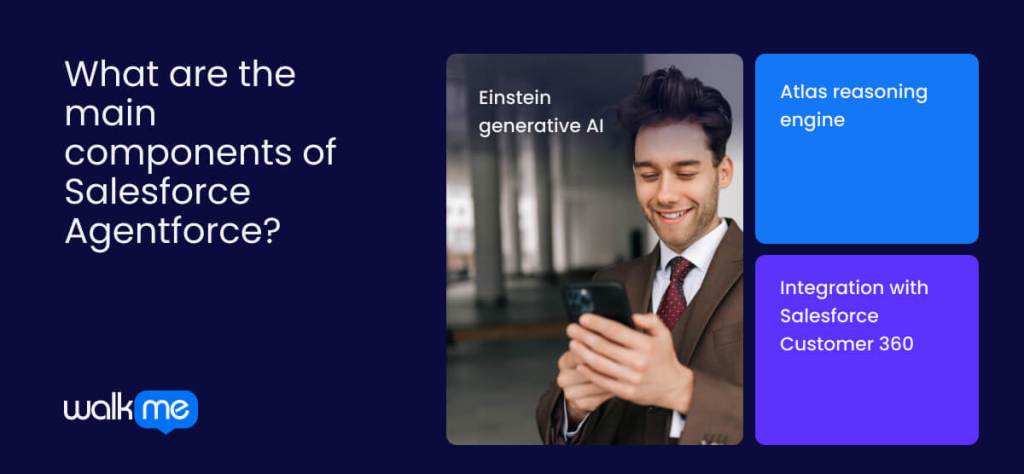
You need to understand the main components of Salesforce Agentforce to set it up properly and connect it to your systems. This knowledge helps you use AI agents to automate tasks and improve customer service.
You will understand exactly what data and tools the agents require to work well. You can also keep agents safe, customize them, and grow them over time.
Here are the components of Salesforce you need to be aware of:
- Einstein generative AI: This technology runs the Salesforce AI Agentforce Assistant, connecting AI with customer data through the Einstein Trust Layer. The system provides automatic emails, call summaries, sales process guidance, and predictive analytics for managers.
- Atlas reasoning engine: This component serves as the brain for Agentforce, enabling AI agents to complete complex multi-step tasks. The engine organizes how agents plan, use tools, remember details, and communicate with users while maintaining strict safety limits.
- Integration with Salesforce Customer 360: This integration connects all Salesforce products and external data sources to create a single customer view. The system gathers information from sales, marketing, and service teams for AI tools to improve business results.
How does Salesforce Agentforce work?

Businesses can run better when they understand Salesforce Agentforce. This tool uses AI agents to boost efficiency and customer satisfaction.
Employees can automate routine tasks and benefit from better data to help future growth.
Let’s dive into the steps of how Salesforce Agentforce works:
- Data retrieval: The AI agent gathers facts from customer records, sales numbers, service history, and connected apps to create a complete picture before making decisions.
- Query evaluation: Your business can benefit from the agent reviewing requests to understand user needs. It also breaks complex Salesforce tasks into smaller pieces and determines the best approach considering context, urgency, and business rules.
- Plan building and refinement: The system creates a step-by-step plan to complete tasks, evaluates different options, checks for potential issues, sets goals and timelines, and identifies backup options.
- Autonomous execution: The agent puts the plan into action without human intervention. This type of Salesforce workflow automation includes updating files, sending emails, and handling errors.
- Continuous learning: The platform tracks results and learns from every interaction, collecting data on speed, success rates, and customer satisfaction to improve future performance.
What are the features of Salesforce Agentforce?
Understanding Salesforce Agentforce features is crucial for improving employee productivity, improving customer experience, and increasing business efficiency. For instance, built-in analytics features allow teams to make data-driven decisions. These tools ultimately lead to better operations.
| Feature | Primary beneficiary | Key capability |
| AI-powered assistance | All Teams | Independent task completion |
| Intelligent automation | Operations | Cross-functional workflow management |
| Multi-channel support | Customer Service | Unified communication platform |
| Security & guardrails | IT/Compliance | Data protection and access control |
| Data-driven recommendations | Sales/Marketing | Real-time insights and suggestions |
| Autonomous execution | Management | Round-the-clock automated operations |
| Low-code customization | Business Users | Easy agent creation without coding |
| Real-time adaptation | All Users | Live data integration |
| Partner network | IT Teams | Pre-built integrations and templates |
AI-powered assistance
Salesforce Agentforce builds AI agents that automate routine tasks such as data entry, freeing employees to focus on higher-value work. The system identifies top leads, predicts customer needs, unifies support channels, and provides instant answers to help agents work faster.
Intelligent automation
AI agents retrieve data, complete tasks, and make decisions across sales, service, marketing, and operations. They summarize conversations, assign field technicians based on skills and location, and adapt to real-time changes. Teams offload routine work while the system enhances workflows and supports custom agents.
Multi-channel support
Agentforce consolidates email, chat, phone, and social into one interface. Agents manage all conversations without switching apps, while AI automates simple responses and personalizes interactions. Customers move between channels seamlessly and receive faster, consistent support.
Security and guardrails
Agentforce includes tools to control what AI agents can access and what they can perform. The Einstein Trust Layer masks sensitive data and blocks harmful content, ensuring responsible, compliant automation.
Data-driven recommendations
The platform analyzes customer data in real time to suggest next steps, product recommendations, and tailored responses. Agents make faster, better decisions, improving both performance and customer experience.
Autonomous action execution
AI agents execute tasks independently based on user goals—updating records, triggering workflows, connecting to external systems, or sending communications. Real-time data fuels accurate decision-making, while trust layers maintain security.
Customization and low-code tools
Agent Builder and Flow Builder let teams design agents visually using drag-and-drop and natural-language instructions. This low-code approach enables anyone to build automation aligned with specific business needs.
Real-time data adaptation
With Salesforce Data Cloud, Agentforce accesses live data—customer history, device status, error logs, predictive scores—to guide decisions and resolve issues quickly.
Partner network
The Agentforce partner ecosystem offers extensions and ready-made agent templates through AppExchange. Zero-copy integrations reduce storage needs, speed implementation, and support cleaner system architectures.
Salesforce Agentforce use cases by function
Salesforce Agentforce use cases are best understood by function. This knowledge helps match AI to goals such as more sales, better service, or custom marketing.
Companies can then find the right tools to improve workflow adoption. Less manual work and better results will follow across the business.
| Function | Key Benefits | AI Capabilities |
| Marketing | Personalized campaigns, better targeting, and real-time optimization | Customer data analysis, automated emails, product suggestions, segmentation |
| Customer Service | 24/7 support, instant replies, consistent quality | Automated FAQs, issue routing, multi-channel support, knowledge base integration |
| Sales | Lead prioritization, automated follow-ups, and real-time insights | Lead scoring, interaction tracking, proposal creation, and quote automation |
| Inventory Management | Demand forecasting, optimal stock levels, and supplier coordination | Sales trend analysis, seasonal forecasting, reorder alerts, location-based tracking |
| Finance | Process automation, real-time reporting, compliance monitoring | Data entry automation, invoice processing, expense tracking, and budget alerts |
Marketing
Agentforce helps marketing teams deliver personalized campaigns by analyzing customer data and recommending the best products, timing, and channels. It automates segmentation, scheduling, and behavior-based email journeys, adjusts campaigns in real time, and boosts conversions while reducing manual workload.
Customer service
Agentforce provides instant responses to common questions and routes complex issues to the right agents. It delivers 24/7 support, maintains consistency across channels, and ensures that more challenging cases reach specialists quickly.
Sales
Sales teams use Agentforce to identify top prospects, automate follow-ups, and surface next-best actions. The system scores and prioritizes leads, provides real-time customer insights, and speeds up proposal and quote creation, so reps can focus more on selling.
Inventory management
Agentforce predicts demand, monitors stock levels, and issues reorder alerts based on forecasts. It enhances supplier communication and tracks inventory across locations, reducing shortages and excess stock.
Finance
Finance teams automate data entry, invoice processing, approvals, and fundamental analysis. Agentforce tracks expenses in real time, flags anomalies, supports faster month-end close, and frees time for strategic work.
Drive business growth and customer centricity with Salesforce Agentforce
Salesforce Agentforce changes how businesses handle work. It automates manual tasks across sales, service, and operations, freeing up teams to focus on more critical projects. Companies using this tool see real results, such as saving time, lowering costs, and keeping customers happier with faster service.
Success with Agentforce requires a few key steps. You need to define clear goals, connect the tool to your current systems, and regularly check its performance. The AI agents must also align with your business needs and your users’ wants.
Agentforce is much more than a standard chatbot. It plays a central role in digital transformation by enabling better decision-making and handling complex tasks.
Organizations ready to try Agentforce should start small. A pilot program can test the tool’s value before a full rollout. Teams also need employee training to use it well, and Salesforce offers many resources to support this process.
FAQs
Salesforce Agentforce is an AI agent that can operate independently. It can handle complex tasks with many steps from start to finish. Einstein AI is more of a helper. It gives insights and automates simpler, structured tasks, but it still needs your input.
Salesforce Agentforce helps small businesses by using AI agents to automate routine work and improve customer service. These agents run 24/7, which can reduce costs, increase efficiency, and make customers happier. They can answer questions, qualify leads, and give employees more time to focus on significant projects.
Salesforce Agentforce helps teams work better. It improves the customer experience by using AI to guide agents in real time. This tool enhances productivity by automating routine tasks and sharing instant insights. It also streamlines workflows, making sales and service more efficient.
To implement Salesforce Agentforce, open Setup and turn on Einstein and Agentforce. Next, open Agent Builder to create your agents, set their topics, and add the actions they need. Finally, test your agent and turn it on, making sure it fits the use case, such as service or sales.
No. Agentforce is the new version of Einstein Copilot. Salesforce rebranded and upgraded Einstein Copilot to create Agentforce. It keeps the same core features but adds tools to let it act on its own. That makes Agentforce a more proactive AI assistant.