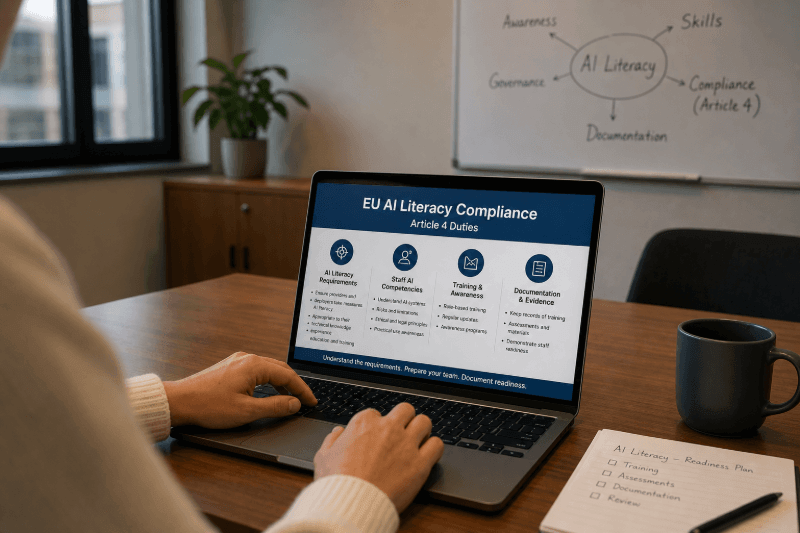
EU AI Literacy Compliance Explained

Many organizations are deploying AI quickly, but they are far less clear on what Article 4 requires in practice. That gap matters because, as WalkMe’s EU AI Act messaging source document states, Article 4 came into force on 2 February 2025, and a deployer “must ensure staff have a sufficient level of AI literacy.”
This article explains what EU AI literacy compliance means, why it matters now, who it applies to, what a practical program should include, and how to operationalize it across real workflows. The goal is not abstract awareness. It is to help you translate a written obligation into guided, documented behavior that holds up when legal, compliance, or regulators ask for evidence.
What is EU AI literacy compliance?
EU AI literacy compliance is the set of steps your organization takes to ensure staff and relevant stakeholders have the skills, knowledge, and awareness needed to use AI systems responsibly under the EU AI Act. In the source material, Article 4 is described as a direct duty on organizations that deploy certain AI systems, and that duty is continuous rather than a one-time project.
That point matters because the law is not framed as a single training event. The EU AI Act messaging source says, “These duties are not one-time projects,” and specifically notes that a deployer must ensure staff have “a sufficient level of AI literacy.” In practice, that means you need more than a policy document, a slide deck, or an annual course completion report.
The readiness checklist makes this even more concrete. It states plainly: “A training certificate isn’t enough. The Act expects a verifiable, role-based record tied to actual AI use.” That is the core of EU AI literacy compliance. You need literacy measures that match the AI system, the role, the task, and the risk involved.
So what should you take from that definition? AI literacy under Article 4 is not just knowledge about AI in general. It is a documented, defensible way to show that the people using AI in your organization understand what they are using, how to use it correctly, and what boundaries apply in their day-to-day work.
Why does EU AI literacy compliance matter now?
Once you understand the definition, the next issue is timing. EU AI literacy compliance matters now because AI literacy is no longer just a workforce skills initiative. It is a compliance obligation that already applies under the EU AI Act.
The timing is explicit in the source material. Article 4 came into force on 2 February 2025, while Articles 14 and 26 become enforceable on 2 August 2026. That means many organizations are already on the clock for literacy obligations even as they continue expanding AI use across business functions.
This also matters because unmanaged AI use creates more than a training gap. The EU AI Act messaging source identifies “regulatory and reputational exposure,” noting that noncompliance can lead to administrative fines, regulatory action, reputational damage, and loss of trust. It also warns that low literacy leads to “misuse, avoidable errors, and unsafe reliance on AI outputs.”
For enterprise leaders, this is an accountability issue as much as a legal one. If your people use AI inside a mix of custom, legacy, and modern applications, static training will not reliably reach them at the moment they use the system. The source document says many organizations cannot meet these duties with their current tools because training is delivered “in classrooms and documents” that do not reach a “diverse, distributed, and changing workforce” when the system is actually in use.
That is why compliance training needs to do more than inform. It needs to reduce risk, improve decision quality, and create consistent evidence that your organization took measures to build and maintain sufficient AI literacy.
Who needs to comply with Article 4?
That raises a practical question. Who should actually pay attention to Article 4?
The source material focuses on organizations that deploy AI systems and, in particular, on deployers of high-risk AI systems. It explains that the EU AI Act “makes deployers, meaning the organizations that use these systems, responsible for how those systems operate in practice.” If you operate in the EU or your AI use affects EU users and markets, Article 4 should be part of your compliance review.
The obligation also reaches beyond technical teams. The messaging source says the duty lands on “the people running these systems day to day,” and the checklist states that “every role that touches an AI system is documented: which tool, which task, what risk level.” That includes people who operate, manage, oversee, or rely on AI systems in their work.
Scope depends on the role, the system, and the level of risk. The checklist is clear that “a blanket ‘all staff’ training module doesn’t satisfy this requirement.” In other words, your AI literacy requirements should be calibrated to actual exposure. A person reviewing AI-influenced decisions needs a different level of support than someone with limited interaction.
What does an EU AI literacy program need to include?
Once scope is clear, the real work begins. A practical EU AI literacy compliance program should treat literacy as an operating practice, not as a single course.
The readiness checklist gives a useful starting point. It says “role-based AI mapping exists” and recommends building a matrix of role, AI tool used, task category, risk level, and training requirement. That matters because Article 4 is tied to actual AI use, not generic awareness. If you cannot show which roles use which tools for which tasks, your literacy program will be hard to defend.
From there, your program should combine several elements. At a minimum, it should include:
- Foundational knowledge about the AI system’s purpose, permitted use, and limits
- Role-specific guidance tied to the tasks people perform
- Acceptable use rules that define what is allowed and what is prohibited
- In-workflow support at the moment of use
- Records that show completion and can be queried by person, role, tool, and date
The source material repeatedly emphasizes in-workflow reinforcement. The checklist states, “Training happens in the workflow, not just in an LMS,” and adds that “a course-completion record isn’t the same as demonstrated competency at the moment someone actually uses the AI tool.” That is a strong signal for enterprise teams designing compliance training. Awareness alone is not enough if the employee has no support when they encounter a real decision.
Documentation is just as important as instruction. The checklist says records must be “queryable by person, role, and date” and that you should be able to export employee ID, role, course, timestamp, and AI tool “in one pull.” It also requires a defined process for keeping records current as new hires join, roles change, and new AI tools are introduced.
The standard, then, is not perfection. It is a sufficient level of AI literacy that is documented, defensible, and aligned to how AI is actually used in your organization.
How do you comply with EU AI Act Article 4?
With those building blocks in mind, how do you comply with Article 4 in practice? The most effective approach is to build a repeatable operating model that connects legal requirements to live workflows.
Start by scoping the AI systems and roles in play. The checklist says every role that touches an AI system should be documented by tool, task, and risk level. It also recommends sign-off from HR and the team lead. This gives you a role-based map that you can defend internally and update over time.
Next, define what sufficient literacy means for each role. The source material does not treat literacy as a generic standard. It ties it to the specific AI system, the user’s context, and the task they perform. That means a reviewer, operator, manager, and occasional user may all need different guidance.
Then move compliance training into the workflow. The checklist is unambiguous: “Move training into the AI tool itself, so guidance shows up at first use and completion is logged per person, per tool, at that moment.” This is one of the clearest operational steps in the source material because it connects learning directly to actual AI use.
After that, make your records audit-ready. The checklist says you need to produce who was trained, in what role, on what date, tied to which tool, rather than an aggregate completion rate. It also advises teams to test exports now, not later. If your records cannot be queried or exported cleanly, your program is harder to evidence.
You also need a maintenance process. New hires, role changes, and new AI tools all trigger updated literacy needs. The checklist says, “Name an owner. Define what triggers new training and how often the record gets reviewed.” That turns literacy from a one-off rollout into a controlled process.
A practical framework usually looks like this:
- Inventory the AI systems in use.
- Map roles to tool, task, and risk level.
- Define role-based literacy expectations.
- Deliver guidance at the moment of use.
- Log completion and interaction data by person, role, date, and tool.
- Review and refresh when systems, roles, or rules change.
This step-by-step approach helps legal, HR, IT, security, and operations work from the same model. It also aligns with the core message in the EU AI Act source: compliance duties “must be met continuously and evidenced on request.”
What are examples of EU AI literacy compliance in practice?
At this point, the concept should be clear, but examples make it easier to apply. In practice, EU AI literacy compliance looks different across workflows because exposure and decision impact are not the same everywhere.
Consider an HR team using AI in a recruiting workflow. The people operating that system may need guidance on the tool’s intended use, its limits, and the correct review steps before acting on an output. If the workflow affects a significant employment decision, literacy should also connect closely to human review and escalation steps.
Now consider a frontline operations team using AI recommendations inside a custom business application. The source material notes that many organizations use AI across “custom-built and legacy systems” that were never designed with these controls. In that environment, compliant practice means the user receives guidance inside the application, follows acceptable use rules, and generates a record that support was delivered.
A third example is a manager overseeing AI-assisted decisions. Here, literacy is not just about tool familiarity. It blends training, policy, oversight, and in-workflow support so the person can interpret outputs correctly and avoid unsafe reliance. In each case, the standard remains the same: sufficient literacy tied to real use, with evidence you can produce later.
How WalkMe supports EU AI literacy compliance
Once the compliance requirement is established, the next question is execution. WalkMe supports EU AI literacy compliance by acting as the execution and accountability layer that helps organizations reinforce literacy where work happens.
The EU AI Act messaging source describes WalkMe as “the practical layer that turns written obligations into guided, validated, and recorded behavior in the flow of work.” That distinction matters. WalkMe is not positioned as legal advice or as a governance, risk, and compliance platform. It helps organizations put obligations into daily practice inside the applications employees already use.
For Article 4 specifically, the source says WalkMe “delivers AI literacy in the flow of work” and provides “role-based guidance at the moment of use so staff learn to use each AI system correctly.” This aligns with the checklist’s requirement that training happen in the workflow, not just in an LMS.
This is also where AI accountability becomes practical. The source material explains that WalkMe records app interaction activity so the organization can demonstrate compliance “with evidence rather than assertions.” In other words, literacy compliance is not just about assigning a course. It is about helping employees apply guidance correctly in live workflows and showing that support was delivered and recorded.
EU AI literacy compliance: what to do next
EU AI literacy compliance is a practical requirement tied to real AI use, role context, and documented measures. Article 4 requires a sufficient level of AI literacy, and the source material makes clear that a training certificate alone is not enough.
Three takeaways stand out. First, role-based training is stronger than generic awareness because scope depends on the AI system, task, and risk level. Second, reinforcement in live workflows matters because people need guidance at the moment of use, not only before deployment. Third, records must be queryable and current if you want defensible compliance training evidence.
If you are evaluating how to support AI literacy, policy reinforcement, and measurable AI accountability across enterprise applications, WalkMe can help you assess how in-workflow guidance and the action bar support documented compliance where work happens.
FAQs
Under the source material, Article 4 requires deployers to ensure staff have a “sufficient level of AI literacy.” In practice, that means more than general awareness. It means users have the knowledge, guidance, and support needed to use the relevant AI system correctly in the context of their role and tasks.
The source material focuses on deployers of AI systems, especially deployers of high-risk AI systems, and says these organizations are responsible for how those systems operate in practice. The obligation reaches beyond technical teams to the people running, using, managing, or overseeing those systems day to day.
No. The readiness checklist states, “A training certificate isn’t enough,” and adds that the Act expects “a verifiable, role-based record tied to actual AI use.” It also says training should happen in the workflow, not just in an LMS, because course completion alone does not prove competency at the moment of use.
According to the source material, a program should include role-based AI mapping, guidance tied to the AI tool and task, in-workflow training, acceptable use reinforcement, and records that are queryable by person, role, and date. It also needs a process to stay current as roles change, new hires join, and new AI tools are introduced.
The checklist says records should show who was trained, in what role, on what date, and tied to which AI tool. It recommends confirming that your system can export employee ID, role, course, timestamp, and AI tool in one pull, and that there is a defined owner and review process to keep records current over time.