
32 Change Management Statistics and Facts

Key change management statistics
- The claim that about 70% of change initiatives fail is widely repeated but was stated without a cited study (Beer and Nohria, Harvard Business Review, 2000).
- 79% of employees have low trust in change (Gartner, 2025).
- Only 32% of mid-to-senior business leaders say the last change they led achieved healthy employee adoption (Gartner, 2025).
- Only 24% of US employees agree that change is executed in a way that makes it easy to embrace (Eagle Hill, 2025).
- 37% of UK employees admit they resist change (Oak Engage, 2023).
- In 2025, 20% of employees worldwide were engaged at work (Gallup, 2026).
- Projects with excellent change management are up to seven times more likely to achieve change success (Prosci).
- Defining success well and measuring performance against objectives can increase the odds of meeting or exceeding them by up to five times (Prosci).
Change management is how an organization helps people adopt a new strategy, structure, technology, or way of working. The research suggests the hard part is rarely the plan. It’s adoption.
Why organizations change
Gartner describes changes today as “continuous, stacked on top of one another”, so large organizations now treat change as close to constant, which is the case for agile change management.
1. AI is a top investment priority for 79 percent of CEOs
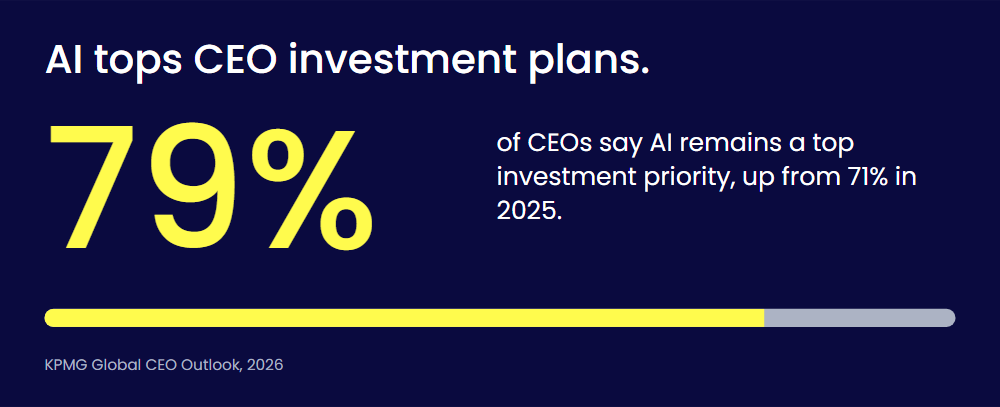
The 12th KPMG Global CEO Outlook, a survey of 1,400 CEOs at companies with annual revenues over US$500 million, run from August to September 2026, found that AI “remains a top investment priority for 79 percent of CEOs, up from 71 percent in 2025.”
2. Digital investment rose 38% in a year, but 40% of that spend underperforms
WalkMe’s State of Digital Adoption 2026, a survey of 3,750 respondents at enterprises with 1,000 or more employees across 14 countries, found: “Despite a 38% increase in digital investment from last year, 40% of that spend underperforms.”
3. 45% of companies named business growth as their top digital transformation goal
In Prophet’s 2023 State of Digital Transformation, a survey of more than 600 executives in North America, Europe and Asia, 45% of companies chose business growth as their top goal for digital transformation, followed by innovation (45%) and efficiency (42%).
4. 7 in 10 business leaders say their main competitive strategy is to be fast and nimble
Deloitte’s 2026 Global Human Capital Trends found that “7 in 10 business leaders say their primary competitive strategy over the next three years is to be fast and nimble,” in a survey of more than 9,000 business and HR leaders in 89 countries.
Change management success and failure rates
The failure rate most often quoted, 70%, rests on weaker evidence than its fame suggests, so the measured rates follow it. For named cases rather than figures, see these change management examples.
5. The “70% of change initiatives fail” claim comes without a cited study
The claim that about 70% of change initiatives fail comes from Michael Beer and Nitin Nohria in Harvard Business Review in 2000: “The brutal fact is that about 70% of all change initiatives fail.” The figure appears in the article’s opening paragraph with no study or data cited, so treat it as an estimate rather than a measured rate.
6. Only 24% of US employees say change is executed in a way that makes it easy to embrace
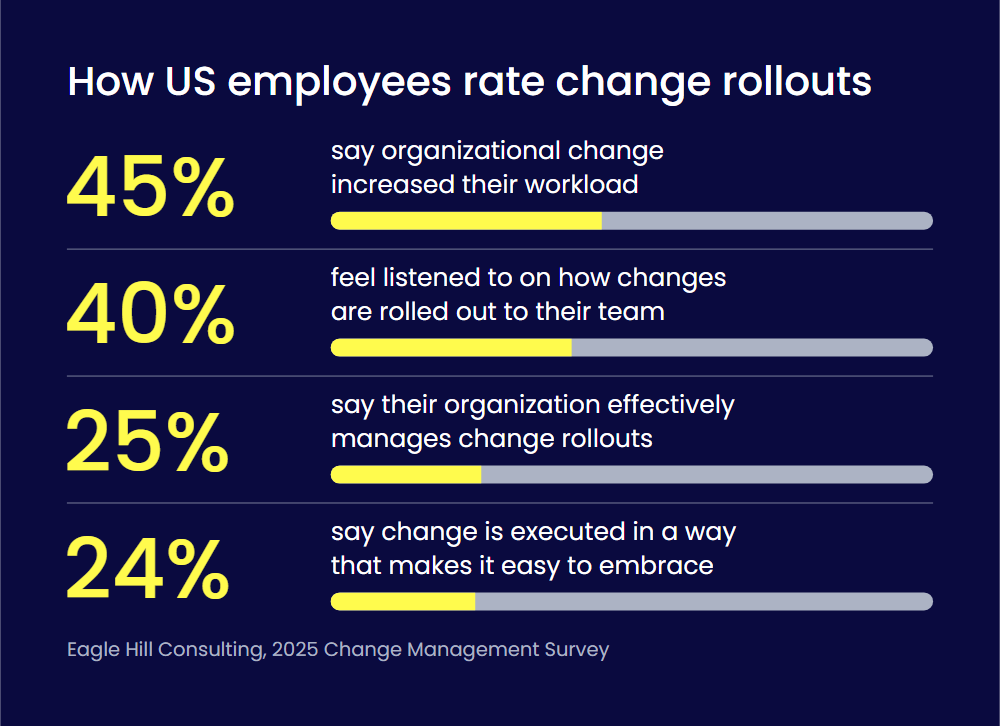
In Eagle Hill Consulting’s 2025 Change Management Survey, run by Ipsos among 1,448 US employees, “Only 24% agree that change is executed in a way that makes it easy to embrace.”
7. 43% of UK employees say their business isn’t prepared to manage change
In a 2023 Censuswide survey of 1,035 UK employees commissioned by Oak Engage, “Nearly half (43%) of employees agreed their business is not prepared to effectively manage change.”
8. Only 25% of US employees say their organization effectively manages change rollouts
In Eagle Hill’s 2025 survey, “only one in four employees (25%) agree their organization effectively manages change rollouts across the workforce,” even though 46% report increased efficiency from recent changes.
9. When change trust is low, only a quarter of changes led by inspiration achieve healthy adoption
Gartner’s 2025 research found that “When change trust is low, Gartner’s model predicts that only one-quarter of changes led by inspirational leaders would achieve healthy change adoption.”
10. Only 32% of business leaders say the last change they led achieved healthy change adoption
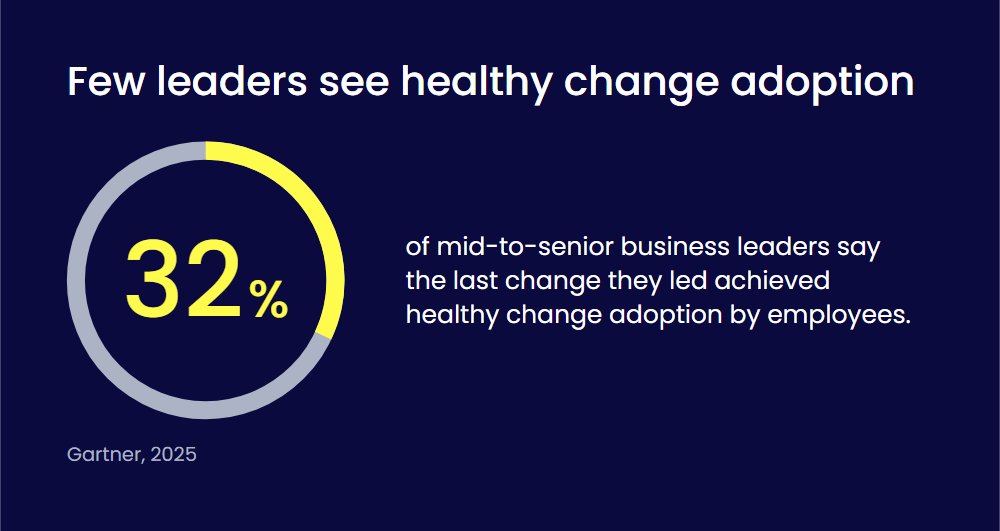
Gartner reported in 2025 that “Only one in three (32%) mid-to-senior level business leaders said that the last change they led achieved healthy change adoption by employees.” Healthy adoption means employees act on the change on time, without damaging performance or engagement.
Why change initiatives fail
11. Projects with extremely ineffective sponsors are only 27% likely to meet their objectives
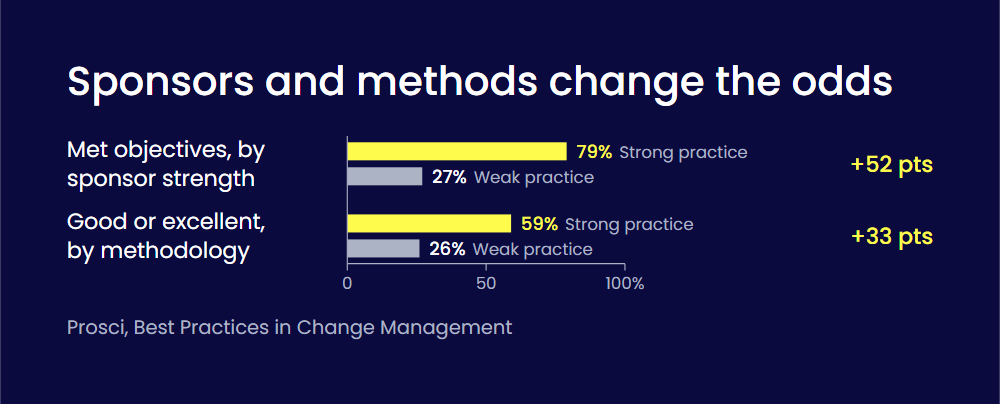
Prosci’s Best Practices in Change Management research shows that “projects with extremely ineffective sponsors were only 27% likely to meet their objectives as compared to 79% with extremely effective sponsors.”
12. 79% of employees have low trust in change
An April 2025 Gartner survey of more than 2,850 employees “revealed that 79% of employees have low trust in change.”
13. 63% of organizations cite human factors as a primary challenge in AI implementation
A Prosci study of 1,107 professionals across multiple industries “found that 63% of organizations cite human factors as a primary challenge in AI implementation.”
14. 45% of US employees say organizational change increased their workload
In Eagle Hill’s 2025 survey, “Nearly half (45%) say organizational change increased their workload,” and 62% say their manager did not reduce their regular work to make time for learning and adjusting to changes.
Employee resistance, engagement and burnout
These figures cover the people side that most change plans touch.
15. 23% of full-time employees feel burned out at work very often or always
In Gallup’s 2018 study of nearly 7,500 full-time employees, “23% of employees reported feeling burned out at work very often or always, while an additional 44% reported feeling burned out sometimes.”
16. 37% of UK employees admit they are resistant to change
In the same 2023 Censuswide survey for Oak Engage, “over a third (37%) of people admit that they are resistant to change.”
17. 20% of employees worldwide were engaged at work in 2025
Gallup’s State of the Global Workplace: 2026 Report found that “In 2025, 20% of employees worldwide were engaged at work,” down from 21% in 2024.
What improves the odds of success
These figures tie specific practices to better results. For the practices themselves, see these change management success factors and the change management frameworks that organize them.
18. Projects with excellent change management are up to seven times more likely to achieve change success
Prosci’s change management research finds that projects with excellent change management “are up to 7X more likely to achieve change success,” and that “88% of participants with excellent change management met or exceeded objectives.”
19. 59% of participants who used a structured methodology achieved good or excellent change management effectiveness
In Prosci’s Best Practices in Change Management research, “Of the participants who applied a particular methodology, 59% achieved good or excellent levels of change management effectiveness, while only 26% achieved the same levels of effectiveness without a structured approach.”
20. Psychological safety can cut change fatigue by up to 46%
Gartner reported in 2023 that “When managers create a psychologically safe environment for their employees it can have up to a 46% reduction in change fatigue.”
21. 47% of US employees say their team lead has the most influence during change
In Eagle Hill’s 2025 survey, “47% of employees say their team lead has the most influence during change,” which is why Eagle Hill recommends treating team leaders as the core unit of change.
22. 38% of AI adoption challenges stem from insufficient training in AI tools
Prosci’s research on AI adoption “shows that 38% of AI adoption challenges stem from insufficient training in AI tools, making it a key barrier to successful integration.”
23. Gartner’s model predicts employees are three times more likely to adopt changes on time when leaders routinize change
Gartner’s 2025 research states: “When leaders routinize change, our model predicts that employees are three times more likely to adopt changes on time and in a healthy way even though they have low change trust.”
Communication during change
These figures cover how employees want to hear about change and what makes them resist it. For the week-to-week work, see these change management activities.
24. 58% of employees prefer to hear about the personal impact of change from their supervisor
Prosci’s Best Practices in Change Management research found that “58% of employees prefer to receive communications about the personal impacts of change directly from their supervisors.” Most want to hear the business reasons for the change from the CEO.
25. 74% of UK employees say leaders need to do more to understand resistance to change
In the 2023 Censuswide survey for Oak Engage, “three quarters (74%) of employees say their leaders need to be doing more to understand why people are resistant to change.”
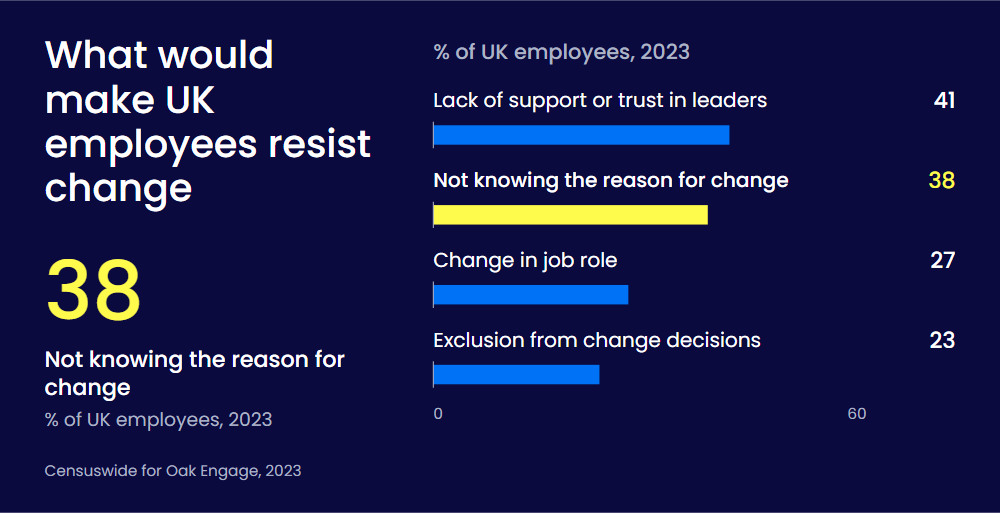
26. 38% of UK employees say not knowing the reason for change would make them resistant
In the same Oak Engage survey, “lack of support from or trust in leaders (41%), lack of awareness about the reason for change (38%), change in job role (27%) and exclusion from change-related decisions (23%) are the main reasons that would make people resistant to change.”
27. 29% of UK employees say their workplace doesn’t communicate change clearly
In the same 2023 Censuswide survey for Oak Engage, “almost a third (29%) of employees say their place of work does not communicate change clearly.”
28. Only 40% of US employees feel listened to on how changes are rolled out to their team
Eagle Hill Consulting’s 2025 Change Management Survey, run by Ipsos among 1,448 US employees, found that “only 40% feel listened to regarding how to roll out changes to their team.”
Change management ROI and measurement
What is the ROI of effective change management?
No primary study gives a single ROI percentage for change management, so these figures show what researchers measured instead. To set up your own measures, see how to measure change management.
29. Defining success and measuring against it can raise the odds of meeting objectives by up to five times
Scott Anderson of Prosci says: “When organizations define success for a change well, and measure performance to objectives, their odds of meeting or exceeding those objectives can increase by up to 5X.”
30. Organizations with better-than-average healthy change adoption report two times higher revenue growth
According to Ingrid Laman of Gartner, “Organizations with better than average healthy change adoption report two times higher year-over-year revenue growth rate.”
31. Tech-focused AI approaches are 1.6 times more likely to miss returns that exceed expectations
Deloitte research with 100 C-suite leaders, cited in Deloitte’s 2026 Global Human Capital Trends, found that most organizations (59%) take a tech-focused approach to AI, and “those taking a tech-focused approach are 1.6x more likely to not realize returns on AI investments that exceed expectations compared to those that take a human-centric approach.”
32. More than a third (34%) of US employees who experienced change say it wasn’t worth the effort
In Eagle Hill’s 2025 survey, among US employees who had experienced workplace change in the past year, “more than a third (34%) believe those changes were not worth the organizational effort.”
What the numbers mean for change management
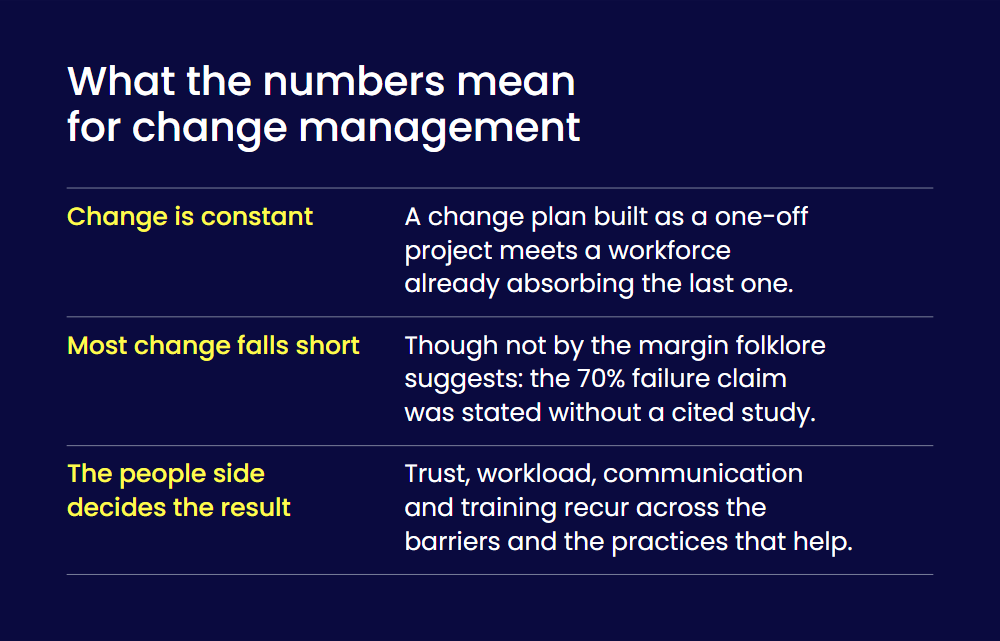
Three patterns run through these figures.
- Change is constant. Seven in 10 business leaders say their main competitive strategy is to be fast and nimble, and AI is a top investment priority for 79 percent of CEOs. A change plan built as a one-off project meets a workforce that is already absorbing the last one.
- Most change falls short, though not by the margin the folklore suggests. The 70% claim was stated without a cited study. The measured figures are sobering enough: only a third of leaders say their last change achieved healthy adoption, and only a quarter of employees say their organization manages change rollouts well.
- The people side decides the result. Trust, workload, communication, and training recur across the barriers and across the practices that improve the odds. Few of these figures measure strategy or software. Most measure whether people took up the new way of working.
The gap between a change plan and its result is usually adoption: whether people can do the new thing inside the tools they use every day, and whether leaders can see it happening. Measurement matters as much as method: Prosci finds that defining success well and measuring performance against objectives can raise the odds of meeting them by up to five times.
WalkMe’s AI-enabled Action Bar can help by reading context across the screen and suggesting the next best action inside the applications people use, so employees can master change in the flow of work with less need for ongoing training and support. When the change is to IT systems themselves, controlling it is a separate discipline, covered in the guide to IT change management software.
Make the next change one that sticks
Change works when people can do the new thing inside the tools they already use, and leaders can see whether they are. When they can’t, trust in change drops, workloads rise, and adoption stalls. The research also shows the cost of not measuring, because you can’t close an adoption gap you can’t see.
If you need the method, start with the change process. If your change lands inside enterprise software, explore how WalkMe supports employees in the flow of work.
FAQs
About 70% of change initiatives fail is a widely repeated claim, popularized by Michael Beer and Nitin Nohria in Harvard Business Review in 2000 without a cited study. Measured figures are more useful. In Gartner’s 2025 survey, only one in three (32%) mid-to-senior business leaders said the last change they led achieved healthy employee adoption.
Only about a third, by Gartner’s measure: in its 2025 survey, only one in three (32%) mid-to-senior business leaders said the last change they led achieved healthy employee adoption. In Eagle Hill’s 2025 survey, only 25% of US employees agreed their organization effectively manages change rollouts.
No primary study gives a single ROI percentage for change management. Research measures links to results instead. Gartner found in 2025 that organizations with better-than-average healthy change adoption report two times higher year-over-year revenue growth, and Prosci finds that projects with excellent change management are up to seven times more likely to achieve change success.
Common change management KPIs are adoption (how many people use the new process or system), proficiency, time to competency, utilization, and employee feedback. Tracking them matters. Prosci finds that when organizations define success well and measure performance to objectives, their odds of meeting or exceeding those objectives can increase by up to five times. Choose measures you can collect before and after the change.
The research points mostly to people and planning. In Prosci’s research, projects with extremely ineffective sponsors were only 27% likely to meet their objectives. In a 2025 Gartner survey, 79% of employees had low trust in change. Heavy workloads and unclear communication make it worse. For ways to respond, see these change management techniques.