AI Human Oversight: Article 14 Explained
High-risk AI cannot be left to run on its own and still meet the standard the EU AI Act expects. Article 14 is explicit that organizations using high-risk AI systems must make sure a real person can understand, monitor, correctly interpret, override, and stop the system in practice.
That is a much higher bar than having a policy that says a human is “in the loop.” According to WalkMe’s EU AI Act messaging source document, “a policy that says oversight exists isn’t oversight. The mechanism has to be operational.” In this article, you’ll learn what AI human oversight means under Article 14, why it matters, the core controls effective oversight requires, and how to implement it across real enterprise workflows.
What is AI human oversight under Article 14?
At a practical level, AI human oversight means designing high-risk AI systems so people can meaningfully supervise them, challenge them, and intervene before harmful or incorrect outputs take effect. Under the EU AI Act messaging source, deployers must “make sure a real person can understand, monitor, correctly interpret, override, and stop a high-risk AI system.”
That definition matters because the human oversight meaning in Article 14 is operational, not symbolic. It is not enough to assign a person on paper or assume managers will catch issues after the fact. The source material states that people assigned to oversee high-risk AI often “have no support at the point of decision, so they cannot reliably catch anomalies or resist over-relying on the machine.”
Article 14 also sits inside a broader set of deployer duties that become enforceable on 2 August 2026, alongside Article 26. WalkMe’s EU AI Act source frames the challenge clearly: these duties “must be met continuously and evidenced on request.” That means oversight is not a one-time control review. It is a live operating requirement inside the applications where AI is actually used.
For enterprise teams, that creates a design problem as much as a legal one. You need a way to make oversight visible, usable, and recorded in the flow of work.
Why is human oversight important in AI?
Once you define Article 14 clearly, the next question is straightforward: why does it matter so much?
Human oversight matters because high-risk AI can produce errors, bias, or unsafe outcomes that people must detect and correct before those outputs are acted on. WalkMe’s EU AI Act source states that weak oversight allows “incorrect or harmful AI outputs to take effect,” which creates risks to “health, safety, and fundamental rights.” That is the direct answer to why is human oversight important in AI.
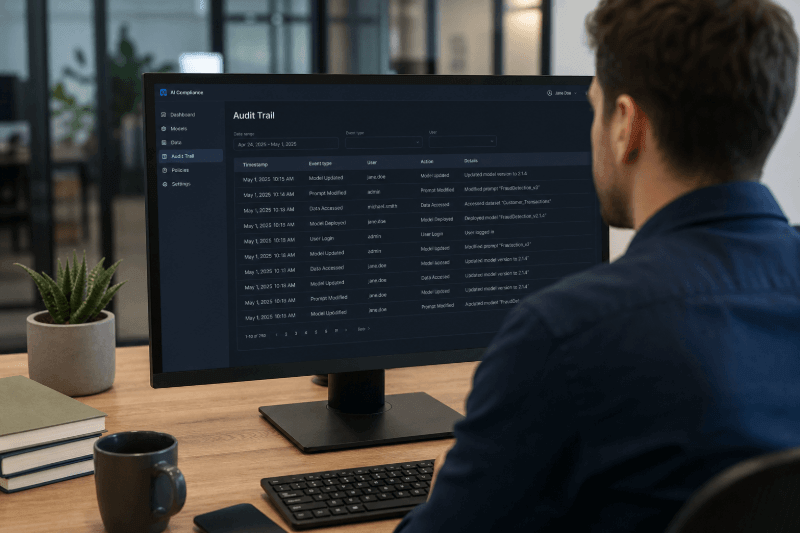
For enterprises, the issue is also about accountability. If an AI system influences a hiring decision, a safety review, a benefits determination, or another regulated process, you need to show who reviewed the output, what they decided, and when. The deployer readiness checklist says “every AI-influenced decision generates an oversight record” that captures the user, timestamp, tool, task, and whether the person accepted or overrode the AI output.
Oversight also matters because model performance alone does not satisfy the law. The EU AI Act source emphasizes that high-risk AI requires safeguards beyond raw technical capability. It calls for “real-time prompts that ask a human to review AI outputs rather than accept them automatically” and “clear, easy-to-reach controls to disregard, override, or stop an AI system.”
In other words, trust in production AI does not come from assuming the system is accurate. It comes from building a process where humans can review, intervene, and leave an auditable record when it matters most.
Human oversight meaning in practice for enterprises
That legal standard only becomes useful once you translate it into operating reality.
In practice, the human oversight meaning under Article 14 is not one person manually watching every output from every AI system. The source material is clear that oversight must be tied to the right decision points and supported “at the point of decision.” You need role-based oversight that matches the risk of the workflow, the competence of the reviewer, and the authority required to intervene.
The checklist sharpens that standard. It says a human override mechanism must be “built and tested, not just described,” and that someone needs to be able to “see that AI is influencing a decision, pause it, and apply judgment, without needing special access to do so.” That is a much more practical threshold than abstract talk about human review.
This is where many enterprises struggle. AI is used across custom-built, legacy, desktop, and modern SaaS applications, and most of those environments were “never designed with these controls.” If oversight depends on a separate document, training session, or review tool, it often breaks down before the person making the decision sees it.
Effective AI human oversight therefore depends on visibility inside the workflow itself. If you cannot see where AI is influencing action, you cannot design meaningful intervention points.
Key elements of effective AI human oversight
Once you view oversight as a workflow control, the required elements become easier to define.
Every effective AI human oversight model needs a small set of technical and operational controls that work together. WalkMe’s EU AI Act source lists several capabilities that directly support Article 14 and related deployer duties. You can use them as a practical checklist for your own environment.
The core elements include the following:
- Clear explanation of the AI system’s purpose, capabilities, and limits in context. The source says organizations need “a way to explain an AI system’s purpose, capabilities, and limits to the person using it, in context.” This helps overseers correctly understand and interpret the system.
- Real-time review prompts at the decision point. Article 14 support requires “real-time prompts that ask a human to review AI outputs rather than accept them automatically.” This reduces automation bias.
- Easy-to-reach intervention controls. Overseers need “clear, easy-to-reach controls to disregard, override, or stop an AI system.”
- Role-based routing to competent people. The source calls for “a way to route oversight tasks to people with the right competence, training, and authority.”
- Deterministic workflow support. WalkMe emphasizes “deterministic guidance and automation rather than probabilistic output” because regulated obligations require controls that work consistently.
- Auditable records. The checklist requires that “every AI-influenced decision generates an oversight record” with the reviewer, decision, and timing captured in a log.
These controls need to work across the systems where high-risk AI is actually used. That includes “web, desktop, and custom applications,” not just the applications with the newest interfaces.
How to implement human oversight for high-risk AI
Knowing the controls is useful, but implementation is where most programs succeed or fail.
The first step is to identify which AI systems are actually in scope. The deployer readiness checklist says, “High-risk AI systems are identified and classified. Not every AI use case is in scope, you need to know which ones are, and why.” It recommends inventorying every AI tool in use, cross-checking each against the Act’s high-risk categories, and flagging borderline cases for legal review.
The second step is to map where AI affects human action inside the workflow. The checklist says that “at each decision point where AI output affects a human action,” you should add a step that surfaces the recommendation, requires acknowledgment, and logs the human’s call. This is how you turn policy intent into operational design.
The third step is to support the reviewer in the moment, not before it. The source explicitly warns that “pre-deployment training doesn’t help someone reviewing an AI output in the moment.” Instead, it recommends placing “a short explainer and a required acknowledgment step right where the decision happens, with a one-click way to flag or override.”
The fourth step is to test whether intervention is realistic. The checklist advises teams to confirm that the override can be completed in “three steps or fewer.” That matters because a hard-to-reach override is not meaningful oversight. If the human cannot pause, challenge, or stop the AI quickly, the control exists only on paper.
The fifth step is to log every oversight event. The source says logging should capture “user, timestamp, tool, task, and whether the person accepted or overrode the AI output.” It also recommends pulling a sample export to verify completeness before enforcement, not after an incident.
The sixth step is to assign oversight to qualified people. Under the required capabilities list, organizations need “a way to route oversight tasks to people with the right competence, training, and authority.” Oversight is not just about having a person available. It is about having the right person available.
Finally, make the system maintainable. WalkMe’s EU AI Act source stresses that content and guidance should be updated “without changing application code,” so controls can keep pace as rules, instructions, and AI systems change. That matters in large enterprises where work spans many applications and updates happen constantly.
In practice, this is why implementation often requires an execution layer across systems. WalkMe positions itself as the deployer-side layer that turns written obligations into “guided, validated, and recorded behavior in the flow of work,” without changing the underlying AI system itself.
Human oversight AI Act requirements vs. real-world operations
Even with the legal requirements defined, enterprises still face a gap between compliance language and day-to-day execution.
The human oversight AI Act standard assumes that oversight happens where decisions happen. Real enterprise work rarely stays in one clean system. WalkMe’s source notes that AI is used across “a wide mix of applications, including custom-built and legacy systems that were never designed with these controls.” That fragmentation is where oversight often fails.
A person may review an AI recommendation in one interface, then carry out the action in another. A copilot may assist in one environment, while the approval or transaction happens elsewhere. If your control model is disconnected from the live workflow, your policy can say oversight exists while your operation says otherwise.
That is why WalkMe frames compliance as behavior embedded “inside the applications where AI is actually used.” The source also stresses that compliant behavior must be “guided, validated, and recorded.” In other words, AI human oversight depends on execution in real workflows, not policy documents alone.
Examples of human oversight for high-risk AI systems
The best way to make Article 14 concrete is to look at how oversight changes by use case.
In one scenario, an HR team uses a high-risk AI system to support employment-related decisions. Meaningful AI human oversight would require the reviewer to see the AI’s recommendation, understand the system’s purpose and limits, acknowledge review, and have a one-click way to flag, disregard, or override the output before taking action. The oversight record would then log who reviewed it, what they decided, and when.
In another scenario, a worker in an operational environment uses AI inside a legacy application that influences a safety-sensitive task. Here, why is human oversight important in AI becomes obvious. Weak oversight could allow a harmful output to take effect. The source says effective oversight helps humans “spot anomalies, resist automation bias, correctly interpret outputs, and can override or stop the system when needed.”
A third example involves multiple systems. An employee may receive AI assistance in one app, then complete the downstream action in a custom or desktop system. In that case, oversight must travel with the workflow. Otherwise, the human review step becomes symbolic rather than meaningful.
AI human oversight is a workflow design challenge
Article 14 is often discussed as a legal requirement, but in practice it is a workflow design challenge. Strong AI human oversight depends on where people, AI, and enterprise software meet: inside the task, at the decision point, with the right context and the right intervention path.
Three takeaways matter most. First, define meaningful intervention points instead of relying on general policy language. Second, give human reviewers the system purpose, limits, and override controls at the moment of decision. Third, measure whether oversight actually works by recording accepted, flagged, and overridden outputs across workflows.
WalkMe turns written obligations into guided, validated, and recorded behavior where work happens. If you need an execution and accountability layer for high-risk AI workflows across applications, the WalkMe action bar can help bring oversight, visibility, and evidence into the flow of work.
FAQs
Human oversight in AI means a real person can understand, monitor, correctly interpret, override, and stop an AI system when needed. Under WalkMe’s EU AI Act source, this is not a symbolic review step. The mechanism has to be operational at the point where AI influences a decision.
Human oversight is important because high-risk AI can produce incorrect or harmful outputs that humans must detect and correct. WalkMe’s source says weak oversight allows those outputs to take effect, creating risks to health, safety, and fundamental rights. It also helps reduce automation bias and creates an auditable record of who reviewed what.
Article 14 requires deployers of high-risk AI systems to make sure meaningful human oversight exists in practice. According to WalkMe’s source, that means a person must be able to understand the system’s capabilities and limits, monitor and correctly interpret outputs, and disregard, override, or stop the system when necessary. Those measures must work continuously, not just be documented in policy.
You implement it by identifying high-risk AI systems, mapping where AI affects human action, and building review and override steps into those workflows. The deployer readiness checklist recommends surfacing the recommendation at the decision point, requiring acknowledgment, enabling override in three steps or fewer, and logging who reviewed the output and what they decided.
The EU AI Act places direct duties on deployers, meaning the organizations that use high-risk AI systems in practice. WalkMe’s source explains that deployers are responsible for how those systems operate day to day, including assigning oversight to competent people and producing evidence of compliance on request. Legal, compliance, and IT may share ownership, but the organization remains accountable.