
7 SaaS pricing models: Types, how they work & differences

SaaS pricing can feel confusing fast. Every provider structures costs differently, tiers rarely follow the same logic, and it’s not always obvious what you’re actually paying for.
As the market continues to expand, new pricing models, add-ons, and “optional” upgrades keep appearing. These shifts often create surprises that slow teams down and make digital adoption harder than it needs to be.
A solid understanding of SaaS pricing models is your best protection. Once you know how each model works, it becomes much easier to predict real costs, compare plans on equal footing, and make confident buying decisions without the guesswork.
This article breaks down the core SaaS pricing models, explains how software value is shaped, and outlines practical ways to choose a plan that fits your needs without running into surprises later.
What are SaaS pricing models?
SaaS pricing models explain how a provider decides what you pay, but in practice, they work more like a rulebook than a simple fee.
Each model sets out what features you get, what counts as extra, and how the meter runs as your usage changes.
Instead of a single flat cost, these models break the service into parts, including the core features included from day one, the limits you can operate within, and the triggers that raise or lower your spending.
Some SaaS pricing models tie charges to users of the tool. Others focus on activity, data volume, or access to advanced functions. A few even blend multiple factors to reflect how individual teams and processes work.
The purpose of a SaaS pricing model is not to judge value, but to show the logic behind the bill.
Such clarity reveals how software is packaged, how expansion works, and how ongoing access is measured so you can see what you’re paying for in the cycle of digital adoption.
Why are Saas pricing models important?
SaaS pricing models are important because they shape the commercial levers you can pull and the contractual outcomes you can demand.
Well-defined pricing structures increase negotiation power, letting you secure performance incentives, clearer remedies, and rate protections. They also enable experiment-friendly rollouts by supporting short pilots and capping the financial impact of vendor exits.
Pricing models influence reporting, funding, and resource allocation because billing terms dictate how revenue is realized. When payments are tied to outputs, you can insist on service credits, technology roadmap changes, or faster bug fixes.
It’s important to note that transparent arrangements reduce legal friction during audits, acquisitions, or regulatory reviews by making obligations explicit. Clarifying data ownership terms and portability costs also protects flexibility, ensuring you can scale, pivot, or switch providers without unnecessary digital friction.
What are the different types of SaaS pricing models?
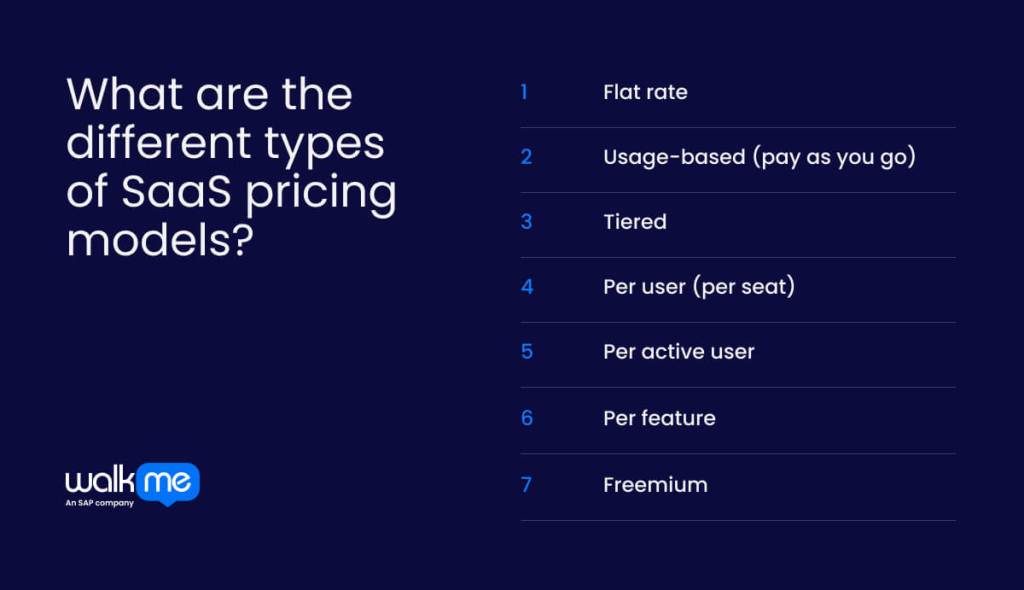
You need to know the different SaaS pricing models and the subtle mechanics behind each, so you can judge every option on how it behaves in practice rather than how it’s presented on paper.
Here are the different types of SaaS pricing models:
| Pricing Model | Suitable For | Description |
| Flat rate | Teams with steady, consistent activity. | One fixed fee for full access. Predictable and straightforward, but not flexible when usage varies. |
| Usage-based (pay as you go) | Projects with variable or unpredictable workloads. | Costs scale with consumption. Good for fluctuating demand, but can spike during heavy use. |
| Tiered | Organizations that can map needs clearly to feature sets. | Features are bundled into levels. Easy to compare, but upgrading for one feature can raise costs. |
| Per user (per seat) | Tools are tied closely to individual roles and daily use. | Pricing is tied to the number of licensed users. Simple but wasteful if accounts go unmanaged. |
| Per active user | Seasonal teams or groups with shifting engagement levels. | Charges only for users who actively engage. Reduces waste, but depends on how “active” is defined. |
| Per feature | Workflows need customized functionality without extra overhead. | Costs based on selected capabilities. Modular and efficient, but may require dependent features. |
| Freemium | Early-stage evaluation or low-risk product trials. | Basic version is free; advanced features require payment. Best for testing, not long-term use. |
- Flat rate
Flat-rate pricing offers one predictable charge for full access, making it easy to understand what you’re paying without tracking usage or fluctuating thresholds. This model’s strength lies in its stability, as the monthly or annual fee remains the same regardless of how heavily the software is used.
Simplicity makes planning straightforward, especially when workloads deviate or new initiatives appear mid-cycle. The trade-off is inflexibility, because heavy use doesn’t increase costs, but light use doesn’t reduce them either.
Flat-rate pricing works best when you expect consistent activity and want clarity without managing fine-grained billing rules.
- Usage-based (pay as you go)
Usage-based pricing charges only for what you consume, creating a direct link between activity and cost. This SaaS pricing model suits tools whose demand fluctuates, as it avoids paying for unused capacity. The biggest benefit is freedom to scale without renegotiating plans or adjusting licences.
However, volatility poses a challenge because bursts of activity push costs higher, and tracking patterns is essential to avoid surprises. It works well when usage is easy to measure, as you can tie spending to clear outputs. Remember that this model offers flexibility, but only when monitored consistently.
- Tiered
Tiered pricing splits access into stacked bundles, with each level offering more features, capacity, or limits. It creates a clear path for expansion because you can upgrade only when you genuinely need more capability.
The model helps compare options quickly, as each tier outlines what’s included and what isn’t. But this does mean that value often depends on alignment. So it’s worth remembering that jumping a tier for one missing feature can significantly raise costs. Tiered structures work best when you can map your requirements to a specific band and evaluate whether the added tools justify the higher fee.
- Per user (per seat)
Per-user pricing assigns a fixed cost to each individual with access, turning licences into the main driver of spending. It’s straightforward to calculate because the total charge changes only when people join or leave the tool.
The sheer simplicity makes it popular, but inefficiency creeps in when inactive accounts remain open or permissions expand unnecessarily. Regularly reviewing access keeps spending honest and aligns licences with demand. Per-user pricing works particularly well when software is heavily tied to day-to-day roles. This is because the cost pattern mirrors the number of people who rely on it.
- Per active user
Per-active-user pricing charges only for accounts that actively use the tool within a defined period. This removes the burden of paying for dormant seats and gives financial breathing room during quieter cycles. The model fits environments where engagement levels change, such as seasonal or project-based teams.
Costs are close to real activity, but success depends on understanding how “active” is defined. With that clarity, you can plan around natural fluctuations and avoid locked-in commitments. Per-active-user pricing delivers efficiency without the manual cleanup demanded in traditional per-seat licensing.
- Per feature
Per-feature pricing structures costs around specific capabilities rather than users or consumption. You pick the functions you need and ignore the ones you don’t, creating a modular approach that keeps spending aligned with purpose.
This helps tailor software to different workflows without paying for features that add little value. Understanding dependencies can be difficult because some advanced functions rely on underlying components that increase cost. When mapped carefully, per-feature pricing helps avoid over-buying and ensures the product reflects the exact outcomes you want to achieve.
- Freemium
Freemium pricing provides open access to a basic version of the product, allowing you to test core functions without a financial commitment. It’s a low-risk way to explore how software behaves, how intuitive it feels, and whether its structure suits your needs.
The catch is that essential capabilities often sit behind paid plans, so it’s important to understand where limits are and how quickly they impact work. Use freemium pricing as a trial mechanism rather than a long-term solution. In most cases, it provides hands-on experience before deciding whether advanced features justify a full upgrade.
How does SaaS pricing work?

Now that the models themselves are defined, it’s worth looking at how SaaS pricing works behind the scenes. Understanding these mechanics turns scattered costs into a structure you can question and control.
Here’s how SaaS pricing models work:
- Cost analysis: Understand base fees, add-ons, limits, and usage triggers to see where costs come from and whether a plan fits.
- Value assessment: Evaluate how well the features align with your needs and whether upgrades deliver meaningful benefits.
- Market research: Compare similar tools to spot pricing outliers, competitive terms, and standard industry structures.
- Pricing structure selection: Choose the model that best reflects how your organization operates—whether by activity, users, or features.
- Adjustment and flexibility: Ensure the plan can scale or shift without restrictive commitments or costly tier jumps.
- Transparency and communication: Look for clear terms on extra charges, support levels, and renewal processes to avoid surprises.
How are SaaS pricing models different from other pricing models?
Now you need to understand how SaaS pricing models differ from other models. This is because much of the confusion stems from billing cycles that change with usage, access, updates, and ongoing service, rather than a one-time purchase.
The table below highlights the differences between SaaS and traditional software pricing.
Below, each aspect is explored in detail, showing how costs, flexibility, performance, and long-term value behave in practice:
| SaaS Pricing Models | Traditional Software Pricing Models | |
| Payment structure | Ongoing subscription tied to access | One-off purchase with optional renewals |
| Cost changes | Adjusts as usage, seats, or features shift | Remains the same unless you buy a new version |
| Updates | Included automatically and rolled out frequently | Delivered as separate releases you install manually |
| Scaling users | Add or remove users instantly | Requires new licenses or additional installations |
| Cost visibility | Real-time usage shows true cost early | Hard to judge total cost until full deployment |
| Flexibility | Adjusts easily with workload changes | Fixed structure that may not match growth |
| Additional charges | Setup, support, and integrations add to spend | Maintenance handled mostly internally after purchase |
| Switching providers | Easy to move between plans or competitors | Hard to change once widely installed |
Assessing long-term value
Long-term value comes from how the service performs after the first rollout. Look at how features mature, how limits change, and how often upgrades are needed. SaaS pricing models only work when their costs stay predictable as your needs inevitably grow.
Using data to compare options
Comparisons improve outcomes when authentic usage data guides decisions. Running short trials or testing small groups shows how each model behaves under normal workloads. These practical results give a clearer picture than marketing claims and indicate which option supports your needs.
Flexibility in plans
Flexibility depends on how easily you can adjust access, features, or capacity without delays or extra steps. A good pricing model supports natural changes in workload, making it simple to scale up, reduce usage, or switch levels without conflict.
Impact on operational costs
Operational costs include far more than the subscription. Setup, admin time, integration, and support needs all contribute to the true price. Understanding these factors helps avoid models that look affordable upfront but become demanding later.
Retention and continuity
Retention and continuity rely on how stable the service remains over a given period. Clear export options, steady performance, and predictable updates protect momentum during staff changes or shifts in priorities. Remember that a pricing model that supports smooth transitions keeps work flowing.
Value for money
Value for money emerges when spending directly connects to results. If improvements in speed, accuracy, or completion rates match the cost pattern, the model is working. This shows hw important it is to choose the right structure, which makes it easier to see where the software ROI comes from.
Adapting to evolving services
Adapting to evolving services requires pricing that changes without unexpected jumps or gaps. Transparent upgrades, steady feature releases, and foreseeable add-on costs help with contingency planning. A supportive model should grow at the same pace as the software itself; otherwise, it becomes harder to justify.
How to choose the SaaS plan that fits your needs and budget
You’ve probably realized that SaaS pricing models are confusing if you don’t understand why they exist and what you’re actually paying for.
Rather than getting bogged down in the fine details, the most important takeaway is that pricing models should align with and anticipate your current needs and remain practical as requirements evolve.
This is easier said than done, and running into pitfalls is a necessary part of learning how to interpret costs and identify which plan delivers value without holding you back.
The right SaaS pricing structure does more than manage spending. It sets the stage for digital transformation and demonstrates how effective SaaS management can drive change and accelerate progress across every part of your operations.
FAQs
Map your projected usage, user count, and required features against each model. Then, factor in add-ons, potential scaling, and seasonal changes. Short pilots or sandbox trials reveal hidden costs early. Comparing actual activity patterns rather than advertised rates ensures you anticipate spending accurately and plan budgets with confidence.
Choose models that flex with team expansion, such as per-active-user or tiered options. These scale naturally with added seats, feature demands, or workflow growth. Evaluating how each structure accommodates new users or functions helps avoid overspending while supporting performance, adoption, and operational efficiency as you expand.
Payment schedules, renewal clauses, and upgrade triggers influence total expenses. Monthly plans allow rapid adjustments, while annual agreements may reduce rates but limit flexibility. Hidden fees, early termination costs, and escalators can alter outcomes, making careful review of contract terms essential to understanding real spending and maintaining control.